By Brian Marckx, CFA
OBB:CTSO
With a consistent streak of setting new records in product sales, accelerating adoption of CytoSorb (OBB:CTSO), case studies supporting efficacy of the device in several applications and certain near-term catalysts to further expand the already burgeoning commercial footprint, we view this as an opportunistic entry point for investors. We believe CTSO remains highly undervalued and are reiterating our Outperform rating and $0.50/share price target. See below for free access to our updated report and financial model on CTSO.
Q3 Financials: Another Record in Product Revenue. Several Developments Could Steepen Sales Curve…
CytoSorbents (CTSO) reported results for the third quarter ending September 30, 2014. The streak of setting a new record in product revenue was extended to seven straight quarters with Q3 product revenue coming in at $1.0 million, an increase of 276% and 56% from Q3 2013 (i.e. - yoy) and Q2 2014 (i.e. - sequentially), respectively. Also consistent are the catalysts of the product revenue growth - those being increasing re-order volumes and expansion of the customer base. Sales through Biocon, the company's distributor in India, also were indicated as a particular catalyst in driving product sales in Q3 and which continue to build steam.
We reiterate, that while there remains the potential for short-term variability in product sales, that we continue to believe that a certain base of business has been established whereby follow-on orders should provide a solid floor. This, coupled with broadening the geographic footprint and customer base - both of which the company has had early successes in doing from internal sales efforts and distribution relationships - should provide for near-to-long term product sales growth and improving operating leverage. And as we have noted in the past, if and when CytoSorb is deemed standard of care in any of the applications for which it has been successfully used, this would be a potential harbinger to significantly accelerated adoption and resultant revenue growth. And while the eventuality of gaining standard-of-care status may not happen in the near-term, indications that physicians view CytoSorb as a go-to therapy for certain critically ill applications suggests that this a real possibility in the future.
Awareness-building to key opinion leaders via industry presentations and conference attendance was largely at the heart of CTSO's early efforts to introduce CytoSorb to the clinical community. The company has since introduced next-steps to penetrate deeper into the clinical community and to the hospital-level and physician-level to drive greater adoption and utilization. We think the company's efforts have been largely successful in doing so - as evidenced by the growth in product sales, interest from third-parties including distributors and medical device companies and from the clinical community at large. Driving adoption of a novel medical is almost always a difficult proposition and the adoption curve is often flat, drawn out and variable. It is also often ultimately a failure. As such we would characterize CTSO's roll-out as relatively highly successful and offering compelling promise.
Recent Business Update
CTSO outlined some of the recent successes that that have had in communicating clinical results, broadening the customer base and geographic reach and increasing adoption and utilization of CytoSorb on the Q3 call. This included an expanded agreement with Biocon with a higher minimum purchase requirement, a partnership in cardiac surgery with a "top four" medical device company and launch of the patient registry.
Relative to Biocon, the company's distributor in India will now promote beyond just sepsis and instead for a whole menu of critical care illnesses as well as for cardiac surgery. While CTSO does not disclose sales per revenue channel, we think Biocon has been a material contributor to product sales growth. And, based on anecdotal feedback from Biocon, the relationship appears to be mutually beneficial. This likely contributed to Biocon's increased involvement with CTSO and CytoSorb. Biocon will also now be involved in conducting and publishing results from investigator initiated studies - which are key in promoting the real-world utility, applicability and efficacy of the device and which, with the recent launch of the patient registry, could be key in accelerating the rate of adoption. In addition, CTSO noted on the Q3 call that Biocon has agreed to increase their minimum sales targets for CytoSorb.
Techno Orbits, CTSO's distributor in the Middle East which the company brought on in April, should have the ability to more fully launch in Saudi Arabia in the near future. CytoSorb is registered in that country and is now in filed testing - which will be used to support formal regulatory approval.
Earlier this week CTSO announced that they consummated a partnership with a leading (unnamed) medical device company for use of CytoSorb in France for cardiac surgery. Per the agreement, this "top four" medical device company will evaluate the device and markets and will collect clinical data. Assuming all goes well, following the evaluation period the parties will collaborate on a broader marketing message and promote the product - initially at the KOL level and then drive down into hospitals and individual physicians levels. We look forward to how this relationship progresses, particularly as France is one of the largest medical markets which could offer CTSO a significant growth opportunity.
CTSO continues to not only grow their third-party distribution tentacles but also remains focused on expanding their own sales force in order to drive their sales/marketing plan of greater geographic reach and detailing at the health care provider levels. Seven internal reps are currently on-staff - the company continues to expect to add another three by early next year.
On the clinical-experience front, the international CytoSorb registry was recently launched and participants are now submitting data. There are currently 40 investigator-initiated studies planned, eleven of which are currently recruiting and another half-dozen or so that are expected to begin enrolling shortly. Data from these studies could be key in contributing to the registry. We see the advent of the registry as somewhat of a milestone event as evidence of successful clinical experience is where we see the bulk of a substantive marketing message. The registry is still in its infancy but we think, as more clinical data is aggregated, that this will be at the forefront of CTSO's marketing programs. We think this has real ability to spark greater adoption given the often hesitation among medical professionals to consider use of novel products without a history of ample and well-documented clinical successes. The registry is now up and running in German with the English version expected to be functioning in January.
Relative to the planned U.S. cardiac surgery study, on the Q3 call management reiterated previous expected timelines that they think they will have an IDE submitted by the current year end and hope to commence the study next year.
Q3 Results
Q3 total revenue $1.2M, up 32% yoy and 13% sequentially. Product sales of $1.0M represented yoy and sequential growth of 276% and 56%, respectively. Grant revenue was $131k. We expect additional grant revenue to be booked during the year from the CTSO's various grants including the DAPRA grant, Phase II SBIR contract and potentially the USAF funded rhabdomyolysis study. CTSO also expects to apply for a Phase II SBIR contract related to HemoDefend - the company is now finishing up the Phase I portion.
And as we have noted in the recent past, important is that the record product revenue is not coming at the expense of margins. Management noted that Q3 product gross margin was approximately 65%, which is similar to that in Q2 and is up from about 61% in both Q1 and well as Q4 2013. Total gross margin, which is less reflective of the core business and is impacted by grant-related R&D expenses being captured in COGS, was 59% in Q3. Q3 operating expenses were $2.3M, slightly higher than our $2.0M estimate.
Q3 net income and EPS were ($2.8) million and ($0.01), in-line with our ($2.7) million and ($0.01) estimates. Cash used in operating activities was $1.9M in Q3. Cash balance, including short-term investments, stood at $7.8M at Q3 quarter end.
U.S. Trial for Cardiac Surgery Looking More Promising …
Management recently provided an update on their potential plans to conduct a U.S. trial of CytoSorb in cardiac surgery. Instead of pursuing an endpoint such as reduction in organ dysfunction, which they were initially exploring, the company is now contemplating reduction of certain inflammatory biomarkers as the clinical endpoint. The inflammatory biomarker endpoint, management noted, has the advantages of a shorter and less costly trial and could potentially follow a 510(k) regulatory pathway, whereas an organ dysfunction trial would likely require the much more involved, time consuming and costly PMA pathway.
CytoSorbents already has early data on efficacy of CytoSorb in reduction of inflammatory biomarkers, which includes that from the study done in Germany and published in the journal Kardiotechnik - results of which showed CytoSorb effectively reduced levels of certain inflammatory biomarkers - we discuss the study and the results in greater detail below. Management noted that in addition to this study, they have had successful results with in vitro studies as well. CytoSorb has also been used successfully by clinicians in Europe in certain cardiac surgery settings and is now being used in a cardiac surgery study in Austria which management noted could have data available by current year-end or early 2015. A larger 200-patient (100 treatment / 100 control) cardiac surgery study just commenced in Germany. Management expects data from these various sources to be available in the coming quarters which could very well provide even more support for use of CytoSorb in this indication.
So CTSO's current game plan relative to a U.S. study is to meet with FDA with their intended protocol for a cardiac surgery inflammatory biomarker study and if all goes well, to submit for an IDE by the current year-end. This potentially means a study could commence in 1H 2015.
Additional Data Supporting Use of CytoSorb in Cardiac Surgery…
A retrospective study done in Germany using CytoSorb in cardiac surgery patients was published in the journal Kardiotechnik in February of this year. The study, titled, Systemic Inflammatory Response Syndrome in Heart Surgery: New possibilities for treatment through the use of a cytokine adsorber during ECC? compared inflammatory response after cardiac surgery in 20 patients utilizing CytoSorb versus 20 patients without CytoSorb.
The study was done at the Ludwig Maximilian University of Munich Hospital in Germany. It looked at whether the use of CytoSorb could better control post-surgery inflammation (based on five distinct inflammatory markers) which is associated with the use of heart-lung machines (HLM) during surgery. The inflammatory complications from which can range from temporary organ function limitations to full blown multiple organ failure and death.
Systemic inflammatory response syndrome (SIRS) is a significant complication after surgery when a HLM is used and while a variety of methods have been used to try to control SIRS, the authors note that these have "resulted in only moderate success in the past."
The study included 20 patients where CytoSorb was included in the bypass circuit and 20 patients where CytoSorb was not used. The two groups were considered comparable and followed similar preparatory and procedural protocol. Blood samples were taken from each patient immediately following the operation and 1 - 3 days after the operation. The following inflammatory markers were analyzed; C-reactive protein, procalcitonin, leukocytes, fibrinogen and interleukin-6 (IL-6).
Results showed a significant difference in IL-6 as well as procalcitonin at all time points. Significant differences in fibrinogen and C-reactive protein were also observed but not at every time point.
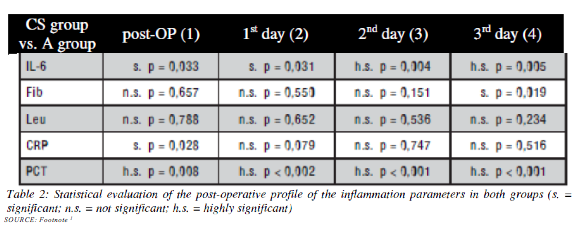
Importantly, investigators found that every marker showed a positive trend in favor of the CytoSorb group even at time points where the difference was not considered statistically significant.
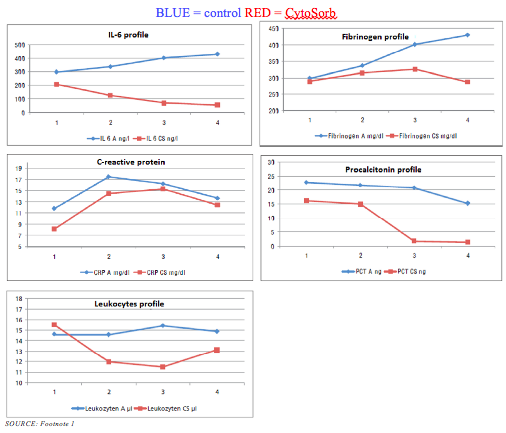
Relative to IL-6, reduction in levels of this cytokine was also a primary endpoint in CytoSorbents' European sepsis trial which was also successfully met - we expect this may also be an endpoint in the U.S. cardiac surgery trial.
Among the investigators' conclusions were that use of CytoSorb during cardiac surgery "can significantly attenuate an excessive inflammatory reaction", that it "may lead to a reduction in the development of SIRS" and that if results of this study are confirmed in a controlled clinical study that "CytoSorb could establish itself as a routine measure in cardiac surgery."
[1] F. Born, et al. Systemic Inflammatory Response Syndrome in Heart Surgery: New possibilities for treatment through the use of a cytokine adsorber during ECC? Kardiotechnik. 2/2014
READ THE LATEST FULL RESEARCH REPORT HERE
SUBSCRIBE TO ZACKS SMALL CAP RESEARCH to receive our articles and reports emailed directly to you each morning. Please visit our website for additional information on Zacks SCR and to view our disclaimer.