06/03/2014
By Grant Zeng, CFA
OBB:DMPI
DelMar Presents Promising VAL-083 Interim Data from GBM Clinical Trial at ASCO
On May 31, 2014, DelMar (OBB:DMPI) presented interim clinical data from the Company's ongoing Phase I/II clinical trial with VAL-083 in refractory glioblastoma multiforme (GBM) at the ASCO conference.
Background of the Phase I/II clinical trial
DelMar initiated the Phase I/II clinical trial of VAL-083 for the treatment of refractory glioblastoma multiforme (GBM) or progressive secondary brain tumor in October 2011. The Phase I/II study is an open-label, single arm dose-escalation study designed to evaluate the safety, tolerability, pharmacokinetics and anti-tumor activity of VAL-083 in patients with histologically confirmed initial diagnosis of primary WHO Grade IV malignant glioma (GBM), now recurrent. Patients with prior low-grade glioma or anaplastic glioma are eligible if histologic assessment demonstrates transformation to GBM. Patients must have been previously treated for GBM with surgery, and/or radiation, if appropriate, and must have failed both Bevacizumab (Avastin) and temozolomide (Temodar), unless either or both are contra-indicated. Patients with brain tumors that have developed due to CNS metastases were eligible for the DelMar clinical trial at early doses.
The primary outcome measures in the dose-modernization portion of the clinical trial will be the determination of maximum tolerated dose (MTD). Secondary outcome measures include tumor response in patients and pharmacokinetics.
An initial phase of the study will involve dose escalation cohorts until a maximum tolerated dose (MTD) is established in the context of modern care. Once the modernized dosing regimen has been established, additional patients will be enrolled at the MTD in a registration directed Phase II clinical trial. Up to 30 patients will be enrolled in the Phase I study.
In Aug, 2013, DelMar received a notice of allowance from the FDA that will enable the company to accelerate the dose-escalation of its ongoing Phase I/II of VAL-083 in refractory glioblastoma multiforme (GBM) patients.
The revised dosing regimen was allowed by the FDA following an extensive safety review of patients treated to date. In comparison to the original dose-escalation scheme, the revised plan will enable the trial to reach higher doses and complete the dose-escalation portion of the clinical trial more quickly by skipping two interim doses. The revised dosing scheme also permits dosing above 40mg/m2 if VAL-083 is safe and well-tolerated at that dose.
Accelerating the program will enable DelMar to complete the dose-escalation portion of the Phase I/II clinical trial, attain doses that are more likely to have anti-tumor effects and advance into registration-directed studies for refractory GBM in the timeliest manner possible. The company’s goal remains to advance into registration-directed trials in 2014.
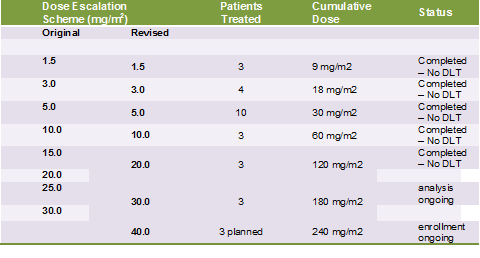
Cohort 6 enrollment has completed, enrollment has advanced to Cohort 7
On April 9, 2014, DelMar presented updated data at the 105th Annual Meeting of the American Association for Cancer Research (AACR) in San Diego.
In summary, DelMar's data demonstrated:
-
VAL-083 therapy is well tolerated; no drug-related serious adverse events have been detected in 26 patients treated to date in the current study.
- The maximum tolerated dose (MTD) has not been reached after completion of cohort 5 (20 mg/m2); analysis of cohort 6 (30 mg/m2) is ongoing.
- A dose-dependent increase in exposure with a short plasma (one to two hour) half-life and a Cmax of 2.
While the analysis of cohort 6 is ongoing, the trial has advanced to enroll patents in the cohort 7 (40 mg/m2)
Updated Interim clinical data presented at ASCO
Following is the summary from the ASCO presentation:
· To date, one of two GBM patients in cohort 6 (30 mg/m2) exhibited stable disease after one cycle of treatment. Outcomes analysis of cohorts 6 and 7 are ongoing.
· No drug-related serious adverse events have been detected, and maximum tolerated dose (MTD) has not been reached at doses up to 30 mg/m2. Enrollment and evaluation of Cohort 7 (40mg/m2) is ongoing.
· Pharmacokinetics are linear and consistent with previous published data suggesting that concentrations of VAL-083 being obtained are effective against glioma cell lines in vitro.
In earlier cohorts, DelMar reported that two patients exhibited a response (stable disease or partial response) with a maximum response of 28 cycles (84 weeks) and improved clinical signs prior to discontinuing due to adverse events unrelated to study.
DelMar has also presented data demonstrating that the cytotoxic activity of VAL-083 is independent of MGMT, the enzyme believed to cause resistance to the current front-line therapy in the treatment of GBM.
If the MTD is not reached in cohort 7, DelMar would be prepared to file a protocol amendment with the FDA to allow dosing beyond 40mg/m2.
A Registration Directed Phase II Trial and a Phase II/III to Begin in 2H2014
Based on the positive interim data, we expect DelMar to initiate a registration directed Phase II trial in refractory GBM in 2H2014. Based on historical development of other products in GBM, it’s possible that DelMar may be able to obtain FDA approval to commercialize VAL-083 to treat patients who have failed other therapies from an open-label Phase II registration-directed clinical trial, which will save significant costs of a large Phase III clinical trial. It’s also possible that the FDA may grant fast-track, accelerated approval and/or priority review status to VAL-083, which will enable DelMar to begin filing for commercial approval during the clinical trial process.
Based on historical precedent with the FDA, the Phase II registration directed trial are expected to mirror the Avastin approval study in that indication. Under this scenario, the Phase II trial would be:
· Single-arm; open label design;
· Primary endpoints: PFS6 & Radiographic response
· Secondary endpoints: overall survival;
· N = 80-100 patients;
· Minimum response rate = 20%;
· Enrollment: Patients with recurrent GBM who have failed or are ineligible for both Temodar® and Avastin® (i.e. the same population as in the current trial);
The recent failure of Avastin in the front line treatment of GBM has highlighted the need for new therapies in newly diagnosed patients, particularly those with unmethylated MGMT promoter regions who do not respond to standard of care with temozolomide. DelMar would plan to advance modernized dosing regimen into a Phase II/III trial in newly diagnosed patients with unmethylated MGMT promoter in parallel with the refractory GBM registration trial (i.e. in 1H2014). The Company has begun designing this trial with KOLs.
· Randomized groups: Temodar vs. VAL-083;
· Primary endpoints: overall survival;
· Secondary endpoints: PFS6 & radiographic response;
· N = 500 – 600 patients (with interim endpoint at ~10% enrollment);
New Pre-clinical Data May Expand VAL-083 Utility
On April 7, 2014, DelMar presented new preclinical data of VAL-083 in the treatment of non-small cell lung cancer (NSCL) at the 105th Annual Meeting of the American Association for Cancer Research (AACR) in San Diego.
The purpose of this pre-clinical study was to evaluate the activity of VAL-083 in in vivo models of drug-resistant NSCLC in comparison to cisplatin.
In an established murine xenograft model of NSCLC, the activity of VAL-083 was compared to standard platinum-based therapy with cisplatin against human NSCLC cell lines A549 (TKI-sensitive) and H1975 (TKI-resistant). In the study, VAL-083 demonstrated superior efficacy and safety in the treatment of TKI-susceptible (A549) tumors and in TKI-resistant (H1975) tumors.
Treatment of TKI-sensitive (A549) NSCLC with 3 mg/kg of VAL-083 resulted in tumor growth delay of 26 days compared to untreated controls. Cisplatin (5 mg/kg) resulted in tumor growth delay of just four days. In addition, mean tumor volume on day 68 was significantly reduced in animals treated with 3 mg/kg VAL-083 (p=0.001) compared to untreated control.
Treatment of TKI-resistant (H1975) NSCLC with 4 mg/kg of VAL-083 resulted in a statistically significant reduction in tumor volume (p = 0.01) versus untreated control after 27 days. In the same model, treatment with 5 mg/kg of cisplatin failed to achieve statistically significant reduction in tumor volume (p = 0.23) versus untreated control after 27 days. Longer-term safety assessments are ongoing in this model.
We think these data suggest that VAL-083 may be a viable treatment option for NSCLC patients failing TKI-therapy, especially where platinum-based therapy has already failed or is predicted to give sub-optimal outcomes.
VAL-083 is approved for treatment of lung cancer in China. These data have immediate implications in the treatment of NSCLC in China. The data also support exploring future clinical development of VAL-083 as a lung cancer therapy in the rest of the world thereby providing DelMar with a potential opportunity to expand its clinical development focus beyond glioblastoma.
Valuation Very Attractive
We maintain our Outperform rating on DelMar shares and reiterate our 12-month price target of $4.50 per share. Our call is based on recent clinical progress the company has made and attractive valuation of the company shares.
DMPI is a clinical and commercial stage biopharmaceutical company focused on the development and commercialization of oncology drugs. The Company’s lead drug candidate VAL-083 is currently in a Phase I/II trial for the treatment of recurring GBM.
Previous multiple clinical studies conducted by NCI have demonstrated that VAL-083 is safe and efficacious for the treatment of GBM. Interim data from the Company’s Phase I/II trial confirmed the efficacy and safety profile of VAL-083 in GBM patients. Based on the data currently available, DMPI intends to initiate a registration directed Phase II trial of VAL-083 for recurring GBM and a Phase II/III trial for first line GBM in 2014. This will be a significant milestone for the Company which will position the Company in a late stage development.
VAL-083 has been approved in China for leukemia and lung cancer and DMPI has acquired its commercial rights in China market. Delmar is seeking to enter into a marketing partnership that could generate upfront fees, milestones and royalty revenue for DMPI, which is a de-risking event for the Company.
VAL-083 is a first-in-class alkylating agent with a different mechanism of action from that of Temodar, current market leader for GBM. The unique MOA of VAL-083 overcomes the resistance problem for Temodar.
Currently, DMPI shares are trading at around $0.8 per share, which values the Company at about $26 million in market cap based on 32 million outstanding shares. This is a deep discount compared to its peers. We noticed that most small biotech companies of development stage are valued from $50 million to $1 billion depending on how advanced the pipeline is and which indications the company is targeting. DMPI’s lead drug candidate VAL-083 is in a Phase I/II clinical trial and will enter a registration directed Phase II trial in 2H2014.
We estimate VAL-083 could be approved by the FDA in 2017 for recurring GBM. The broad application of VAL-083, including first line, second line and third line treatment of GBM, and other cancers, means a great market potential for VAL-083, which could be a blockbuster for DelMar. We estimate DMPI will be profitable in 2018 with an EPS of $0.06 based on product sales of $35 million. EPS will grow to $0.35 in 2019 based on total product sales of $70 million.
Based on our financial model and the Company’s fundamentals, we have a price target of $4.50 per share for DMPI. We think a P/E ratio of 38x is appropriate for DMPI considering its growth in the next few years. Based on this P/E multiple, we come up with our price target of $4.50 per share using 25% discount for 5 years. Our price target values DMPI at $144 million in market cap, which we think is appropriate and fare compared to its peers.
But risk is high at this point for DMPI. Although VAL-083 has been approved in China for marketing, its indications are leukemia and lung cancer, different from the current indication of GBM under development in the US. The bar on both clinical and regulatory hurdle in the US is higher. We remind investors that risks associated with drug development are high, especially for early stage drug candidates. VAL-083 is only in Phase I clinical trial, and both clinical and regulatory hurdles are significant at this point.
Another concern we have is that DMPI has a limited pipeline. Right now, VAL-083 is the Company’s only clinical-stage candidate. While DelMar has early-stage second-generation analogues from the VAL-083 chemistry platform and has access to additional clinical-stage product candidates through its relationship with Valent Technologies LLC, no other clinical stage candidates currently in the DelMar portfolio. If VAL-083 fails, the value of the Company will be negatively impacted significantly.
READ THE LATEST FULL RESEARCH REPORT HERE
SUBSCRIBE TO ZACKS SMALL CAP RESEARCH to receive our articles and reports emailed directly to you each morning.
Please visit our website for additional information on Zacks SCR and to view our disclaimer.
Multimedia Files:
Categories:
Press Releases