By Grant Zeng, CFA
OTC:ONCS
Earlier today, OncoSec Medical (OTC:ONCS) announced the initiation of a landmark Phase II combination trial in collaboration with the UCSF and Merck to evaluate the safety, tolerability and efficacy of Merck’s anti-PD-1 drug, KEYTRUDA® (pembrolizumab) in combination with OncoSec’s ImmunoPulse therapy (intratumoral IL- 12) for the treatment of metastatic melanoma patients, who are non-responsive to KEYTRUDA®.
This Phase II clinical trial will be a multicenter investigator sponsored trial (IST), with UCSF and Dr. Alain Algazi as the sponsor. Merck will supply pembrolizumab, and OncoSec will provide electroporation devices and plasmid IL-12. Enrollment is expected to begin in 1Q15.
Immune checkpoint inhibition is the one of the most promising area for the treatment of cancer. Both CTLA-4 and PD-1/PDL-1 inhibitors have shown impressive results in clinical care and in ongoing clinical studies. Recent approval of Yervoy (CTLA-4 antibody from BMS) and Keytruda (PD-1 antibody from Merck) demonstrated the importance of immune checkpoint inhibitors in the treatment of cancer. We think the cancer immunotherapy by immune checkpoint inhibitors will enter widespread clinical use and will command a large market share of the cancer care market within the next decade.
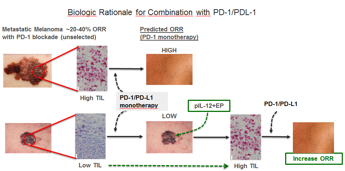
Studies have demonstrated that tumors (specifically melanoma) can be divided into a high and low TIL (tumor infiltrating lymphocyte) phenotype. Tumors with high TIL are referred to as immunogenic, while tumors with low TIL are referred to non-immunogenic. Ongoing clinical trials of PD-1/PDL-1 inhibitors suggest that response correlates with high TIL phenotype. Tumors with low TIL have low response rate to PD-1/PDL-1 inhibitors.
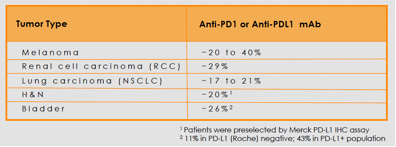
Anti-PD-1 non-responders constitute the majority of patients even in “immune therapy” tractable tumors like melanoma and RCC. Recent melanoma studies have reported response rates in the range of 20-40% using anti-PD-1 or anti-PDL-1, and the argument is that the majority of the responders are the high-TIL population. If this is the case, then the question becomes how to make those non-immunogenic tumors into immunogenic tumors so that they can respond to PD-1/PDL-1 or similarly effective T cell checkpoint agents.
Since IL- 12 promotes tumor immunogenicity and increases the number of TILs in the tumor, the combination therapeutic concept is that ImmunoPulse will convert low TIL tumors into high TIL ones, thus allowing KEYTRUDA® to kill tumor in patients, who would otherwise be PD-1 unresponsive.
This Phase II combo study presents a potential to address the vast majority of the metastatic melanoma patients, as well as, has profound implications on many other tumor indications.
The potential ability of ImmunoPulse to convert the non- or weakly immune-responsive cancer into strongly immune-responsive cancer may represent a paradigm shift in cancer therapy. This area is an enormous unmet medical need and represents a huge market for OncoSec. It is estimated that about 50% to 80% cancer patients will not have TIL infiltrate at baseline or even after PD-1/PDL-1 treatment. This is where OncoSec’s ImmunoPulse can get in and convert those non-immunogenic tumors into immunogenic tumors. In addition to melanoma, ImmunoPulse can virtually target any solid tumors, which represents a multi-billion dollar market for OncoSec.
There is a huge unmet medical need for OncoSec’s ImmunoPulse in combination with checkpoint inhibitors. If we look at the melanoma indication alone, this is a disease that has the highest response rates with PD-1 inhibitor monotherapy. But still there are about 60% to 80% of patients who will not respond to PD-1 checkpoint inhibitors. This powerful combination is expected to treat the larger population of approximately 70% of the patients.
In other solid tumors, the percentage of PD-1 non-responders/non-immunogenic tumors is likely to be even greater. Thus, there is a tremendous unmet medical need, across many solid tumors.
We estimate the market for the combination therapy will be a multi-billion business.
The Phase II combination study will provide the Company with information for a key inflection point in the development of this program. If the Phase II study can confirm safety and efficacy of ImmunoPulse, pivotal trial could start in early 2016. And we estimate approval of ImmunoPulse for the treatment of melanoma may be obtained as early as in late 2017 if the pivotal trial data prove to be positive.
We think positive data from the Phase II combination study may lead to a major license deal for OncoSec.
We Maintain Outperform Rating and Raise Our Price Target to $4
We maintain our Outperform rating on OncoSec shares and raise our 12-month price target to $4.00 from previous $2.00 due to the clinical advancement of the combination study with the PD-1 inhibitor.
OncoSec is an emerging biotech company focused on developing and commercializing innovative approaches for the treatment of cancers. OncoSec’s key platform technology is its proprietary electroporation delivery system to locally deliver DNA or chemotherapeutics into tumor cells. But what makes the technology unique is that this locally delivered DNA has demonstrated systemic response for the treatment of melanoma, meaning that the technology can be used to treat metastasis of cancers.
OncoSec’s lead candidate ImmunoPulse is a delivery device encoding for IL-12. ImmunoPulse is currently in three Phase II clinical trials for melanoma, Merkel cell carcinoma and cutaneous T-cell lymphoma respectively. OncoSec already reported positive data from the Phase II melanoma trial.
One important application of ImmunoPulse is that it can be combined with checkpoint inhibitors such as PD-1/PDL-1 for the treatment of melanoma and other solid tumors. In this case, the combination therapy can convert non-immunogenic cancers into immunogenic cancers, which can be killed by the combination therapy. The Company already initiated a Phase II combination trial for melanoma. If data are positive from the combination study, pivotal trial for melanoma could start in early 2016, and approval of this indication could be obtained as early as in 2017.
The market for ImmunoPulse is huge even for the melanoma indication alone. If we consider other indications for solid tumors, the market is much bigger.
Based on OncoSec’s fundamentals, we think its shares are undervalued at current market price. Currently, OncoSec shares are trading at about $0.50 per share, which values the company at $122 million in market capitalization based on 244 million outstanding shares. This certainly is a huge discount compared to its peers. We understand that valuing a development stage biotech company is always difficult. But if we look at similar companies in the cancer space, the value of a typical development stage biotech firm with similar fundamentals to OncoSec is usually from $50 million to $1 billion depending on how advanced the programs are and how big the markets are for its candidates. OncoSec is a mid-stage development biotech company. The market of melanoma and/or other solid tumors is huge for its lead candidate ImmunoPulse.
With the estimated approval of ImmunoPulse in 2017, we model OncoSec will become profitable in fiscal 2018 with earnings per share (EPS) of $0.01 based on ImmunoPulse sales of $50 million. Revenue will increase to $215 million in fiscal 2020 and EPS will grow into $0.22 per share according to our estimates. We think a 45 x P/E multiple is appropriate for OncoSec. Using this P/E ratio and a 20% discount rate for five years, we arrive at our price target of $4.00 per share for OncoSec, which values the Company at $900 million in market cap. This valuation is appropriate in our view considering the relatively strong fundamentals of the Company.
Recent interest in electroporation technology from big pharma could serve as a wildcard for OncoSec valuation. In September 2013, Roche entered into collaboration with Inovio Pharmaceuticals with an over $400 million investment in Inovio’s electroporation technology. Also in Feb 2014, Pfizer entered into a collaboration agreement with Ichor Medical Systems to utilize Ichor’s intramuscular electroporation technology. With proven clinical data, OncoSec’s ImmunoPulse could be the next target for big pharma companies.
READ THE LATEST FULL RESEARCH REPORT HERE
SUBSCRIBE TO ZACKS SMALL CAP RESEARCH to receive our articles and reports emailed directly to you each morning. Please visit our website for additional information on Zacks SCR and to view our disclaimer.