By Grant Zeng, CFA
OTC:ONCS
OncoSec Exits Fiscal 2014 with a Strong Balance Sheet
Recently OncoSec (OTC:ONCS) reported its financial results for the fiscal year ended July 31, 2014.
There was no revenue reported for the fiscal year ended July 31, 2014, or July 31, 2013.
Research and development expenses were $5.8 million for the fiscal year ended July 31, 2014, compared to $3.2 million for the same period in 2013.
General and administrative expenses were $6.2 million for the fiscal year ended July 31, 2014, compared to $3.9 million for the same period in 2013.
The Company recorded a net loss of $12.0 million ($0.06 per share) for fiscal year ended July 31, 2014, compared to a net loss of $7.2 million ($0.07 per share) for the same period last year.
On June 6, 2014, OncoSec closed a registered direct offering of 22,535,212 shares of its common stock at a price of $0.71 per share and warrants to purchase up to an aggregate of 7,887,325 shares of common stock at an exercise price of $0.90 per share for a term of five years.
Net proceeds, after deducting the placement agent’s fee and other estimated offering expenses payable by OncoSec, were approximately $14.9 million.
OncoSec intends to use proceeds from the offering for general corporate purposes, including clinical trial expenses and research and development expenses.
We are pleased with this financing which not only strengthens OncoSec’s cash position, but also validates the company’s technology and clinical programs.
At July 31, 2014, OncoSec had $37.9 million in cash and cash equivalents, which will last through the end of fiscal 2017 according to our financial model.
Phase IIb Study of ImmunoPulse in Combination with a Checkpoint Inhibitor for Metastatic Melanoma to be Initiated in late 2014
While OncoSec’s current Phase II monotherapy study in metastatic melanoma is coming to a conclusion, the company is preparing for its next phase of development and is setting up for the initiation of a Phase IIb metastatic melanoma study of ImmunoPulse in combination with a checkpoint inhibitor in late 2014.
Immune checkpoint inhibition is the one of the most promising area for the treatment of cancer. Both CTLA-4 and PD-1/PDL-1 inhibitors have shown impressive results in clinical care and in ongoing clinical studies. Recent approval of Yervoy (CTLA-4 antibody from BMS) and Keytruda (PD-1 antibody from Merck) demonstrated the importance of immune checkpoint inhibitors in the treatment of cancer. We think the cancer immunotherapy by immune checkpoint inhibitors will enter widespread clinical use and will command a large market share of the cancer care market within the next decade.
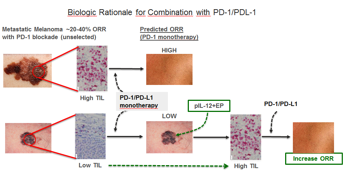
Studies have demonstrated that tumors (specifically melanoma) can be divided into a high and low TIL (tumor infiltrating lymphocyte) phenotype. Tumors with high TIL are referred to as immunogenic, while tumors with low TIL are referred to non-immunogenic. Ongoing clinical trials of PD-1/PDL-1 inhibitors suggest that response correlates with high TIL phenotype. Tumors with low TIL have low response rate to PD-1/PDL-1 inhibitors.
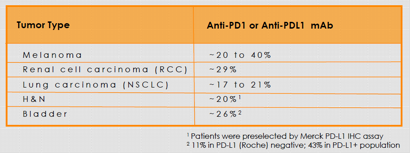
Anti-PD-1 non-responders constitute the majority of patients even in “immune therapy” tractable tumors like melanoma and RCC. Recent melanoma studies have reported response rates in the range of 20-40% using anti-PD-1 or anti-PDL-1, and the argument is that the majority of the responders are the high-TIL population. If this is the case, then the question becomes how to make those non-immunogenic tumors into immunogenic tumors so that they can respond to PD-1/PDL-1 or similarly effective T cell checkpoint agents.
The therapeutic concept is that ImmunoPulse with IL-12 will convert low TIL tumors into high TIL ones, thus allowing an anti-PD-1/PDL-1 therapy to work in patients, who would otherwise be PD-1 unresponsive.
The potential ability of ImmunoPulse to convert the non- or weakly immune-responsive cancer into strongly immune-responsive cancer may represent a paradigm shift in cancer therapy. This area is an enormous unmet medical need and represents a huge market for OncoSec. It is estimated that about 50% to 80% cancer patients will not have TIL infiltrate at baseline or even after PD-1/PDL-1 treatment. This is where OncoSec’s ImmunoPulse can get in and convert those non-immunogenic tumors into immunogenic tumors. In addition to melanoma, ImmunoPulse can virtually target any solid tumors, which represents a multi-billion dollar market for OncoSec.
There is a huge unmet medical need for OncoSec’s ImmunoPulse in combination with checkpoint inhibitors. If we look at the melanoma indication alone, this is a disease that has the highest response rates with PD-1 inhibitor monotherapy. But still there are about 60% to 80% of patients who will not respond to PD-1 checkpoint inhibitors.
In other solid tumors, the percentage of PD-1 non-responders/non-immunogenic tumors is likely to be even greater. Thus, there is a tremendous unmet medical need, across many solid tumors.
We estimate the market for the combination therapy will be a multi-billion business.
In order to accelerate the development of the combination study, OncoSec recently hired industry veteran Dr. Robert H. Pierce as the Company’s Chief Scientific Officer (CSO). Dr. Pierce was a key member of the global development team behind Merck’s anti-PD-1 program (MK-3475) before joining OncoSec. We believe the addition of Dr. Pierce will accelerate the combination development of ImmunoPulse with PD-1/PDL-1 inhibitors.
The Phase IIb combination study will be a randomized, controlled study, providing the company with information for a key inflection point in the development of this program.
If the Phase IIb study can confirm safety and efficacy of ImmunoPulse, pivotal trial could start in 2015. And we estimate approval of ImmunoPulse for the treatment of melanoma may be obtained as early as in late 2017 if the pivotal trial data prove to be positive.
Positive Phase II Interim Data of ImmunoPulse in Melanoma Reported
On June 2, 2014, at the ASCO meeting, OncoSec announced interim data from its Phase II melanoma study.
OncoSec’s ImmunoPulse locally delivers plasmid-DNA encoding IL-12 into tumor cells.
OncoSec initiated a Phase II clinical trial in patients with melanoma in Feb 2012. The Phase II melanoma trial (OMS-I100) is a single dose trial treating approximately 30 patients, who are eligible to receive one treatment cycle every 12 weeks. The primary endpoint is objective response rate (local and distant) at six months. Secondary trial endpoints include time to objective response (complete and partial responses), duration of distant response and overall survival.
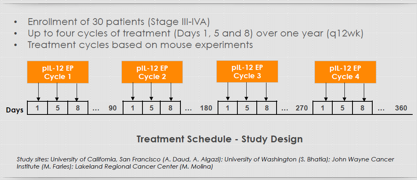
Data from the multicenter, open-label, single-arm study confirmed the safety of ImmunoPulse, which delivers the anti-tumor agent pIL-12 directly into the tumor via in-vivo electroporation (EP), with no treatment-related serious adverse events or deaths having been reported. Regression of treated and non-treated tumors suggests successful induction of systemic anti-tumor response.
As of the reporting date, 30 patients was enrolled and received at least one cycle of treatment. At the time of this interim analysis, 28 patients were evaluable for objective response rate (ORR) at 24-week primary time point.
Best ORR was 32.1% (9/28), which included a complete response rate of 10.7% (3/28) and a partial response rate of 21.4% (6/28).
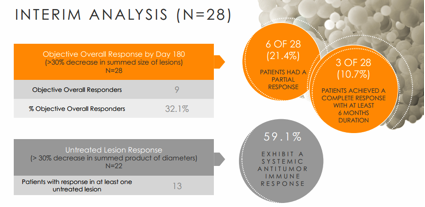
Importantly, intratumoral treatment with IL-12 EP resulted in the development of a systemic anti-tumor effect in the majority of patients. Twenty-two of the enrolled patients presented with baseline lesions that were left untreated in order to evaluate the induction of a systemic response. Regression was documented in at least one non-injected tumor in 59 percent (13/22) of patients. These results suggest that intratumoral therapy with IL-12 can induce systemic anti-tumor responses while avoiding the toxicities observed with systemic recombinant IL-12 therapy.
In addition to best overall response and systemic response, an assessment of best local response in treated lesions was conducted. Complete response was defined as complete regression of a treated lesion. Partial response was defined as >30 percent reduction in the longest diameter of the tumor, while stable disease was defined as ≤30 percent reduction and <20 percent increase in the longest diameter of the tumor.

Correlative data were also presented, including gene expression in a subset of eight patients, where adequate paired pre- and post-treatment biopsy samples were available. A focused analysis of immunomodulatory cell types and pathways supported the hypothesis that IL-12 electroporation leads to induction of interferon-g and downstream interferon-g-inducible genes, including key modulators of antigen presentation and processing machinery and chemokines. Additional genes of interest were also up-regulated, including PD-1, PD-L1 and T cell markers, confirming the Phase I data, indicating that treatment results in T cell infiltration.
These data strengthen and expand upon previously reported Phase I results, which indicated a complete response in 16% of patients (3/19) and disease stabilization in 38% (7/19).
We are encouraged by the safety and efficacy data of ImmunoPulse in the Phase II study in melanoma patients. The positive Phase II data further validates results from previous Phase I study. We are especially impressed with the response rate of untreated tumors, which suggests an induction of systemic antitumor response, without systemic toxicity.
Systemic response is significant for two main reasons. First, it suggests that unlike most locally administered melanoma treatments, ImmunoPulse may induce antitumor response throughout the entire body, which would have clear benefits in the treatment of metastatic disease. Secondly, the favorable safety profile of ImmunoPulse indicates its potential to deliver systemic benefit, without the toxicities associated with many other systemic treatments.
OncoSec Plans to Evaluate Increased Dose Frequency of ImmunoPulse in Ongoing Phase II Melanoma Trial
In March 2014, OncoSec submitted a protocol addendum to the FDA and Institutional Review Board (IRB) to evaluate an increased dose frequency for ImmunoPulse in an expansion of its ongoing Phase II melanoma trial. The Company expects to enroll up to 21 patients in this expansion.
The protocol addendum will allow for the assessment of the safety and efficacy of a six-week treatment cycle with ImmunoPulse in up to 21 melanoma patients. Each cycle will consist of treatments on Days 1, 8 and 15. Subjects will be eligible for an additional cycle as early as six weeks from the first treatment up to a maximum of nine treatment cycles.
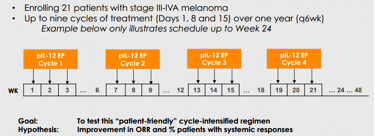
There are three goals of the trial expansion:
· It will provide an opportunity to assess whether more frequent treatment with ImmunoPulse can provide additional clinical benefit to melanoma patients.
· The expansion is also intended to help optimize the treatment design of the Company’s Phase IIb study in melanoma patients, which is expected to initiate in late 2014.
· Safety of this intensified dose regimen will also be assessed.
Data from this expansion study will be available in late 2015.
READ THE LATEST FULL RESEARCH REPORT HERE
SUBSCRIBE TO ZACKS SMALL CAP RESEARCH to receive our articles and reports emailed directly to you each morning. Please visit our website for additional information on Zacks SCR and to view our disclaimer.