05/28/2014
By Grant Zeng, CFA
OTC:ONCS
OncoSec: On Schedule to Advance ImmunoPusle Clinical Program
OncoSec Plans to Evaluate Increased Dose Frequency of ImmunoPulse in Ongoing Phase II Melanoma Trial
In March 2014, OncoSec (OTC:ONCS) submitted a protocol addendum to the FDA and Institutional Review Board (IRB) to evaluate an increased dose frequency for ImmunoPulse in an expansion of its ongoing Phase II melanoma trial. The Company expects to enroll up to 21 patients in this expansion.
The protocol addendum will allow for the assessment of the safety and efficacy of a six-week treatment cycle with ImmunoPulse in up to 21 melanoma patients. Each cycle will consist of treatments on Days 1, 8 and 15. Subjects will be eligible for an additional cycle as early as six weeks from the first treatment up to a maximum of nine treatment cycles.
There are three goals of the trial expansion:
· It will provide an opportunity to assess whether more frequent treatment with ImmunoPulse can provide additional clinical benefit to melanoma patients.
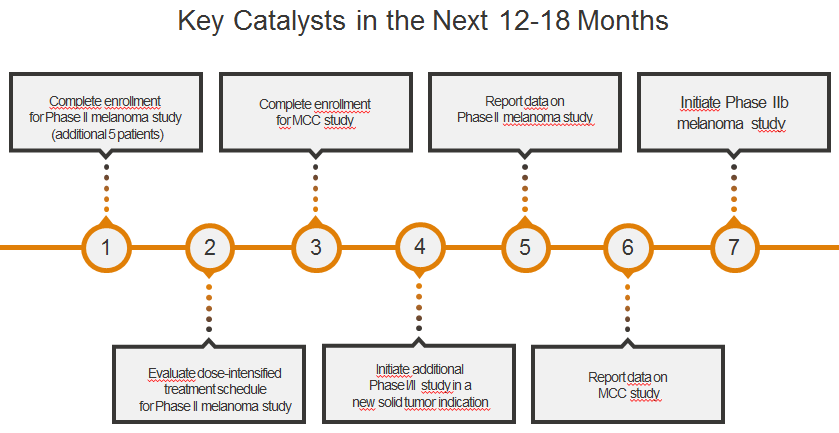
· The expansion is also intended to help optimize the treatment design of the Company’s Phase IIb study in melanoma patients, which is expected to initiate in late 2014.
· Safety of this intensified dose regimen will also be assessed.
Update on the Ongoing Phase II Trial of ImmunoPulse for Melanoma
OncoSec’s ImmunoPulse locally delivers plasmid-DNA encoding IL-12 into tumor cells.
OncoSec initiated a Phase II clinical trial in patients with melanoma in Feb 2012. The Phase II melanoma trial (OMS-I100) is a single dose trial treating approximately 30 patients, who are eligible to receive one treatment cycle every 12 weeks. The primary endpoint is objective response rate (local and distant) at six months. Secondary trial endpoints include time to objective response (complete and partial responses), duration of distant response and overall survival.
In December 2013, OncoSec announced positive interim data from the ongoing Phase II trial of OMS-I100 from the first 21 patients.
ImmunoPulse was safe and well tolerated. Data from the multicenter, open-label, single-arm study confirmed the safety of ImmunoPulse. In Phase I and Phase II studies, a total of 47 melanoma patients have been treated without a single drug-related, serious adverse event. The most often occurred side effect was injection site pain (56.5%) which was only mild and transient.
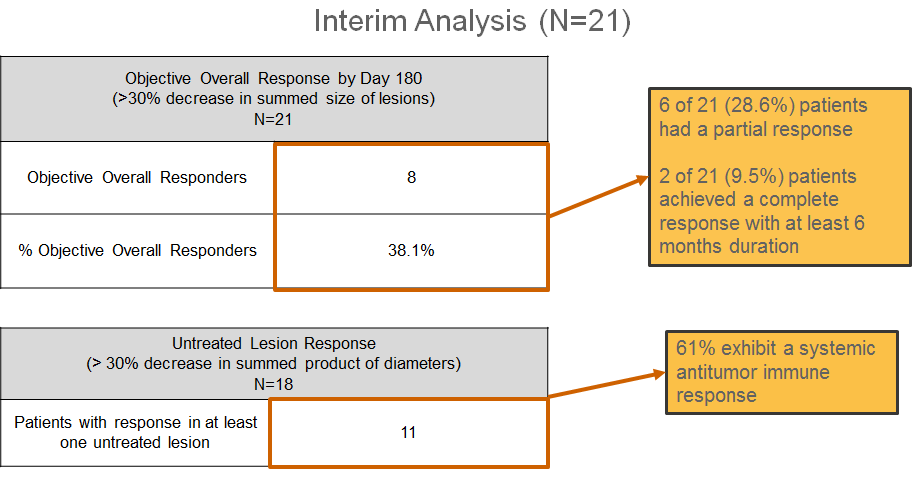
Patients treated in OMS-I100 also demonstrated positive response rates based on modified RECIST criteria, a standardized measure of solid-tumor response to treatment. Interim efficacy analysis of 21 evaluable patients on Day 180 indicated that 38.1% (8/21) achieved an objective overall response, defined as ≥30% reduction in summed size of lesions. At the time of this interim analysis, six patients (28.6%) had demonstrated a partial response, and two patients (9.5%) had achieved a complete response, lasting at least 6 months. An additional 9.5% (2/21) of patients exhibited clinically beneficial disease stabilization for at least 3 months.
These data strengthen and expand upon previously reported Phase I results, which indicated a complete response in 16% of patients (3/19) and disease stabilization in 38% (7/19). These data were published in Journal of Clinical Oncology in 2008.
Importantly, 61.1% of patients (11/18) with evaluable lesions exhibited systemic antitumor immune responses, as evidenced by objective regression (≥30% reduction in size) in at least one untreated lesion.
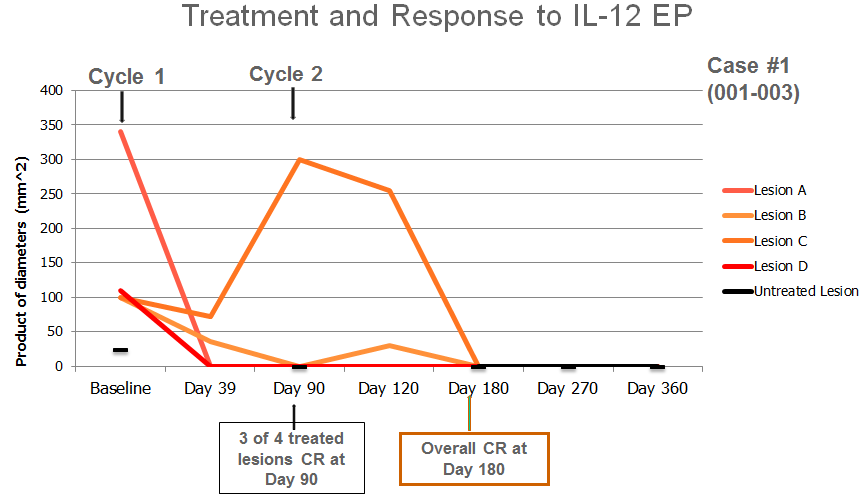
The following chart describes an example of one complete responder in the Phase II melanoma trial. At baseline he had 5 lesions: 4 treated and 1 untreated. The untreated lesion was visible by PET-CT and remained untreated for the duration of the study.
Following the first cycle, 3 of the 4 treated lesions completely responded, including the untreated lesion. Following the second cycle, all treated lesions responded and by Day 180 this patient was disease free.
OncoSec has completed enrollment of 29 patients in the Phase II trial and expects to reach its expanded enrollment target of 30 patients in the near future and report additional data from the trial in mid-2014.
We are encouraged by the safety and efficacy data of ImmunoPulse in the Phase II study in melanoma patients. The positive Phase II data further validates results from previous Phase I study. We are especially impressed with the response rate of untreated tumors, which suggests an induction of systemic antitumor response, without systemic toxicity.
Systemic response is significant for two main reasons. First, it suggests that unlike most locally administered melanoma treatments, ImmunoPulse may induce antitumor response throughout the entire body, which would have clear benefits in the treatment of metastatic disease. Secondly, the favorable safety profile of ImmunoPulse indicates its potential to deliver systemic benefit, without the toxicities associated with many other systemic treatments.
Phase IIb Study of ImmunoPulse for Metastatic Melanoma To be Initiated Soon
While OncoSec’s current Phase II study in metastatic melanoma is coming to a conclusion, the company is preparing for its next phase of development and is setting up for the initiation of a Phase IIb metastatic melanoma study in late 2014. The Phase IIb study will be a randomized, controlled study, providing the company with information for a key inflection point in the development of this program.
If the Phase IIb study can confirm safety and efficacy of ImmunoPulse, pivotal trial could start in 2015. And we estimate approval of ImmunoPulse for the treatment of melanoma may be obtained as early as in late 2017 if the pivotal trial data prove to be positive.
Update on the Phase II CTCL Lymphoma Study
In April, 2014, OncoSec announced that it will re-launch its Phase II cutaneous T-cell lymphoma (CTCL) trial under a protocol amendment.
As a reminder, in July 2012, a Phase II trial of ImmunoPulse was initiated at the University of California San Francisco (UCSF) under an FDA-approved investigator-sponsored Investigational New Drug application (IND) with Weiyun Ai, M.D. as principal investigator. In November 2012, this IND was transferred to OncoSec.
Following review of the protocol under OncoSec’s own accord, the company determined that an amendment to the protocol should be considered in order to broaden the inclusion and exclusion criteria, implement a more patient-friendly treatment design, and expand the exploratory endpoints for the trial. In consultation with Key Opinion Leaders (KOLs), OncoSec has amended the protocol, and Institutional Review Board approval is pending.
OncoSec will expand enrollment to Stanford University. Stanford is regarded as having a large CTCL patient population and is experienced in investigating novel therapies in this disease. This Phase II clinical trial is an open label, multi-center study. The trial’s primary endpoint is to assess the objective response rate (both local and distant) at six months post-treatment, with safety and progression-free survival as secondary endpoint measures.
In the revised protocol, all subjects will be eligible to receive up to six treatment cycles consisting of treatment days (Days 1 and 8) in a 28-day cycle. A total of up to 34 patients will be enrolled in this study. Subjects will be followed for safety and clinical evaluation every four weeks. Quality of Life will be assessed. Survival follow-up will occur at three-month intervals over two years following the end of the study.
Yuon Kim, M.D. will serve as principal investigator for the Stanford University study.
OncoSec Presents New Data at 10th Annual PEGS
On May 5, 2014, OncoSec presented preliminary experimental data showing that ImmunoPulse in mice can lead to systemic anti-tumor immune responses in distant untreated lesions at the Essential Protein Engineering Summit (PEGS) in Boston.
In the syngeneic B16.F10 mouse melanoma tumor model, the left-side tumors were treated with ImmunoPulse and tumors on the right side were not treated. Forty-percent of the untreated tumors (4/10) showed brisk inflammatory infiltrate and pathologic changes of regression at day 18 or day 22 after ImmunoPulse treatment. This result demonstrated ImmunoPulse’s systemic anti-tumor efficacy.
An IL-12-dependent TIL (tumor infiltrating lymphocyte) and interferon gamma response was confirmed in both treated and untreated tumors.
The above data are collected from an ongoing collaboration with Old Dominion University (ODU) and the Frank Reidy Research Center for Bioelectrics. Current experiments are focused on evaluating the effects of ImmunoPulse in combination with checkpoint inhibitors for melanoma cancer.
Studies have demonstrated that tumors (specifically melanoma) can be divided into a high and low TIL (tumor infiltrating lymphocyte) phenotype. Tumors with high TIL are referred to as immunogenic, while tumors with low TIL are referred to non-immunogenic. Ongoing clinical trials of PD1/PDL1 inhibitors suggest that response correlates with high TIL phenotype. Tumors with low TIL have low response rate to PD-1/PDL-1 inhibitors.
Recent melanoma studies have reported response rates in the range of 20-40% using anti-PD-1 or anti-PDL-1, and the argument is that the majority of the responders are the high-TIL population. If this is the case, then the question becomes how to make those non-immunogenic tumors into immunogenic tumors so that they can respond to PD-1/PDL-1 or similarly effective T cell checkpoint agents.
The therapeutic concept is that ImmunoPulse with IL-12 will convert low TIL tumors into high TIL ones, thus allowing an anti-PD1/PDL1 therapy to work in patients, who would otherwise be PD-1 unresponsive.
The potential ability of ImmunoPulse to convert the non- or weakly immune-responsive cancer into strongly immune-responsive cancer may represent a paradigm shift in cancer therapy. This area is an enormous unmet medical need and represents a huge market for OncoSec. It is estimated that about 50% to 80% cancer patients will not have TIL infiltrate at baseline or even after PD-1/PDL-1 treatment. This is where OncoSec’s ImmunoPulse can get in and convert those non-immunogenic tumors into immunogenic tumors. In addition to melanoma, ImmunoPulse can virtually target any solid tumors, which represents a multi-billion dollar market for OncoSec.
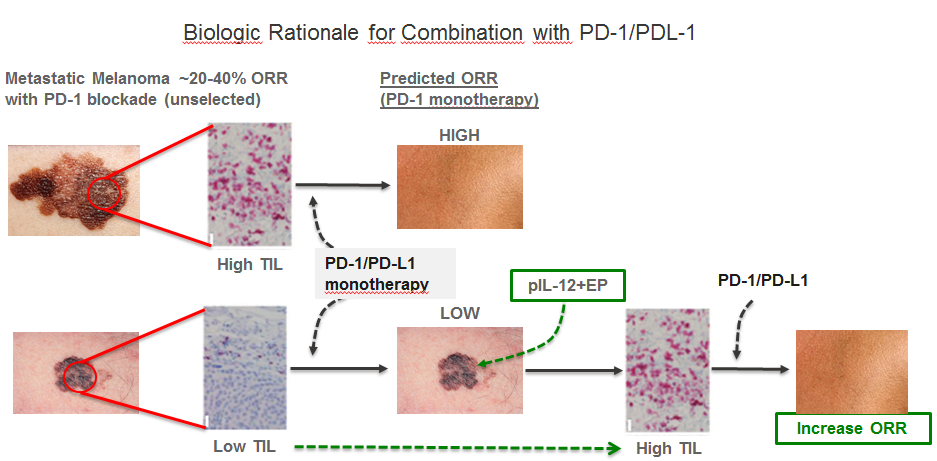
There is a huge unmet medical need for OncoSec’s ImmunoPulse in combination with checkpoint inhibitors. If we look at the melanoma indication alone, this is a disease that has the highest response rates with PD-1 inhibitor monotherapy. But still there are about 60% to 80% of patients who will not respond to PD-1 Checkpoint Inhibitors.
In other solid tumors, the percentage of PD-1 non-responders/non-immunogenic tumors is likely to be even greater. Thus, there is a tremendous unmet medical need, across many solid tumors.
We estimate the market for the combination therapy will be a multi-billion business.
In order to accelerate the development of the combination study, OncoSec recently hired industry veteran Dr. Robert H. Pierce as the Company’s Chief Medical Officer (CMO). Dr. Pierce was a key member of the global development team behind Merck’s anti-PD-1 program (MK-3475) before joining OncoSec. We believe the addition of Dr. Pierce will accelerate the combination development of ImmunoPulse with PD-1/PDL-1 inhibitors.
Balance Sheet Remains Strong
As of January 31, 2014, OncoSec had cash and cash equivalents of $18.5 million. This cash balance could last through into fiscal 2016 according to our model.
Valuation Attractive
We maintain our Outperform rating on OncoSec shares and reiterate our 12-month price target of $1.50.
OncoSec is an emerging biotech company focused on developing and commercializing innovative approaches for the treatment of cancers. OncoSec’s key platform technology is its proprietary electroporation delivery system to locally deliver DNA or chemotherapeutics into tumor cells. But what makes the technology unique is that this locally delivered DNA has demonstrated systemic response for the treatment of melanoma, meaning that the technology can be used to treat metastasis of cancers.
OncoSec’s lead candidate ImmunoPulse is a delivery device encoding for IL-12. ImmunoPulse is currently in three Phase II clinical trials for melanoma, Merkel cell carcinoma and cutaneous T-cell lymphoma respectively. OncoSec already reported positive data from the Phase II melanoma trial, and plans to move to Phase IIb trial for melanoma soon. We estimate pivotal trial for melanoma could start in calendar 2015, and approval of this indication could be obtained as early as in 2017.
One important application of ImmunoPulse is that it can be combined with checkpoint inhibitors such as PD-1/PDL-1 for the treatment of melanoma and other solid tumors. In this case, the combination therapy can convert non-immunogenic cancers into immunogenic cancers, which can be killed by the combination therapy.
The market for ImmunoPulse is huge even for the melanoma indication alone. If we consider other indications for solid tumors such as Merkel cell carcinoma and cutaneous T-cell lymphoma, the market is much bigger.
Based on OncoSec’s fundamentals, we think its shares are undervalued at current market price. Currently, OncoSec shares are trading at about $0.75 per share, which values the company at $159 million in market capitalization based on 212 million outstanding shares. This certainly is a huge discount compared to its peers. We understand that valuing a development stage biotech company is always difficult. But if we look at similar companies in the cancer space, the value of a typical development stage biotech firm with similar fundamentals to OncoSec is usually from $50 million to $1 billion depending on how advanced the programs are and how big the markets are for its candidates. OncoSec is a mid-stage development biotech company, and is ready to move to pivotal study with its lead candidate. The market of melanoma and/or other solid tumors is huge for its lead candidate ImmunoPulse.
With the estimated approval of ImmunoPulse in 2017, we model OncoSec will become profitable in fiscal 2018 with earnings per share (EPS) of $0.03 based on ImmunoPulse sales of $50 million. Revenue could double in fiscal 2019 and EPS will grow into $0.10 per share according to our estimates. If we use the biotech industry average P/E multiple of 35 and 20% discount rate for five years, we arrive at our price target of $1.50 per share for OncoSec, which values the Company at $318 million in market cap. This valuation is still conservative in our view considering the relatively strong fundamentals of the Company.
Recent interest in electroporation technology from big pharma could serve as a wildcard for OncoSec valuation. In September 2013, Roche entered into collaboration with Inovio Pharmaceuticals with an over $400 million investment in Inovio’s electroporation technology. Also in Feb 2014, Pfizer entered into a collaboration agreement with Ichor Medical Systems to utilize Ichor’s intramuscular electroporation technology. With proven clinical data, OncoSec’s ImmunoPulse could be the next target for big pharma companies.
 READ THE LATEST FULL RESEARCH REPORT HERE
SUBSCRIBE TO ZACKS SMALL CAP RESEARCH to receive our articles and reports emailed directly to you each morning.
Please visit our website for additional information on Zacks SCR and to view our disclaimer.
Multimedia Files:
Categories:
Press Releases