By Grant Zeng, CFO
Recently, Professor Ruedi Aebersold of Molecular Systems Biology at ETH Zurich and the University of Zurich, and his team presented a novel, accurate, highly reproducible, and robust method to allow – for the first time – routine high-throughput protein analysis on small needle biopsy samples by mass spectrometry within 12 hours. Professor Aebersold and his team discussed their findings in several well-attended presentations at the 13th Human Proteome Organization World Congress, held October 5-8, in Madrid, Spain.
The method presented by Professor Ruedi Aebersold combines PBIO's (OTC:PBIO) patented pressure cycling technology (PCT) sample preparation platform with the novel SWATH mass spectrometry method developed (PCT-SWATH) by Dr. Aebersold's group in collaboration with AB SCIEX.
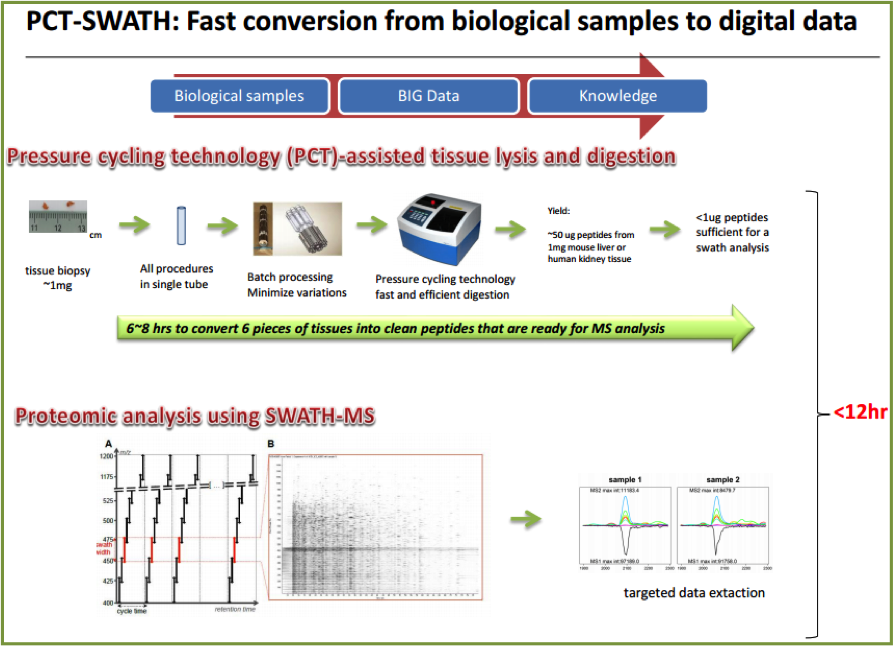
This PCT-dependent method provides high quality mass spectrometry-based proteomic analysis in small needle biopsy samples for the first time, offering potential to vastly improve drug discovery and design programs and diagnostic insights in research and clinical laboratories worldwide.
Needle biopsy tissues are routinely sampled in many hospitals and research laboratories. Methods for high throughput proteomic analysis of needle biopsy tissues are currently not readily available. Typical mass spectrometric-based proteomic experiments require relatively large sample amounts, laborious sample processing that can lead to significant technical variation, and lengthy analysis in the mass spectrometer, all of which excludes the practical application of mass spectrometry analysis on the small needle biopsy samples routinely found in clinical settings.
Needle biopsy tissue samples contain thousands of proteins. The analysis of these proteins is crucial to personalized medicine, as well as to drug discovery and development. In the past, because of the small amount of tissue in the needle biopsy sample and shortcomings in available analytical methods, it was nearly impossible to obtain accurate quantities of 1,000s of proteins expressed in such samples.
The combination of PBIO’s PCT technology with mass spectrometry can accurately quantifies thousands of proteins with a high degree of reproducibility across large sample cohorts, which resulted in significantly improved proteomic data from needle biopsy samples. The PCT-SWATH will greatly enhance proteomic analysis of needle biopsy samples in both clinical and research settings. This in turn should lead to better drug discovery and design, shortened time to discovery, and measurable advances in personalized medicine, especially in the areas of cancer diagnosis and treatment.
The market for the new method is very large and underserved. PBIO plans to focus greater efforts in this area over the coming months. We believe the significantly improved analysis of needle biopsy tissue by the PCT-SWATH, if adopted by the thousands of research and clinical laboratories analyzing needle biopsy tissue, could result in greatly increased sales of PBIO’s PCT product line of instruments and consumables.
PBIO Partners with Powertech to Develop China Market
In October 2014, PBIO announced a three-year, exclusive distribution agreement with Powertech Technology Company Ltd.
Based in Xiamen, China, Powertech is one of China's most recognized and prestigious distributors of analytical instruments and other equipment to the biotechnology, pharmaceutical, agricultural, environmental, food safety, and commercial testing laboratory markets. Powertech offers strong distribution and support network of 20 offices/laboratories, over 60 sales/marketing/service/engineering staff, and multiple sub-dealers throughout China. Powertech's current business partners include Dupont, GE Healthcare, Sartorius, Zeiss, and Agilent.
In recent years, Chin has greatly increased its investment in biotech and pharmaceutical research industry. China will become the largest single country market for PBIO’s PCT products outside the US. In the coming quarters, Powertech will introduce the advantages of PCT to its existing customer base, to the overall Chinese life sciences market, and to other markets that can benefit greatly from PCT as well.
We believe the partnership will accelerate revenue growth drastically in the coming quarters.
First Phase of Commercialization Plan for the Barozyme HT48 Completed
In September, 2014, PBIO announced that it had received and approved all parts required to build nine high throughput Barozyme HT48 instruments and had begun to manufacture the new PCT-based instrument system.
According to management, the first instrument will be ready for shipment by mid-October and that additional Barozyme instruments will be built and released at a rate of about one per week thereafter.
PBIO officially launched its much anticipated High Throughput PCT-based Barozyme HT48 for the enhanced preparation of proteins for mass spectrometry analysis at the American Society for Mass Spectrometry (ASMS) Annual Conference on Mass Spectrometry and Allied Topics held June 15-19, 2014 in Baltimore, Maryland.
The bench-top Barozyme HT48 is a first-in-class, high throughput PCT-based instrument. It is capable of processing up to 48 samples simultaneously using the Company's new and proprietary BaroFlex 8-well processing strips.
The high throughput system is a breakthrough technology for PBIO. PBIO announced in June 2013 that they have achieved and passed proof-of-principle objectives in their multi-year investment into the development of a high throughput (HT) system for their patented pressure cycling technology (PCT) platform. The High Throughput (HT) Barozyme HT48 uses the disposable microwell strips that are universally used by labs worldwide. PBIO’s ability to perform PCT with these strips will allow the Company to directly integrate its PCT instruments with the current automated robotically-driven microwell templates used by thousands of labs worldwide.
This breakthrough also has the potential to significantly accelerate its growth in existing and new PCT-based applications and products, and its ability to attract and form new strategic partnerships.
Many research laboratories working with biological samples worldwide use automated, HT sample preparation and analytical systems in their studies. HT systems generally use sample handling robotics and “multiwell” test plates in standardized formats (e.g., 24, 96, or 384 wells per plate) for processing and testing large numbers of samples simultaneously. The multiwell plate is often processed in an automated fashion, allowing scientists to perform other important tasks while samples are being processed unattended.
Although a number of studies have shown significant advantages of the PCT platform in preparing biomolecules (e.g., DNA, proteins, and lipids) for analysis, the PCT platform continues to be used primarily in small but important research studies. Unlike today’s popular HT multiwell plates that use an automated, unattended approach, the PCT Platform uses individual test tubes that require a lot of manual sample handling. These manual sample handling requirements have prevented the PCT platform from being better accepted by the research community. To that end, PBIO’s new HT multiwell format will substantially enhance and accelerate the acceptance of the PCT platform in the life sciences R&D marketplace. This technology breakthrough is a game-changer for PBIO in our view.
From a financial perspective, we believe the new Barozyme HT48 has the potential to significantly fuel growth and increase revenue for both existing and new PCT-based applications and products, as soon as in the second half of 2014. We also believe that the new Barozyme HT48 high throughput system can greatly facilitate the commencement of new strategic partnerships.
PBIO gave guidance earlier this year to not expect the sale of Barozyme HT48 instruments in 2014. However, based on discussions with existing customers, the Company is changing that guidance. PBIO believes that the evaluation period required by some existing customers will be shorter than first thought, and that one or more existing customers will ask to purchase the instrument shortly after their evaluation concludes, which will positively impact 4Q14 revenue.
Based on the strong financial performance in 1H14, as well as the two new products launch in 1H14 and continued marketing efforts by management, we estimate that revenue will continue to grow in the remainder of 2014.
Specifically, we model product sales will reach $1.61 million in fiscal 2014, an increase of 54% over $1.05 million product sales for fiscal 2013.
We think revenue ramp in 2015 will be driven by sales from both existing and new products (instruments and consumables), from the Company’s expanding distribution network, and from grants currently being reviewed.
PBIO Shares are undervalued
We maintain our Outperform rating on PBIO shares and reiterate our twelve-month price target of $2.00 per share.
Below are the reasons for the call.
PBIO reported record product sales for the first half of 2014, and we expect continued revenue growth in the remainder of 2014 and beyond due to two new products launch and continued marketing efforts from management.
In terms of valuation, we think PBIO shares are undervalued based on the Company’s fundaments. Currently, the Company trades around $0.30 per share with a market cap of $4.8 million based on 15 million outstanding shares. We believe this deeply undervalues the Company based on the current fundamentals we discussed above. We understand that market discounts the value of the Company because the Company has only limited revenue base and has been losing money since its inception. We also understand that the Company has a relatively weak balance sheet, and further financing will be needed. However, when we look at the Company and the industry in which it operates in detail, we realize that PBIO is a company with huge opportunity and one that can grow its revenue and earnings at a tremendous rate in the next few years.
PBIO operates in the rather large, but underserved research services market. The Company has developed a unique and superior pressure cycling technology (PCT) for the preparation of biological laboratory samples. The Company’s PCT platform holds competitive advantages over incumbent technologies in many important aspects related to sample preparation.
Currently, the Company is in the early stage of commercialization of its platform technology. We have realized that sales have not been stellar so far, but this is understandable. Pressure cycling technology is quite new to most customers in the sample preparation market, and the costs for PCT are also higher than those for most existing technologies. Therefore, rollout of the PCT platform will take time. However, once customers become familiar with the new PCT platform, and realize its advantages over existing technologies, uptake of PCT and its consumable products by the industry will increase dramatically in our view.
We are now optimistic about the Company’s prospect. With a rapidly growing market worldwide, combined with its unique technology and broad range of product offering, the Company is well positioned to boost its top line and bottom line in the coming years. According to our long term financial model, the Company’s revenue will grow at a compound annual growth rate (CAGR) of 66% in the next five fiscal years from 2015 to 2019. PBIO will become profitable in fiscal 2017 with an EPS of $0.01.
We think PBIO is more like a development stage biotech company. Our price target of $2.00 per share values the company at $30 million in market cap based on 15 million outstanding shares. This valuation is still very conservative in our view. As long as the Company can execute its growth strategy correctly, we believe this goal is achievable. Patient investors will get rewarded.
READ THE LATEST FULL RESEARCH REPORT HERE
SUBSCRIBE TO ZACKS SMALL CAP RESEARCH to receive our articles and reports emailed directly to you each morning. Please visit our website for additional information on Zacks SCR and to view our disclaimer.