By Brian Marckx, CFA
NASDAQ:CBMX
Financial Results In-Line…
CombiMatrix Corp (NASDAQ:CBMX) announced financial results for the third quarter ending September 30th on November 4th. Revenue was in-line with our estimate (which we upwardly revised following the company's 10/7/14 preannouncement) while operating expenses came in slightly better than our numbers. The beat on operating expense is despite this continuing to be artificially high due to significant litigation expense, which was almost $750k in Q3 (although down from almost $900k in Q2).
Importantly the fundamentals of the company remain very strong, with prenatal microarray testing, total microarray testing and non-microarray testing volumes posting 71%, 24% and 84% yoy growth, respectively. In aggregate, the number of total billable tests increased 36% from the same period in 2012 to 1,959. The 925 prenatal microarray tests, 539 non-microarray tests and 1,959 total tests billed in Q3 were all-time records (as was testing revenue).
The impressive performance was not confined just to testing volumes and revenue, however, as CBMX also realized relatively strong pricing in Q3 with price per microarray test coming in at $1,294, up from an average of $1,278 in 2013 and $1,252 through the first six months of 2014. Indications are that pricing may be firming up, from both out-of-pocket payers and third-party reimbursement. This would be a meaningful and positive development as pricing had experienced some moderate softening over the recent past.
Total revenue was $2.06M including $2.01M from diagnostic testing services, compared to our $2.00M and $1.96M respective estimates. Q3 marked the fifth consecutive quarter where testing services revenue set a new all-time record. Testing services revenue increased 37% yoy and 6% sequentially.
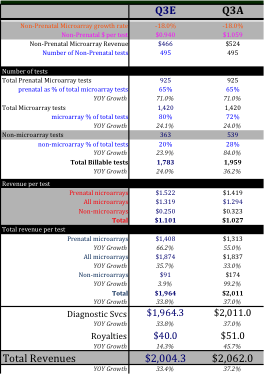
Gross margin continues to benefit from improved test processing efficiencies. Service margin at 43.9% was well-improved from 41.1% in the year-earlier period and up from 43.1% for the full year 2013. Service margin benefitted from lower test processing costs from the company's recent switch to an Illumina platform as well as much higher total revenue per test ($1,027 vs. $1,021 in Q3 2013 and $1,009 in 2013).
Operating expenses were $3.4M, meaningfully better than our $3.8M estimate. Included in operating expense was $746k in litigation-related expense. Excluding litigation-related expenses, operating expense was about $2.7M, flat from Q2. Relative to the year-earlier period, while opex excluding litigation expense was up on an absolute basis (opex was $2.0M in Q3 2013), it fell as a percentage of revenue (129% vs 133%). The latter highlights improvement in operating leverage despite the additional expense related to growth of the sales force and investments made in the company's billing and reimbursement departments over the last few quarters.
As we noted in a prior update, these investments are paying significant dividends via revenue growth, increasing operating leverage, record cash collections, increasing reimbursement and a growing list of managed care contracts. In addition, these investments have facilitated the company's strategic focus on ramping growth of their prenatal microarray platform, which commands the highest revenue per test among the company's offerings and also holds the most potential for outsized long-term growth. Prenatal microarray testing now accounts for 47% of all billable tests (and 65% of total testing revenue), up from 38% (58% of total testing revenue) in Q3 2013 and 36% (57% of total testing revenue) for all of 2013.
Net loss and EPS were $2.5M and ($0.23), compared to our $2.9M and ($0.26) estimates. We have made no meaningful changes to our model following Q3 results. We are maintaining our Outperform rating and $3.50/share price target. See below for free access to our full report on CBMX.
Add'l Study Data Supports CMA's Superiority Over Standard Genetic Testing…
CBMX presented new study data at the American Society of Human Genetics Annual Meeting in October which provides additional support of the superiority of CMA as compared to standard prenatal genetic testing. The study included 3,408 samples from both fresh tissue (n = 2,712) and tissue preserved (n = 564) with formalin and embedded paraffin (FFPE) which were analyzed by three CMA platforms; BAC-aCGH, oglio-aCGH and SNP array. SNP, one of the platforms that CBMX utilizes, demonstrated the highest abnormality detection rate at 53.8%.
CMA analysis provided a successful result in 86.5% (2,345/2,712) of the fresh samples and 87.2% (492/564) of the preserved samples. This relatively high success rate is similar to other studies which have shown CMA provides a successful result between 87% and 98% of the time while karyotyping, the standard products of conception testing method, produces a successful result only about 60% - 70% of the time.
The lower success rate of karyotyping is largely due to the need to culture the cells (which is not required with CMA) for a period prior to analysis, during which time the cells may die. This "culture failure" can occur in as many as 20% - 55% of cases, making karyotyping much less reliable than CMA given that the latter can analyze non-living tissue.
READ THE LATEST FULL RESEARCH REPORT HERE
SUBSCRIBE TO ZACKS SMALL CAP RESEARCH to receive our articles and reports emailed directly to you each morning. Please visit our website for additional information on Zacks SCR and to view our disclaimer.