By Grant Zeng, CFA
OBB:SNGX
On November 10, Soligenix (OBB:SNGX) reported financial results for the third quarter ended September 30, 2014.
Total revenues for 3Q14 were $2.8 million, compared to $0.3 million for 3Q13. The increase in revenue in 3Q14 was primarily related to contracts with the US Department of Health and Human Service's Biomedical Advanced Research and Development Authority (BARDA) and the National Institute of Allergy and Infectious Diseases (NIAID) in support of OrbeShield™ development in the treatment of gastrointestinal acute radiation syndrome (GI ARS).
R&D expenses were $5.1 million for 3Q14, compared to $1.2 million for 3Q13. The increase of $3.9 million was attributable to the acquisition of SGX301 from Hy BioPharma.
G&A expenses were $0.7 million in 3Q14, compared to $0.7 million for 3Q13.
Net loss for 3Q14 was $4.3 million, or $(0.21) per share, as compared to $6.6 million, or $(0.34) per share for 3Q13.
As of September 30, 2014, Soligenix had cash of $4.2 million.
In November 2013, Soligenix signed a stock purchase agreement with Lincoln Park Capital Fund, LLC (LPC) providing an initial investment in Soligenix of $600,000 and the availability of additional periodic investments up to $10.0 million over a 36 month term. At its sole discretion, Soligenix has the right to sell to LPC up to an additional $10.0 million of its common stock. With this new flexible financing vehicle, Soligenix should be able to focus on advancing its clinical programs.
Management remains aggressive in the pursuit of government grants and contracts across its entire pipeline as a way to secure non-dilutive funding to support multiple development programs, while effectively managing its cash position.
As a result, Soligenix has been rewarded multiple contracts from government worth up to $57 million for program development. These rewards not only boost the company’s balance sheet, but also validate its technology and clinical programs.
Update on SGX301
Background
In early September 2014, Soligenix entered into an asset purchase agreement with Hy Biopharma, Inc. Pursuant to the agreement, Soligenix acquired a novel orphan drug candidate, known as SGX301 (synthetic hypericin) for the treatment of cutaneous T-cell lymphoma (CTCL). As part of the acquisition, Soligenix acquired all rights for synthetic hypericin, including intellectual property, and preclinical and clinical data.
In addition to SGX301, the acquired technology package also includes preclinical and clinical data supporting other potential indications for hypericin photodynamic therapy, such as psoriasis. Psoriasis is an autoimmune inflammatory disease that is similarly characterized by cutaneous accumulation of T-cell lymphocytes but without cancerous transformation.
The total purchase price including all milestones is $14.025 million, of which approximately 2% is payable in cash and approximately 98% is payable in restricted securities of the Company, and the assumption of certain liabilities of Hy Biopharma related to the hypericin assets.
Over the years, Hy BioPharma has developed a novel topical photodynamic therapy using a synthetic hypericin (a powerful photosensitizer) and safe, visible light to treat early-stage cutaneous T-cell lymphoma (CTCL) and mild to moderate psoriasis. CTCL and psoriasis have a common link of malfunctioning T-cells. CTCL is a type of non-Hodgkin's lymphoma (NHL) caused by a T-cell mutation, whereas psoriasis is caused by overactive T-cells that attack healthy skin cells.
In hypericin photodynamic therapy, fluorescent light (not cancer-causing ultraviolet radiation) energizes topically applied hypericin, thereby producing singlet oxygen molecules that kill malignant T-cells (apoptosis) in CTCL. Hypericin photodynamic therapy is selective for killing the malignant T-cells since the drug is applied directly onto the affected skin sites without exposing the normal skin cells to the drug. Only the area where hypericin has been applied to the skin will be directly affected by the therapy. Thus, hypericin photodynamic therapy is focused and selective to malignant T-cells.
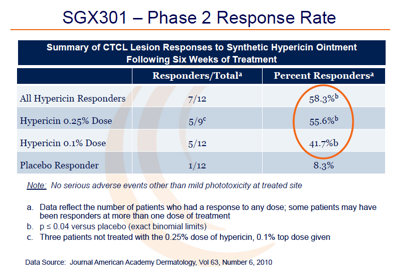
Hy Biopharma conducted both Phase I and Phase II studies of hypericin. Topical hypericin was safe and well tolerated in a Phase I clinical study in healthy volunteers. In a Phase II, placebo-controlled, clinical study in CTCL patients, the drug was safe and well tolerated, with 58.3% of the CTCL patients responding to topical hypericin treatment compared to only 8.3% receiving placebo (p < 0.04).
A Medical Advisory Board formed for SGX301
On November 17, 2014, Soligenix announced the formation of a Medical Advisory Board (MAB) to provide medical/clinical strategic guidance to the Company with regard to the Phase III clinical development of SGX301.
The MAB is comprised of dermatologic oncology thought leaders, such as Alain Rook, a professor of dermatology at UPenn School of Medicine, Gary Wood, chair and professor of dermatology at University of Wisconsin. All members have extensive experience in CTCL. The MAB will play an important advisory role in the conduct of the upcoming Phase III pivotal clinical study as well as in the design of subsequent clinical studies (in other indications, e.g., psoriasis) and associated regulatory interactions with health authorities. The MAB will provide feedback, input and guidance on clinical strategies and their implementation as well as on other critical issues, such as health economics and reimbursement to assist Soligenix in meeting the needs of the CTCL patient population.
Phase III trial will be initiated in 1H15
Based on positive data from Phase I and Phase II studies, Soligenix has reached an agreement with the FDA on the design of a pivotal, Phase III clinical trial evaluating SGX301 for the treatment of cutaneous T-cell lymphoma (CTCL).
Soligenix plans to initiate the Phase III trial in 1H15 with primary data available in 2H16.
· The upcoming Phase III protocol will be a highly powered, double-blind, randomized, placebo-controlled, multicenter trial;
· Will seek to enroll approximately 120 patients;
· The trial will consist of three treatment cycles, each of 8 weeks duration;
· Treatments will be administered twice weekly for the first 6 weeks and treatment response will be determined at the end of Week 8;
· In the first treatment cycle, approximately 80 patients will receive SGX301 and 40 will receive placebo treatment of their index lesions. In the second cycle, all patients will receive SGX301 treatment of their index lesions and in the third (open-label) cycle all patients will receive SGX301 treatment of all their lesions;
· Subjects will be followed for an additional 6 months after the completion of treatment;
· The primary clinical efficacy endpoint is treatment response assessed using the CAILS (Composite Assessment of Index Lesion Severity) score evaluating the three worst index lesions at the end of Cycle 1 (Week 8).
We estimate SGX301 could be approved by the FDA in 2H17 if data from the Phase III trial are positive.
SGX301 has received orphan drug designation by the FDA for the treatment of CTCL, which provides for 7 years of market exclusivity upon approval in the US.
CTCL is a class of non-Hodgkin's lymphoma (NHL). It is estimated that CTCL affects over 20,000 individuals in the US, with approximately 2,800 new cases seen annually.
With CTCL mortality is related to stage of disease, with median survival generally ranging from about 12 years in the early stages to only 2.5 years when the disease has advanced. There is currently no cure for CTCL.
We welcome the acquisition of late stage candidate SGX301, which, we think, will have positive impact for the company’s operations and valuation. Soligenix becomes a late development stage biotech company through the acquisition of SGX301, which is highly synergistic with the company’s existing development pipeline.
SGX301 may also be developed for other indications such as psoriasis, which further expands the company’s pipeline. Psoriasis is a common autoimmune disease that affects over 7 million adults in the US. Photodynamic therapy is a frequently used initial therapy for psoriasis, despite the need for ultraviolet light exposure and its attendant risk of melanoma and non-melanoma skin cancer.
READ THE LATEST FULL RESEARCH REPORT HERE
SUBSCRIBE TO ZACKS SMALL CAP RESEARCH to receive our articles and reports emailed directly to you each morning. Please visit our website for additional information on Zacks SCR and to view our disclaimer.