By Grant Zeng, CFA
OBB:SNGX
Soligenix Enters Late Development Stage by Acquisition of Phase III-Ready Clinical Program
On September 3, 2014, Soligenix (OBB:SNGX) entered into an asset purchase agreement with Hy Biopharma, Inc. Pursuant to the agreement, Soligenix acquired a novel orphan drug candidate, known as SGX301 (synthetic hypericin) for the treatment of cutaneous T-cell lymphoma (CTCL). As part of the acquisition, Soligenix acquired all rights for synthetic hypericin, including intellectual property, and preclinical and clinical data.
In addition to SGX301, the acquired technology package also includes preclinical and clinical data supporting other potential indications for hypericin photodynamic therapy, such as psoriasis. Psoriasis is an autoimmune inflammatory disease that is similarly characterized by cutaneous accumulation of T-cell lymphocytes but without cancerous transformation.
The total purchase price including all milestones is $14.025 million, of which approximately 2% is payable in cash and approximately 98% is payable in restricted securities of the Company, and the assumption of certain liabilities of Hy Biopharma related to the hypericin assets.
Over the years, Hy BioPharma has developed a novel topical photodynamic therapy using a synthetic hypericin (a powerful photosensitizer) and safe, visible light to treat early-stage cutaneous T-cell lymphoma (CTCL) and mild to moderate psoriasis. CTCL and psoriasis have a common link of malfunctioning T-cells. CTCL is a type of non-Hodgkin's lymphoma (NHL) caused by a T-cell mutation, whereas psoriasis is caused by overactive T-cells that attack healthy skin cells.
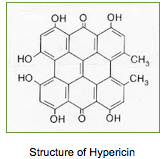
In hypericin photodynamic therapy, fluorescent light (not cancer-causing ultraviolet radiation) energizes topically applied hypericin, thereby producing singlet oxygen molecules that kill malignant T-cells (apoptosis) in CTCL. Hypericin photodynamic therapy is selective for killing the malignant T-cells since the drug is applied directly onto the affected skin sites without exposing the normal skin cells to the drug. Only the area where hypericin has been applied to the skin will be directly affected by the therapy. Thus, hypericin photodynamic therapy is focused and selective to malignant T-cells.
Hy Biopharma conducted both Phase I and Phase II studies of hypericin. Topical hypericin was safe and well tolerated in a Phase I clinical study in healthy volunteers. In a Phase II, placebo-controlled, clinical study in CTCL patients, the drug was safe and well tolerated, with 58.3% of the CTCL patients responding to topical hypericin treatment compared to only 8.3% receiving placebo (p < 0.04).
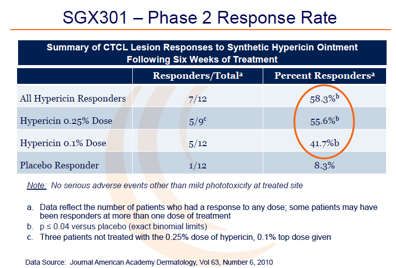
Based on positive data from Phase I and Phase II studies, Soligenix has reached an agreement with the FDA on the design of a pivotal, Phase III clinical trial evaluating SGX301 for the treatment of cutaneous T-cell lymphoma (CTCL).
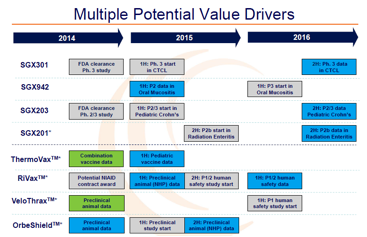
Soligenix plans to initiate the Phase III trial in 1H15 with primary data available in 2H16.
· The upcoming Phase III protocol will be a highly powered, double-blind, randomized, placebo-controlled, multicenter trial;
· Will seek to enroll approximately 120 patients;
· The trial will consist of three treatment cycles, each of 8 weeks duration;
· Treatments will be administered twice weekly for the first 6 weeks and treatment response will be determined at the end of Week 8;
· In the first treatment cycle, approximately 80 patients will receive SGX301 and 40 will receive placebo treatment of their index lesions. In the second cycle, all patients will receive SGX301 treatment of their index lesions and in the third (open-label) cycle all patients will receive SGX301 treatment of all their lesions;
· Subjects will be followed for an additional 6 months after the completion of treatment;
· The primary clinical efficacy endpoint is treatment response assessed using the CAILS (Composite Assessment of Index Lesion Severity) score evaluating the three worst index lesions at the end of Cycle 1 (Week 8).
We estimate SGX301 could be approved by the FDA in 2H17 if data from the Phase III trial are positive.
SGX301 has received orphan drug designation by the FDA for the treatment of CTCL, which provides for 7 years of market exclusivity upon approval in the US.
CTCL is a class of non-Hodgkin's lymphoma (NHL). It is estimated that CTCL affects over 20,000 individuals in the US, with approximately 2,800 new cases seen annually.
With CTCL mortality is related to stage of disease, with median survival generally ranging from about 12 years in the early stages to only 2.5 years when the disease has advanced. There is currently no cure for CTCL.
We welcome the acquisition of late stage candidate SGX301, which, we think, will have positive impact for the company’s operations and valuation. Soligenix becomes a late development stage biotech company through the acquisition of SGX301, which is highly synergistic with the company’s existing development pipeline.
SGX301 may also be developed for other indications such as psoriasis, which further expands the company’s pipeline. Psoriasis is a common autoimmune disease that affects over 7 million adults in the US. Photodynamic therapy is a frequently used initial therapy for psoriasis, despite the need for ultraviolet light exposure and its attendant risk of melanoma and non-melanoma skin cancer.
Another Important Contract for Soligenix from NIAID
On September 19, 2014, Soligenix announced that it has been awarded a contract valued at up to $24.7 million by the National Institute of Allergy and Infectious Diseases (NIAID), an division of the US Department of Health and Human Service's National Institutes of Health (NIH).
The main goal of the contract is to help advance the development of Soligenix's ThermoVax™, combined with the company's ricin toxin vaccine, Rivax™, as a medical countermeasure (MCM) to prevent the effects of ricin exposure.
According to the company’s news release, the contract contains a 16 month base period. During this base period, $5.8 million will be provided to fund the development of the technology and the vaccine. The 16-month base period will be followed by several contract options that would extend the contract award for up to six years. If all contract options are exercised, the total award will support the preclinical, manufacturing and clinical development activities.
This contract is the third contract Soligenix received from the federal government. With this new contract award, the company now has up to $57 million in NIAID and BARDA funding to advance the biodefense business segment.
We think this highly competitive NIAID contract not only boosts the company’s balance sheet via non-dilutive financing, but also validates the company’s thermostabilization vaccine technology.
Positive Survival Results with Heat Stable Ricin Toxin Vaccine
On September 2, 2014, Soligenix announced promising preliminary results from a preclinical study with its ricin toxin vaccine RiVax™, in a non-human primate (NHP) lethal aerosol exposure model. The study demonstrated that NHPs vaccinated with RiVax™ were completely protected against a lethal aerosol of ricin toxin with a highly significant survival benefit (p<0.002).
RiVax™ is manufactured with the Company’s thermostabilization platform technology ThermoVax™, which provides for stabilized, lyophilized (freeze-dried) subunit vaccines that are resistant to exposure to heat, avoiding refrigeration during storage and distribution.
In this pilot study, the ability of the stabilized RiVax™ vaccine to protect against an aerosolized form of ricin toxin was evaluated. Animals were exposed to an aerosol of ricin toxin 3-5 times the amount that is known to result in death of untreated animals. In the case of vaccinated NHPs, the vaccine regimen was safe and well-tolerated, with all of the animals developing antibodies in their sera that neutralized the activity of ricin toxin. More importantly, all of the NHPs in the RiVax™-vaccinated treatment group survived when exposed to the respiratory aerosol of ricin toxin, with no apparent signs of gross lung damage. Conversely, all NHPs in the unvaccinated treatment group died within approximately 36 hours of exposure to aerosolized ricin while developing severe lung damage, including hemorrhaging.
This particular study is a critical step along the path of establishing efficacy under the FDA 'animal rule' which dictates that efficacy in animals must be ascertained in cases where a drug or vaccine cannot be ethically tested for efficacy in humans.
Soligenix plans to further conduct human safety and immunogenicity trials along with advanced manufacturing of RiVax.
The National Institute of Allergy and Infectious Diseases (NIAID) awarded grants to Soligenix for the development of the vaccine for potential counter terrorism measures. Currently, there are no approved methods to prevent the toxic effects of ricin poisoning which results in tissue necrosis, organ damage and death within days of exposure. If subsequent studies are successful, RiVaxTM could be added to the US Strategic National Stockpile and potentially dispensed if ricin is used as a biological weapon in a terrorist attack.
Soligenix Advances Development of a Heat Stable Rapidly Acting Anthrax Vaccine
On August 7, 2014, Soligenix announced results demonstrating the improved immunogenicity and rapid action of its anthrax vaccine, VeloThrax™.
VeloThrax™ is Soligenix’s proprietary vaccine based on a recombinant Protective Antigen (rPA) derivative intended for use against anthrax. Soligenix licensed VeloThrax™ (also known as DNI for dominant negative inhibitor) from Harvard College for a vaccine directed at the prevention of anthrax infection of humans.
Recent developments in the VeloThrax™ formulation have resulted in immune responses indicative of protection after no more than two administrations of the vaccine in a shortened (less than one month) vaccination regimen, in an animal model. These results are indicative of a vaccine that can be given to humans in an abbreviated regimen, compared to the current vaccination that requires up to five administrations over a period of 18 months for full protective immunity in humans.
A rapidly acting form of VeloThrax™ has been developed by combining Soligenix’s proprietary vaccine thermostabilization platform technology, ThermoVax™, and a potent adjuvant compound to yield a vaccine that is stable to high temperatures and induces neutralizing antibodies in an animal model. The enhanced DNI vaccine was formulated with a synthetic immunostimulatory adjuvant that activates toll-like receptor 4 (TLR-4), a receptor that is important in recognition of pathogens. The immune responses indicative of protective immunity were observed in fewer doses than the vaccine that did not contain the additional immunostimulatory adjuvant.
The enhanced vaccine was also stable at 40 degrees Celsius (104 degrees Fahrenheit) for at least 3 months, indicating that the synthetic adjuvant component and the DNI antigen component were both stabilized. Furthermore, even when VeloThrax™ was stored at 40 degrees Celsius for up to 3 months prior to administration, there was no evident loss of the ability to induce antibodies that neutralize anthrax toxin.
We believe VeloThrax™ provides a distinct advantage over other anthrax vaccine technologies currently in development. Soligenix plans to continue VeloThrax™ development with the support of government grants and contracts.
Potential government procurement contracts could reach $500 million assuming development efforts are successful for VeloThrax™.
Soligenix Announces Positive Results for Combination Vaccine
On July 9, 2014, Soligenix (SNGX) announced positive results from a preclinical study of the combination of RiVax™ and VeloThrax™. The combination induces protective antibodies for both ricin toxin and anthrax toxin exposure.
Previously, Soligenix has demonstrated that each vaccine, when administered as a single vaccine, induced neutralizing antibodies for each toxin respectively. In this preclinical study, Soligenix further demonstrated that the combination of RiVax and VeloThrax induced neutralizing antibodies that were reactive against both toxins and these antibodies were detected until at least 200 days after the immunization regimens. Consequently, the combined vaccination provided protection to exposure to both ricin toxin and anthrax toxin that persisted for at least six months after 2 vaccinations.
This study is sponsored under $9.4 million cooperative grant from the National Institute of Allergy and Infectious Diseases (NIAID). The results suggest that long-term immunity upon simultaneous vaccination can be achieved. This is important because both vaccines are developed for military usage and emergency first responders.
Soligenix plans to develop the combination vaccine using the company’s proprietary ThermoVax™ platform for stabilizing vaccines for stockpiling and for distribution of vaccines outside of normal cold chain requirements.
NIDCR SBIR Grant Supporting Phase II Clinical Trial of SGX942
In April 2014, Soligenix was awarded by the National Institute of Dental and Craniofacial Research (NIDCR) a Small Business Innovation Research (SBIR) grant to support the conduct of the Company’s Phase II, randomized, double-blind, placebo-controlled study evaluating SGX942 as a treatment for oral mucositis in patients undergoing chemoradiation therapy for head and neck cancer.
In December 2013, Soligenix initiated the Phase II, randomized, double-blind, placebo-controlled study. This Phase II study is a multicenter trial focused on patients with tumors of the mouth and oropharynx who often experience debilitating oral mucositis as a consequence of tumor treatment with intensity modulated radiation and chemotherapy. The primary efficacy will be assessed on the basis of the incidence and duration of both ulcerative and severe oral mucositis throughout the course of radiation treatment. Other key efficacy measures will assess patient reported outcomes, pharmacoeconomic parameters such as hospitalization and radiation-associated side effects including mouth stiffness (trismus) and dryness (xerostomia).
SGX942 is a fully synthetic, 5-amino acid peptide with high aqueous solubility and stability. Extensive in vivo preclinical studies have shown that SGX942 reduces tissue damage associated with chemotherapy, radiation, trauma and inflammation. Although SGX942 is not directly antimicrobial, it accelerates pathogen clearance and increases host survival in a broad spectrum of bacterial infections including Gram positive and negative bacteria, and both drug sensitive and resistant strains, by directly targeting the host innate immune system.
Soligenix has completed a double-blind, placebo-controlled Phase I clinical trial of SGX942 in 84 healthy volunteers with both single ascending dose and multiple ascending dose components. SGX942 showed a strong safety profile when administered IV over 7 days and was consistent with safety results seen in pre-clinical studies. Drug clearance in humans is rapid and similar to results seen in pre-clinical studies.
Results from the Phase II trial are expected to be available in 1H15.
The receipt of this grant as well as other grants not only boosts the Company’s balance sheet in a non-dilutive way, but further validates the potential of its development programs.
Two More Phase II Trials Will Be Initiated
SGX203 for children’s Crohn’s disease
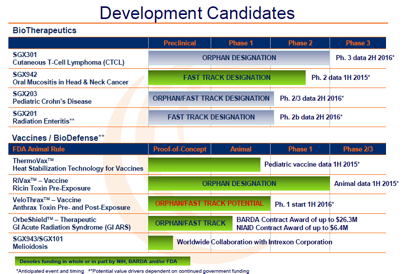
Soligenix plans to start Phase II/III trial of SGX203 (oral beclomethasone 17,21-dipropionate or oral BDP) for the treatment of pediatric Crohn's disease in 1H2015. Primary endpoint data are expected in 2H2016.
The Company has enrolled and treated all patients in the Phase I study, which enrolled 24 subjects between the ages of 18-22, with all assessments completed in May 2013. Preliminary PK results indicate that the PK profile in this population is consistent with the profile established in previous studies in a broader population and supports a convenient twice a day dosing regimen. SGX203 administration (6 mg BDP twice daily over 7 days) was found to be safe and well-tolerated.
The PK data generated from the Phase I study will be used to refine the PK model previously established with Dr. Jeffrey S. Barrett, PhD, FCP, from The Children's Hospital of Philadelphia. The refined model will provide the justification for limited PK sampling in the planned Phase II/III pediatric clinical study and will help inform the dose selection for the Phase III component of the study.
There is currently no cure for Crohn's disease, and there is no one treatment that works for everyone. Drug therapies usually include anti-inflammatory drugs, immune system suppressors and antibiotics. There are currently no FDA approved corticosteroid therapies for pediatric Crohn's disease. 80% of patients with Crohn’s disease are treated with steroids off-label as first-line therapy, which may suppress adrenal function and result in growth retardation. Remicade is the only approved product in pediatric Crohn’s disease in the US, which is used in 30% of patients within first year of diagnosis. However, Remicade carries a black box warning for potential malignancy (T cell lymphoma). Two biologics, Cimzia and Tysabri and one corticosteroid Entocort (budesonide) are on the market to treat Crohn’s disease in adult patients, and are currently in trials in pediatric patients.
SGX203 is designed to block inflammation of Crohn’s disease throughout the GI tract and is positioned as a corticosteroid option with less toxicity than the current standard systemic steroid therapy – prednisone.
SGX203 has received Fast Track and Orphan Drug designations from the US FDA for the treatment of pediatric Crohn's disease. We believe SGX203 has the potential to meet an important medical need in children with this serious illness.
SGX201 for Preventing Acute Radiation Enteritis
SGX201 is a delayed-release formulation of BDP specifically designed for oral use and is designed to block inflammatory component of radiation enteritis in GI tract of cancer patients receiving pelvic radiation therapy.
Soligenix completed a 16-subject Phase I/II clinical trial testing SGX201 in prevention of acute radiation enteritis. Patients with rectal cancer scheduled to undergo concurrent radiation and chemotherapy prior to surgery were randomized to one of four dose groups. SGX201 is safe and well tolerated in these subjects.
The Company plans to initiate a Phase II randomized, double-blind, placebo-controlled trial in 2015. Data are expected in 2H2016, assuming continued financial support from NIH. The Company has received Fast Track designation from the FDA for SGX201 for radiation enteritis. It’s possible for continued government funding for the Phase IIa trial.
External radiation therapy is used to treat most types of cancer. During delivery of treatment, some level of radiation will also be delivered to healthy tissue, including the bowel, leading to acute and chronic toxicities. The large and small bowels are very sensitive to radiation and the larger the dose of radiation the greater the damage to normal bowel tissue. Radiation enteritis is a condition in which the lining of the bowel becomes swollen and inflamed during or after radiation therapy to the abdomen, pelvis, or rectum. Most tumors in the abdomen and pelvis need large doses, and almost all patients receiving radiation to the abdomen, pelvis, or rectum will show signs of acute enteritis.
Patients with acute enteritis may have nausea, vomiting, abdominal pain and bleeding, among other symptoms. Some patients may develop dehydration and require hospitalization.
Symptoms will usually resolve within 2-6 weeks after therapy has ceased. Radiation enteritis is often not a self-limited illness, as over 80% of patients who receive abdominal radiation therapy complain of a persistent change in bowel habits. Moreover, acute radiation injury increases the risk of development of chronic radiation enteropathy, and overall 5% to 15% of the patients who receive abdominal or pelvic irradiation will develop chronic radiation enteritis.
Based upon published studies and reports, there are over 100,000 patients annually in the U.S. and over 200,000 patients worldwide, who receive abdominal or pelvic external beam radiation treatment for cancer, and these patients are at risk of developing acute and chronic radiation enteritis. Currently there are no approved therapies for this indication. Based on current preclinical and Phase I/II clinical data, SGX201 has the potential to make a meaningful difference in this indication.
Conservative Cash Burn Coupled with Non-dilutive Financing
As of June 30, 2014, the Company's cash position was $5.0 million as compared to $5.9 million at December 31, 2013.
In November 2013, Soligenix signed a stock purchase agreement with Lincoln Park Capital Fund, LLC (LPC) providing an initial investment in Soligenix of $600,000 and the availability of additional periodic investments up to $10.0 million over a 36 month term. At its sole discretion, Soligenix has the right to sell to LPC up to an additional $10.0 million of its common stock, in amounts as described in the agreement.
With this new flexible financing vehicle, Soligenix should be able to focus on advancing its clinical programs.
Management remains aggressive in the pursuit of government grants and contracts across its entire pipeline as a way to secure non-dilutive funding to support multiple development programs, while effectively managing its cash position.
As a result, On August 1, 2014, Soligenix was awarded additional $2.1 million in funding from the National Institute of Allergy and Infectious Diseases (NIAID) to advance the preclinical development of OrbeShieldTM. The 12-month option provides an additional $2.1 million to Soligenix to advance OrbeShield™ as a medical countermeasure (MCM) for the treatment of gastrointestinal acute radiation syndrome (GI ARS). NIAID granted an initial award of $2.1 million to Soligenix on September 18, 2013. The total contract award is valued at up to $6.4 million over three years.
Soligenix’s GI ARS program is supported by contract awards from both the Biomedical Advanced Research Development Authority (BARDA) and NIAID, totaling up to approximately $32 million. In addition to developing oral BDP as a MCM, the company is also pursuing oral BDP as a treatment for GI inflammation in pediatric Crohn’s disease, acute radiation enteritis and chronic Graft-versus-Host disease (cGVHD).
Soligenix Shares Are Undervalued
We maintain an Outperform rating for Soligenix and reiterate our 12-month price target of $4.50 per share.
Soligenix becomes a late development stage biotech company through the acquisition of SGX301, a Phase III candidate for CTLC. Soligenix is focused on cancer/cancer supportive care and GI disorders, two large pharmaceutical markets both in the US and around the world. Soligenix also develops vaccines/oral therapeutics for biodefense.
In addition to SGX301, Soligenix has built a diversified pipeline using three proprietary platform technologies: the SGX942 platform, the oral BDP platform and the ThermoVax platform. We are especially optimistic about its lead drug candidate SGX942 for the treatment of mucositis. SGX942 is currently under a Phase II study. Results will be available in 1H15, which, if positive, would be a significant de-risking event for Soligenix. SGX942 has a new mechanism of action and will command a significant market share of the oral mucositis market if approved in our view.
The Company’s oral BDP has the potential to target multiple GI disorders such as Crohn’s disease, radiation enteritis and GVHD as well as ARS.
Soligenix’s vaccines and biodefense therapeutics are being developed under specific FDA regulatory guidelines called the “Animal Rule.” We think the “Animal Rule” means a lot for Soligenix, because this can accelerate the development of the ricin and anthrax vaccines as well as OrbeShield. Once approved by the FDA, Soligenix will have the opportunity to negotiate a stock-pile contract with the US government. These stock-pile or procurement contracts have been very lucrative for other companies supplying similar drugs to the US government and will provide significant cash flow to Soligenix.
Based on our analysis, we think Soligenix shares are undervalued at current market price. Currently shares of Soligenix are trading at around $2.00 per share, which values the Company at $40 million in market cap based on 20 million outstanding shares. This deeply undervalues Soligenix shares in our view.
Most small biotech companies of development stage are valued from $50 million to $1 billion depending on how advanced the pipeline is and which indications the company is targeting. Soligenix has one Phase III candidate, two Phase II programs, and two more programs will move to Phase II/III study in 2015. Soligenix has multiple catalysts in the next 6 to 12 month or so.
Our price target of $4.50 per share values Soligenix at $90 million in market cap which we think is very conservative.
READ THE LATEST FULL RESEARCH REPORT HERE
SUBSCRIBE TO ZACKS SMALL CAP RESEARCH to receive our articles and reports emailed directly to you each morning. Please visit our website for additional information on Zacks SCR and to view our disclaimer.