By Grant Zeng, CFA
OBB:SNGX
Soligenix Reports 1Q14 Financials
Earlier today (May 12, 2014), Soligenix (OBB:SNGX) announced its financial results for the first quarter ended March 31, 2014.
Revenues for 1Q14 were $0.9 million as compared to $0.9 million for 1Q13. These revenues came from different contracts with the US government in support of OrbeShield™ development in the treatment of gastrointestinal acute radiation syndrome (GI ARS).
Research and development expenses for 1Q14 were $1.0 million, this compared to $0.8 million for the same period in 2013.
General and administrative expenses for 1Q14 were $0.8 million as compared to $0.5 million for the same period in 2013.
The increase of overall operating expenses was mainly due to expenses related to the Company’s Phase II clinical trials with SGX942 in the treatment of oral mucositis and orBec® in the treatment of chronic gastrointestinal Graft-versus-host disease (GI GVHD), as well as from increased headcount and non-cash expenses for stock based compensation from stock options issued to existing and newly hired employees.
Net loss for 1Q14 was $3.3 million, or $(0.17) per share, as compared to $1.1 million, or $(0.10) per share, for the first quarter ended March 31, 2013. Included in the net loss for the quarter ended March 31, 2014 is a non-cash charge of $1.7 million, or $0.09 per share, due to the change in fair value of the warrant liability related to warrants issued in connection with the Company’s June, 2013 registered public offering.
Excluding the $1.7 million non-cash charge, net loss for 1Q14 was $1.6 million, or $0.08 per share.
Cash Burn is Very Conservative
As of March 31, 2014, the Company’s cash position was $5.6 million as compared to $5.9 million at December 31, 2013.
In November 2013, Soligenix signed a stock purchase agreement with Lincoln Park Capital Fund, LLC (LPC) providing an initial investment in Soligenix of $600,000 and the availability of additional periodic investments up to $10.0 million over a 36 month term.
Upon execution of the agreement, the Company received an investment of $600,000 in exchange for the issuance of 285,714 shares of the Company’s common stock to LPC. The per share purchase price of $2.10 was equal to the closing price of the Common Stock on the day prior to the execution of the agreement.
At its sole discretion, Soligenix has the right to sell to LPC up to an additional $10.0 million of its common stock, in amounts as described in the agreement and subject to certain conditions, which include the effectiveness of a registration statement with the U.S. Securities and Exchange Commission covering the sale of the shares that may be issued to LPC. The purchase price of the shares will be based on prevailing market prices of Soligenix’s shares immediately preceding the notice of a sale without any fixed discount. Soligenix controls the timing and amount of any future investment and LPC is obligated to make such purchases, if and when the Company decides in accordance with the stock purchase agreement. Additionally, there are no upper price limit restrictions, negative covenants or any restrictions on the Company’s future financing activities. Soligenix can terminate the agreement at any time without any monetary cost or penalty. LPC has also agreed not to cause or engage in any manner whatsoever, any direct or indirect short selling or hedging of the Company’s shares of common stock.
We think this financing is favorable to Soligenix in the following aspects:
· Soligenix has the ability to raise capital at or near market prices, which will enhance the potential to pursue strategic alliances in a very efficient and opportunistic manner;
· The financing agreement is favorable to and flexible for Soligenix with the company controlling the timing and amount of share sales;
· The flexible financing agreement not only boosts Soligenix’s balance sheet, but importantly validates the company’s technology and clinical programs;
With this new flexible financing vehicle, Soligenix should be able to focus on advancing its clinical programs.
Management remains aggressive in the pursuit of government grants and contracts across its entire pipeline as a way to secure non-dilutive funding to support multiple development programs, while effectively managing its cash position.
NIDCR SBIR Grant Supporting Phase II Clinical Trial of SGX942
In April 2014, Soligenix was awarded by the National Institute of Dental and Craniofacial Research (NIDCR) a Small Business Innovation Research (SBIR) grant to support the conduct of the Company’s Phase II, randomized, double-blind, placebo-controlled study evaluating SGX942 as a treatment for oral mucositis in patients undergoing chemoradiation therapy for head and neck cancer.
In December 2013, Soligenix initiated the Phase II, randomized, double-blind, placebo-controlled study. This Phase II study is a multicenter trial focused on patients with tumors of the mouth and oropharynx who often experience debilitating oral mucositis as a consequence of tumor treatment with intensity modulated radiation and chemotherapy. The primary efficacy will be assessed on the basis of the incidence and duration of both ulcerative and severe oral mucositis throughout the course of radiation treatment. Other key efficacy measures will assess patient reported outcomes, pharmacoeconomic parameters such as hospitalization and radiation-associated side effects including mouth stiffness (trismus) and dryness (xerostomia).
SGX942 is a fully synthetic, 5-amino acid peptide with high aqueous solubility and stability. Extensive in vivo preclinical studies have shown that SGX942 reduces tissue damage associated with chemotherapy, radiation, trauma and inflammation. Although SGX942 is not directly antimicrobial, it accelerates pathogen clearance and increases host survival in a broad spectrum of bacterial infections including Gram positive and negative bacteria, and both drug sensitive and resistant strains, by directly targeting the host innate immune system.
Soligenix has completed a double-blind, placebo-controlled Phase I clinical trial of SGX942 in 84 healthy volunteers with both single ascending dose and multiple ascending dose components. SGX942 showed a strong safety profile when administered IV over 7 days and was consistent with safety results seen in pre-clinical studies. Drug clearance in humans is rapid and similar to results seen in pre-clinical studies.
Results from the Phase II trial are expected to be available in 2H14.
The receipt of this grant as well as other grants not only boosts the Company’s balance sheet in a non-dilutive way, but further validates the potential of its development programs. Within the past twelve months, Soligenix has received contract and grant funding totaling up to approximately $33.0 million.
NIAID Grant Supporting Development of SGX943 for Melioidosis
In February, 2014, Soligenix was awarded by the National Institute of Allergy and Infectious Diseases (NIAID) a Small Business Innovation Research (SBIR) grant to support further preclinical development of SGX943 as a treatment for melioidosis. The award will provide Soligenix with approximately $300,000 over one year to conduct the studies in collaboration with Tulane University.
Melioidosis remains a significant biothreat as well as a major life-threatening endemic disease in Southeast Asia and Northern Australia. Melioidosis is caused by the Gram-negative bacterium Burkholderia pseudomallei (Bps). Current treatment for melioidosis requires long and intensive antibiotic administration and extensive supportive care. In endemic regions, mortality from melioidosis can be as high as 40%. In addition to causing a high rate of endemic disease in Southeast Asian and Northern Australia, Bps is also considered a top five priority in the most recent Public Health Emergency Medical Countermeasure Enterprise (PHEMCE) Strategy document.
|
Country/Region
|
Incidence
|
|
Northeast Thailand
|
21.0 /100,000
|
|
Southwestern (Er-Ren River Basin) Taiwan
|
36/100,000
|
|
Northern Australia
|
19.6 /100,000
|
|
Kimberley region of Western Australia
|
14/100,000
|
|
Singapore
|
1.7/100,000
|
|
Alor Setar, Malaysia
|
16.35/100,000
|
|
India
|
conservative estimate 10/100,000
|
|
China
|
conservative estimate 10/100,000
|
SGX943 is the drug product designation for the active ingredient SGX94 in the treatment of melioidosis. SGX94 is an innate defense regulator (IDR), a new class of short, synthetic peptides that has a novel mechanism of action in that it has simultaneous anti-inflammatory and anti-infective activity. IDRs have no direct antibiotic activity but modulate host responses, increasing survival after infections with a broad range of bacterial Gram-negative and Gram-positive pathogens, as well as accelerating resolution of tissue damage following exposure to a variety of agents including bacterial pathogens, trauma and chemo- and/or radiation-therapy.
SGX943 has been comprehensively evaluated in bacterial infection models and has shown preclinical efficacy with Gram-positive methicillin resistant Staphylococcus aureus (MRSA) as well as with other Gram-negative pathogens. As an innate defense regulator, SGX943 does not have direct antibacterial activity, but rather stimulates the innate immune system to combat infection while simultaneously suppressing inflammation. Thus, SGX943 has the potential to be a novel adjunctive treatment paradigm for antibiotic resistant infections, including melioidosis.
This new grant will support further evaluation of SGX943 in the treatment of melioidosis in preclinical studies. These results will represent a significant step forward in the development of SGX943 as a medical countermeasure for melioidosis.
Soligenix has two distinctive programs for melioidosis now: SGX943 and SGX101.
Soligenix is also developing SGX101 for the treatment of melioidosis through a worldwide exclusive collaboration with Intrexon. Under this collaboration with Intrexon, Soligenix intends to develop and commercialize human monoclonal antibody therapies for new biodefense and infectious disease applications for melioidosis using Intrexon’s advanced human antibody discovery, isolation and production technologies. Under the agreement, Intrexon will provide discovery and development of therapeutic antibody candidates, as well as optimize and expand production of human monoclonal antibodies targeting melioidosis by applying its proprietary platforms and technologies. Soligenix will undertake preclinical and clinical development, regulatory and government interactions, as well as the commercialization of therapeutic products.
We are very pleased to see that Soligenix is advancing its melioidosis programs, especially for the SGX943 program through the government support. The grant from the US government not only boosts the company’s balance sheet in a non-dilutive way, it also further validates the company’s platform technology.
The melioidosis program further expands Soligenix’s biodefense pipeline, which has the potential to qualify for the FDA's tropical disease voucher program sometime in the future.
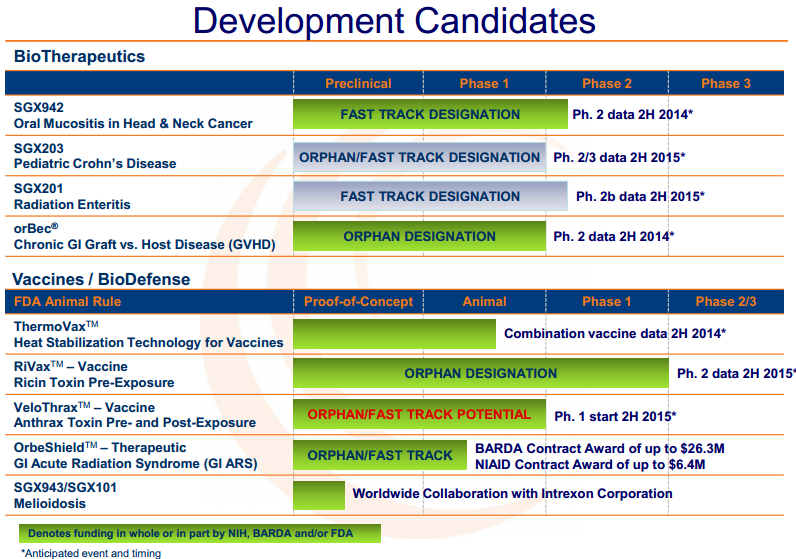
Two More Phase II Trials Will Be Initiated In 2014
SGX203 for children’s Crohn’s disease
Soligenix plans to start Phase II/III trial of SGX203 (oral beclomethasone 17,21-dipropionate or oral BDP) for the treatment of pediatric Crohn's disease in 2H 2014. Primary endpoint data are expected in 2H 2015.
The Company has enrolled and treated all patients in the Phase I study, which enrolled 24 subjects between the ages of 18-22, with all assessments completed in May 2013. Preliminary PK results indicate that the PK profile in this population is consistent with the profile established in previous studies in a broader population and supports a convenient twice a day dosing regimen. SGX203 administration (6 mg BDP twice daily over 7 days) was found to be safe and well-tolerated.
The PK data generated from the Phase I study will be used to refine the PK model previously established with Dr. Jeffrey S. Barrett, PhD, FCP, from The Children's Hospital of Philadelphia. The refined model will provide the justification for limited PK sampling in the planned Phase II/III pediatric clinical study and will help inform the dose selection for the Phase III component of the study.
There is currently no cure for Crohn's disease, and there is no one treatment that works for everyone. Drug therapies usually include anti-inflammatory drugs, immune system suppressors and antibiotics. There are currently no FDA approved corticosteroid therapies for pediatric Crohn's disease. 80% of patients with Crohn’s disease are treated with steroids off-label as first-line therapy, which may suppress adrenal function and result in growth retardation. Remicade is the only approved product in pediatric Crohn’s disease in the US, which is used in 30% of patients within first year of diagnosis. However, Remicade carries a black box warning for potential malignancy (T cell lymphoma). Two biologics, Cimzia and Tysabri and one corticosteroid Entocort (budesonide) are on the market to treat Crohn’s disease in adult patients, and are currently in trials in pediatric patients.
SGX203 is designed to block inflammation of Crohn’s disease throughout the GI tract and is positioned as a corticosteroid option with less toxicity than the current standard systemic steroid therapy – prednisone.
SGX203 has received Fast Track and Orphan Drug designations from the US FDA for the treatment of pediatric Crohn's disease. We believe SGX203 has the potential to meet an important medical need in children with this serious illness.
SGX201 for Preventing Acute Radiation Enteritis
SGX201 is a delayed-release formulation of BDP specifically designed for oral use and is designed to block inflammatory component of radiation enteritis in GI tract of cancer patients receiving pelvic radiation therapy.
Soligenix completed a 16-subject Phase I/II clinical trial testing SGX201 in prevention of acute radiation enteritis. Patients with rectal cancer scheduled to undergo concurrent radiation and chemotherapy prior to surgery were randomized to one of four dose groups. SGX201 is safe and well tolerated in these subjects.
The Company plans to initiate a Phase II randomized, double-blind, placebo-controlled trial in 1H2014. Data are expected in 2H2015, assuming continued financial support from NIH. The Company has received Fast Track designation from the FDA for SGX201 for radiation enteritis. It’s possible for continued government funding for the Phase IIa trial.
External radiation therapy is used to treat most types of cancer. During delivery of treatment, some level of radiation will also be delivered to healthy tissue, including the bowel, leading to acute and chronic toxicities. The large and small bowels are very sensitive to radiation and the larger the dose of radiation the greater the damage to normal bowel tissue. Radiation enteritis is a condition in which the lining of the bowel becomes swollen and inflamed during or after radiation therapy to the abdomen, pelvis, or rectum. Most tumors in the abdomen and pelvis need large doses, and almost all patients receiving radiation to the abdomen, pelvis, or rectum will show signs of acute enteritis.
Patients with acute enteritis may have nausea, vomiting, abdominal pain and bleeding, among other symptoms. Some patients may develop dehydration and require hospitalization.
Symptoms will usually resolve within 2-6 weeks after therapy has ceased. Radiation enteritis is often not a self-limited illness, as over 80% of patients who receive abdominal radiation therapy complain of a persistent change in bowel habits. Moreover, acute radiation injury increases the risk of development of chronic radiation enteropathy, and overall 5% to 15% of the patients who receive abdominal or pelvic irradiation will develop chronic radiation enteritis.
Based upon published studies and reports, there are over 100,000 patients annually in the U.S. and over 200,000 patients worldwide, who receive abdominal or pelvic external beam radiation treatment for cancer, and these patients are at risk of developing acute and chronic radiation enteritis. Currently there are no approved therapies for this indication. Based on current preclinical and Phase I/II clinical data, SGX201 has the potential to make a meaningful difference in this indication.
Valuation Is Very Attractive
We maintain an Outperform rating for Soligenix and reiterate our 12-month price target of $4.50 per share.
Soligenix is a mid-stage development biopharmaceutical company focused on cancer supportive care and GI disorders, two large pharmaceutical markets both in the US and around the world. Soligenix also develops vaccines/oral therapeutics for biodefense.
Soligenix has built a diversified pipeline using three proprietary platform technologies: the SGX942 platform, the oral BDP platform and the ThermoVax platform. We are especially optimistic about its lead drug candidate SGX942 for the treatment of mucositis. SGX942 is currently under a Phase II study. Results will be available in 2H14, which, if positive, would be a significant de-risking event for Soligenix. SGX942 has a new mechanism of action and will command a significant market share of the oral mucositis market if approved in our view.
The Company’s oral BDP has the potential to target multiple GI disorders such as Crohn’s disease, radiation enteritis and GVHD as well as ARS.
Soligenix’s vaccines and biodefense therapeutics are being developed under specific FDA regulatory guidelines called the “Animal Rule.” We think the “Animal Rule” means a lot for Soligenix, because this can accelerate the development of the ricin and anthrax vaccines as well as OrbeShield. Once approved by the FDA, Soligenix will have the opportunity to negotiate a stock-pile contract with the US government. These stock-pile or procurement contracts have been very lucrative for other companies supplying similar drugs to the US government and will provide significant cash flow to Soligenix.
Based on our analysis, we think Soligenix shares are undervalued at current market price. Currently shares of Soligenix are trading at around $1.87 per share, which values the Company at $37 million in market cap based on 19.8 million outstanding shares. This deeply undervalues Soligenix shares in our view.
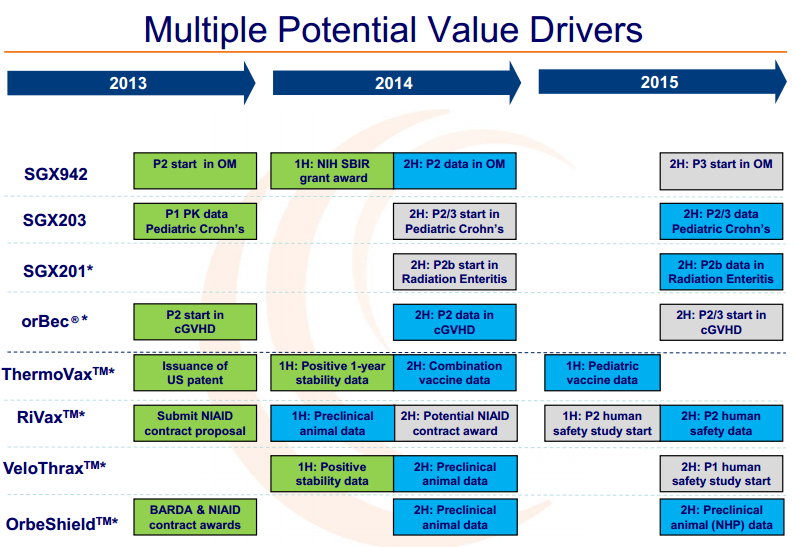
Most small biotech companies of development stage are valued from $50 million to $1 billion depending on how advanced the pipeline is and which indications the company is targeting. Soligenix has two Phase II programs, and two more programs will move to Phase II/III study this year. Soligenix has multiple catalysts in the next 6 to 12 month or so.
Our price target of $4.50 per share values Soligenix at $90 million in market cap which we think is very conservative.
READ THE LATEST FULL RESEARCH REPORT HERE
SUBSCRIBE TO ZACKS SMALL CAP RESEARCH to receive our articles and reports emailed directly to you each morning.
Please visit our website for additional information on Zacks SCR and to view our disclaimer