By Brian Marckx, CFA & Anita Dushyanth
TSX:TLT.V
OTC:TLTFF
What’s New
In the third quarter of 2014, Theralase (TSX:TLT.V) (OTC:TLTFF) had been busy in advancing their cancer therapy technology and in getting ready to launch their therapeutic laser technology, the TLC-2000.
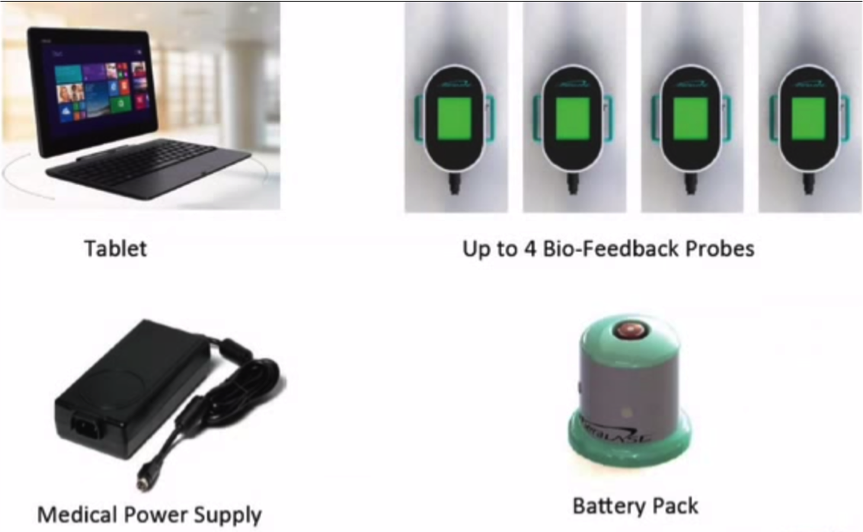
TLC-2000
The TLC-2000 Biofeedback Laser System is a fully automated wireless technology driven by a tablet. Up to 4 laser probes can be run off of a single system. All of the specifications pertaining to the patient are entered on the computer and the system pulls up the corresponding protocol, sends it wirelessly to the probe to commence treatment. The LED screen on the probe displays the treatment time remaining. The instrument offers ease of use as the practitioner only needs to select the patient and the appropriate treatment. There is an option to over-ride the presets on the protocol and set the values manually. We believe that this device with its unique tissue sensing technology has the scientific backing to displace competitive devices.
The TLC-2000 device offers live tracking capability thereby allowing Theralase to track the use of the device. Theralase has also obtained a unique CPT code for reimbursement purposes in the U.S. market. Theralase plans to use third party contractors to manufacture the device as demand increases. Since management wants to maintain quality control over their device, they would supply two key components, the laser diodes and the test software to the manufacturer. The company plans to install the final product software onto the device before launch. As a part of the lease model, Theralase plans to lease the device through a third party contractor. They offer warranty, marketing as well as updates to the software for the lease term. The device is projected to have 75% gross margin. Cost of device, including the stand, power supply and computer, is priced at $7,500 with one probe and $25,000 with all four probes. The lease cost on the single probe system amounts to $150/month (5 year lease, 10% buyout) and $500/month with all four probes. The TLC-2000 is being offered as a trade-in to the customers who already own the TLC-1000 device.
Theralase still maintains an objective of displacing 100 of their legacy device in Canada by end of Q4, 2014. We expect about $500,000 in expenses related to the launch of TLC-2000. The TLC-2000 is expected to be launched in the U.S. by 3Q 2015 and internationally in 2016. Even though management is awaiting marketing approval for the device in Canada (2 weeks) and in the U.S. (1 month) they do not anticipate any hiccups with launch times. Currently the devices are ready for deployment pending approval in Canada.
TLC-3000
In early September 2014, Global News in Canada reported that there has been a problem at manufacturing plants operated by Merck and Sanofi Pasteur that manufactures BCG. This drug has been routinely used to prevent the recurrence of non-invasive bladder cancer (cancer that has not invaded muscle tissue), following surgical removal of the tumor. The drug is believed to work by stimulating the body's natural immune response that helps in destroying the cancer cells within the bladder. The unavailability of drug has serious implications in patients who suffer from bladder cancer as they may have to resort to surgical removal of the bladder.
Theralase has been involved in developing an alternative therapy for treatment of bladder cancer; the Photo Dynamic Therapy ((PDT)). From the recent research completed in November 2014 involving Theralase's patented Photo Dynamic Compounds ((PDC)) technology, it was scientifically proven that the PDCs have the ability to destroy the tumor cells and offer short-term immune-mediated "memory response". Additionally, the PDT can be personalized for cancer patients to destroy their cancer permanently and prevent its recurrence in a single treatment.
At the beginning of September 2014, Theralase dispatched the TLC-3000 multi-wavelength laser system to Princess Margaret Cancer Centre, University Health Network ((UHN)) and to the University of Toledo to test the safety and efficacy of the PDCs in the preclinical environment. Tests to study the optimization between the combinations of wavelength of light used as well as the amount of light delivered to the cancer cells are due to be conducted. This will help determine the specific PDC that is most effective in the treatment for a particular type of cancer. The TLC-3000 laser system is designed to allow the user to adjust both the wavelength of laser light emitted as well as the amount of light energy delivered to a specific set of cancer cells. Beginning 2015, the company hopes to test their TLC-3000 device using various PDCs (patent issued and pending) in treating bladder cancer in humans.
Theralase would require clinical data from trials employing PDT to support a regulatory pre-market submission; need to drive its product adoption initially in the Canadian market and subsequently in international territories, and a medical reimbursement for its product. It is known that a Contract Research Organization ((CRO)) helps shorten the development time of the product thereby speeding the "time-to-market" phase. Many companies in the biotech sector have employed a CRO to alleviate the increase in pressure in terms of cost, time and regulatory hurdles. Theralase has partnered with JSS, a Montreal based CRO to provide expert guidance on the clinical development of TLC-3000 employing PDC technology. JSS is known to have an integrated expertise and approach to cover the entire spectrum of clinical research projects from conception, design, execution, data analysis, and announcing the results. The Medical Device Excise Tax and Obamacare are not yet clearly defined. This in turn puts Theralase on a high alert for ways to reduce costs, increase development efficiency and accelerate the time-to-market. Therefore, it is a strategic move by Theralase to partner with JSS in order to leverage their expertise to bring this technology to market.
Effect of research results on TLT.V’s stocks:
If additional research proves that the PDCs activated by laser light has anti-cancer effects in humans, it would be an opportunity to buy TLT.V stock. Currently, the research is in the animal models. If the experiments are successful and the research progresses towards human trials with positive results, Theralase’s stock might show positive reaction. It might be worthwhile to keep a lookout on the significant developments this company has to offer.
Financial Condition:
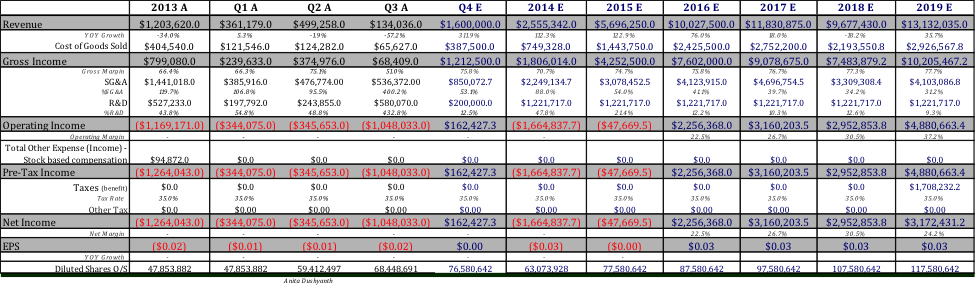
Theralase has shown minimal revenues with increase in selling and marketing expenses representing about 35% of sales, compared to 28% in 2013 for the 9 month period ending September 2014. Management has invested on advertising and travel in anticipation of increase in revenues in subsequent quarters. Administrative expenses increased due to spending on investor relations activities. The expenses related to the commercialization of the TLC-2000 therapeutic laser technology and scientific and preclinical research towards the development of the TLC-3000 anti-cancer technology, amounted to about $1M and were expensed as gross research and development costs. We expect the selling expenses to continue to increase in the future as Theralase expands its base in Canada, the U.S. and international markets. We anticipate a pop in revenue once the TLC-2000 is launched end of Q4 2014. Currently the company has cash of about $2M which should help cover expenses in the near-term.
Updated Financial Model
READ THE LATEST FULL RESEARCH REPORT HERE
SUBSCRIBE TO ZACKS SMALL CAP RESEARCH to receive our articles and reports emailed directly to you each morning. Please visit our website for additional information on Zacks SCR and to view our disclaimer.