By Grant Zeng, CFA
NASDAQ:THLD
Threshold Reports 3Q14 Financials, Current Cash Can Run into 2017
Total revenue for 3Q14 ended September 30 was $3.7 million, compared to $3.2 million for 3Q13. Both revenues were generated form the amortization of the aggregate of $110 million in upfront payment and milestone payments from the Company’s (NASDAQ:THLD) collaborator Merck KGaA.
R&D expenses for 3Q14 were $8.9 million, compared to $6.4 million for the third quarter of 2013. The increase was due primarily to an increase in clinical development expenses and increase in consulting and employee related expenses.
G&A expenses were $2.4 million for 3Q14, compared to $2.1 million for the third quarter of 2013. The increase was due primarily to an increase in consulting and employee related expenses to support business development activities.
Operating loss for 3Q14 was $7.6 million and net loss for the third quarter was $7.7 million, compared to net income of $1.2 million for the third quarter of 2013. Net income for 3Q13 included non-cash income of $6.4 million.
As of September 30, 2014 Threshold held $68.5 million in cash, cash equivalents and marketable securities. The balance sheet is relatively strong in our view.
Threshold has a collaboration agreement with Merck KGaA worth total of $550 million in terms of upfront and milestone payments. To date Threshold has received upfront and milestone payments of $110 million. The Company can earn additional potential milestone payments of up to $440 million, comprised of $100 million in development and regulatory milestones and $340 million in sales-based milestones.
We welcome this non-dilutive financing which benefits all of its shareholders. We estimate current cash balance combined with the potential payment from Merck KGaA could last into 2017 when the Company’s TH-302 could be approved for soft tissue sarcoma.
Target Enrollment for Phase III MAESTRO Study of TH-302 Completed
On Nov 3, 2014, Threshold announced that its global partner Merck KGaA has completed target enrollment of 660 patients in the global Phase III MAESTRO study.
As a reminder, in December 2012, Merck KGaA initiated the global pivotal Phase III MAESTRO clinical trial assessing the efficacy and safety of TH-302 in combination with gemcitabine in patients with previously untreated, locally advanced unresectable or metastatic pancreatic adenocarcinoma. MAESTRO stands for TH-302 in the treatment of MetastAtic or unrESectable pancreaTic adenocaRcinOma.
The MAESTRO trial is a randomized, placebo-controlled, international, multi-center, double-blind Phase III clinical trial of TH-302 plus gemcitabine compared with placebo plus gemcitabine and is expected to enroll 660 patients. The primary efficacy endpoint is overall survival; the secondary endpoints include efficacy measured by progression-free survival, overall response rate and disease control rate, as well as assessments of safety and tolerability, pharmacokinetics and biomarkers. The study is being conducted under an SPA with the FDA. The study design was also discussed with the European Medicines Agency (EMA) during a scientific advice procedure.
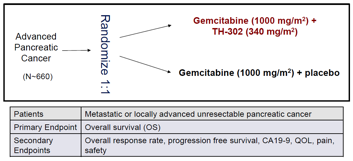
The MAESTRO trial of TH-302 is one of the two pivotal Phase III trials of TH-302. The other one is Phase II trial for previously untreated patients with metastatic or locally advanced unresectable soft tissue sarcoma. Both trials have completed enrollment. Top line data from MAESTRO are expected to be available in 2016.
Phase III TH-302 in Soft Tissue Sarcoma Continues After Interim Analysis
In September, 2014, the Independent Data Monitoring Committee (IDMC) completed the planned interim efficacy and safety analyses of unblinded data for the pivotal Phase III clinical trial of TH-302 in combination with doxorubicin versus doxorubicin alone in patients with locally advanced unresectable or metastatic soft tissue sarcoma (STS).
Based on their analyses, the IDMC recommended that the trial should continue as planned to its natural conclusion. This is in line with our expectations.
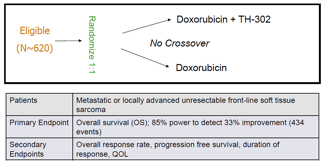
Threshold initiated the pivotal TH-CR-406 trial in partnership with the Sarcoma Alliance for Research through Collaboration (SARC) in September 2011. CR-406 trial is an international, randomized, pivotal Phase III trial enrolling patients with metastatic or locally advanced unresectable soft tissue sarcoma (STS) who have not previously received chemotherapy outside the adjuvant or neoadjuvant setting. The trial is designed to evaluate the efficacy and safety of TH-302 in combination with doxorubicin, compared to doxorubicin alone. The study is under a Special Protocol Assessment (SPA) with the FDA.
The primary endpoint is overall survival; secondary endpoints include efficacy measured by progression-free survival, overall response rate, overall survival at 6 and 12 months, progression free rate at 3 months and progression-free rate at 6 months, duration of response, stable disease or better rate, change in Eastern Cooperative Oncology Group or ECOG and performance status, as well as assessments of safety and tolerability, pharmacokinetics and biomarkers. The FDA and the European Commission have granted TH-302 orphan drug designation for the treatment of soft tissue sarcoma.
In December 2013, Threshold completed the target enrollment of 620 patients. The enrollment achievement triggered a milestone payment of $12.5 million from Merck KGaA.
The Company projected the pre-specified number of events (n=434 deaths) required to trigger the primary efficacy analysis would occur in the latter half of 2015. We expect overall survival data will be available in 1Q16. The FDA approval could be in late 2016 or early 2017.
Sarcomas are a group of aggressive cancers of connective tissues of the body. Currently, there are only limited treatment options for sarcomas. Soft tissue sarcomas are usually treated with surgery, chemotherapy and radiation or in combination of these modalities.
Doxorubicin and ifosfamide are the most commonly used chemotherapeutic agents in patients with advanced soft tissue sarcoma, but response rates are generally low and toxicity can be significant. Doxorubicin is the only approved front line therapy with an overall survival rate of approximately 8 months to 12 months, and an overall response rate of approximately 15% to 25%. The most serious toxicity for doxorubicin is the cumulative cardiotoxicity which usually limits the use of doxorubicin.
According to the American Cancer Society, about 12,020 new soft tissue sarcomas will be diagnosed and about 4,740 patients are expected to die of soft tissue sarcomas in the US in 2014.
New Phase I/II Data on TH-302 in Glioblastoma to be Presented at the 2014 SNO Annual Meeting
New data from an investigator-sponsored Phase I/II trial evaluating the combination of TH-302 and Avastin® (bevacizumab) in patients with bevacizumab-refractory recurrent glioblastoma will be presented in two posters at the 19th Annual Scientific Meeting and Education Day of the Society for Neuro-Oncology (SNO) held in Miami, Florida, from November 13-16, 2014.
Background
Glioblastoma multiforme (GBM), also called glioblastoma, is the most common and most aggressive type of primary brain tumor and accounts for approximately 50% to 60% of all primary brain tumors. It is estimated that 23,130 people were diagnosed with and 14,080 people died of cancer of the brain and other nervous system in 2013 in the US.
Glioblastomas are among the most aggressively malignant human neoplasms. The median survival time from the time of diagnosis without any treatment is usually less than 1 year. Despite multimodality treatment, median survival is about 14.6 months. The overall 5-year survival is less than 10% with the standard of care today.
Chemotherapy (temozolomide) with radiotherapy (RT) is standard care for newly diagnosed glioblastoma. Avastin (bevacizumab, Roche) is approved in the U.S. for progressive disease following prior therapy. After disease progression on bevacizumab, patients may start a subsequent bevacizumab-containing regimen. These patients typically progress in 5 to 8 weeks.
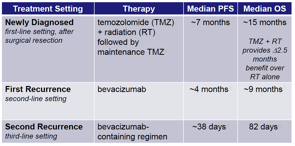
An investigator-sponsored Phase I/II trial (the 4003 trial) to evaluate TH-302 in combination with Avastin® (bevacizumab) in patients with recurrent glioblastoma following bevacizumab failure is ongoing.
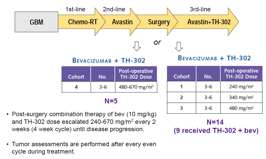
This is a single center, dose-escalation, prospective study with 2:1 randomization to TH-302 single dose of 575 mg/m2 or placebo administered pre-surgery (cohorts 1-3 only), followed by post-surgery combination therapy of BEV at 10 mg/kg and TH-302 dose escalated 240-670 mg/m2 every 2 weeks (4-week cycle) until disease progression. Following the first 5 patients in cohort 3, patients were allowed to proceed directly to TH-302/BEV combination therapy without surgery.
The Updated Data from 2014 SNO
Twenty three patients have been enrolled: 14 randomized in pre-surgery cohorts 1-3 with 9 proceeding to TH-302/BEV after surgery and 9 additional patients proceeding directly to TH-302/BEV.
TH-302 was safe and well tolerated in the patients.
In 18 patients evaluable for response,
· best responses included one complete response (1CR) and three partial responses (3PR) for a response rate of 22%, and nine stable disease (9 SD) assessments for a clinical benefit rate of 72%;
· The median progression-free survival (PFS) was 3.1 months on combination therapy vs. 2.4 months on prior single-agent bevacizumab; the 4-month PFS rate was 26%;
Patients continue to be enrolled in the 670 mg/m2 TH-302 cohort.
We think preliminary data from the SNO presentation are encouraging. The 22% objective responses are rarely seen at this advanced stage of the disease. The median PFS with TH-302 plus bevacizumab was longer than with prior single-agent bevacizumab (3.1 vs 2.4 months). We look forward to updating investors when new data are available.
Immunohistochemistry study showed that CA-IX as a hypoxia marker might be a predictive biomarker for TH-302 and histone γH2AX a response biomarker for TH-302.
Pipeline Expanded with License of Hypoxin
In October, 2014, Threshold licensed Hypoxin from the University of Auckland.
Hypoxin (formerly known as PR610) is a hypoxia-targeted epidermal growth factor receptor (EGFR) tyrosine-kinase inhibitor (TKI). Hypoxin is designed to selectively release a potent, picomolar irreversible inhibitor in hypoxic tumors. The University of Auckland has completed preclinical and Phase I studies. Data suggest that plasma concentrations of Hypoxin that are active in EGFR-dependent tumor xenograft models in mice could be attained in patients with an acceptable therapeutic index. Accordingly, the Company plans to conduct preclinical translational studies to further evaluate the rationale for proceeding with further clinical development of the compound.
Subject to the satisfactory completion of these preclinical studies, the Company expects to initiate a Phase II proof-of-concept study in a subset of molecularly-defined non-small cell lung cancer patients in 1H2015.
The license of Hypoxin is a natural expansion of the Company’s clinical pipeline, which diversify its clinical risks in our view.
Phase II of TH-302 in Combination with Pemetrexed in Advanced NSCLC Initiated
In early July, Threshold initiated of a 440-patient, randomized, double-blind, placebo-controlled Phase II trial of TH-302, in combination with pemetrexed in advanced non-squamous non-small cell lung cancer (NSCLC).
The international Phase II trial will compare the combination of TH-302 and pemetrexed versus the combination of pemetrexed and placebo as second-line therapy for NSCLC. A TH-302 dose of 400 mg/m2 will be utilized in combination with full-dose pemetrexed. The primary endpoint is overall survival. Secondary endpoints include safety and assessment of anti-tumor activity as determined by progression-free survival and objective response rate.
The initiation of the Phase II trial was based on the positive results from a completed Phase I/II study that evaluated TH-302 in combination with full-dose pemetrexed in 18 patients with relapsed/refractory non-squamous NSCLC. In this Phase I/II trial, median progression-free (PFS) survival was 7.0 months and median overall survival was 14.9 months. Of 15 patients evaluable for response, 6 (40%) achieved a partial response including 4 confirmed responses, 6 (40%) achieved stable disease, and 3 (20%) had progressive disease. The most common adverse events following combination therapy of TH-302 and pemetrexed were fatigue, anemia, stomatitis and nausea.
Positive data from the ongoing Phase II trial will support a registrational Phase III trial in patients with advanced non-squamous non-small cell lung cancer.
New Data Will be Presented at ASH Meeting for TH-302 for Multiple Myeloma
Background
In March 2012, Threshold initiated a Phase I/II (the 408 trial) open label clinical trial of TH-302 with relapsed/refractory multiple myeloma.
The study has three parts:
· The first part is designed to establish the maximum tolerated dose of TH-302 in combination with dexamethasone; completed;
· This MTD of TH-302 will be further evaluated in combination with dexamethasone in additional patients in the second part of the study; ongoing;
· Lastly, the combination of TH-302 and dexamethasone with Velcade® (bortezomib, a proteasome inhibitor currently used to treat patients with multiple myeloma) will be investigated, initiated in July 2014.
The dose of TH-302 administered in the dose escalation portion of the study was 240, 340, or 480 mg/m2 given on days 1, 4, 8, and 11 of a 21-day cycle, with 40 mg dexamethasone given on the same days as TH-302.
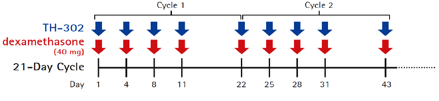
The first part dose escalation of the Phase I/II trial has been completed. 14 patients received therapy. These patients were heavily pretreated having received 3 to 11 prior treatments (median of 6.5) and all having received a regimen containing bortezomib, an immunomodulatory agent lenalidomide and/or thalidomide, and an alkylating agent. Patients received one to 19 cycles (median of 4 cycles) of therapy with TH-302 and dexamethasone. The maximum tolerated dose was determined to be 340 mg/m2 TH-302. The most frequent Grade 3/4 side effects were thrombocytopenia, leukopenia, anemia, and neutropenia.
New Data from the ACSO Presentation
Enrollment of the second part dose-expansion of the study is now complete. The ASCO presentation includes data from 24 patients enrolled at the maximum tolerated dose of TH-302 (340 mg/m2) from dose escalation and dose expansion portions. According to the presentation, patients had received a median of 6.5 systemic therapies prior to enrollment. The patients initiated treatment prior to March 1, 2014 and analyses reflected the clinical database as of May 19, 2014. Of these 24 patients, 23 were evaluable for response, and 17 were treated at the maximum tolerated dose of TH-302 (16 evaluable).
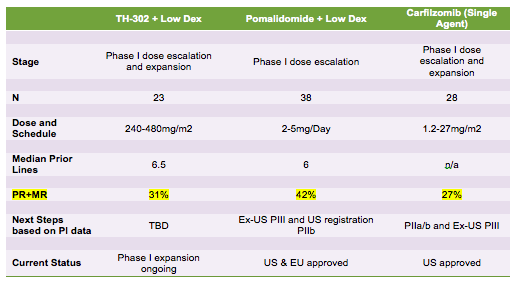
Best responses included four partial responses (4 PR), two minimal responses (2 MR), and 15 stable disease (15 SD) assessments; two patients had progressive disease (2 PD). The clinical benefit rate for patients treated at the maximum tolerated dose of TH-302 (n=16 evaluable patients) was 31% (comprised of 3 PR and 2 MR).
The most common adverse events were nausea and fatigue. The most common Grade 3/4 hematologic adverse events were thrombocytopenia (29%) and leukopenia (25%). Dose-limiting toxicities of Grade 3 stomatitis were reported during the first treatment cycle for the first two patients treated at 480 mg/m2 TH-302.
The clinical benefit rate from TH-302 in combination with low dexamethasone for multiple myeloma is comparable to early data as listed below from two of the most recently approved agents for advanced multiple myeloma, i.e., pomalidomide and carfilzomib.
Threshold initiated the third part of the trial in July 2014, which was 5 month ahead of our estimated schedule.
In the final stage of the trial to evaluate TH-302, bortezomib, and low-dose dexamethasone (TBorD), an initial dose of TH-302 of 240 mg/m2 will be administered twice weekly for the first two weeks of a three-week treatment cycle. The dose of TH-302 will be escalated in cohorts of 3-6 patients. The dose of bortezomib will remain fixed at 1.3 mg/m2.
Updated results will be presented at the 56th ASH Annual Meeting, December 3-6, 2014, in San Francisco, California.
There are few treatment options for patients with advanced multiple myeloma that stop responding to bortezomib and lenalidomide, and responses to subsequent salvage therapy have historically been extremely low. The preliminary results suggest that the combination of TH-302 with dexamethasone is active in some heavily pretreated patients who have failed conventional therapy.
READ THE LATEST FULL RESEARCH REPORT HERE
SUBSCRIBE TO ZACKS SMALL CAP RESEARCH to receive our articles and reports emailed directly to you each morning. Please visit our website for additional information on Zacks SCR and to view our disclaimer.