06/02/2014
By Grant Zeng, CFA
NASDAQ:THLD
New Data Presented At ASCO for TH-302 for Multiple Myeloma
Background
In March 2012, Threshold (NASDAQ:THLD) initiated a Phase I/II (the 408 trial) open label clinical trial of TH-302 with relapsed/refractory multiple myeloma.
The study has three parts:
· The first part is designed to establish the maximum tolerated dose of TH-302 in combination with dexamethasone; completed;
· This MTD of TH-302 will be further evaluated in combination with dexamethasone in additional patients in the second part of the study; ongoing;
· Lastly, the combination of TH-302 and dexamethasone with Velcade® (bortezomib, a proteasome inhibitor currently used to treat patients with multiple myeloma) will be investigated, planned.
The dose of TH-302 administered in the dose escalation portion of the study was 240, 340, or 480 mg/m2 given on days 1, 4, 8, and 11 of a 21-day cycle, with 40 mg dexamethasone given on the same days as TH-302.
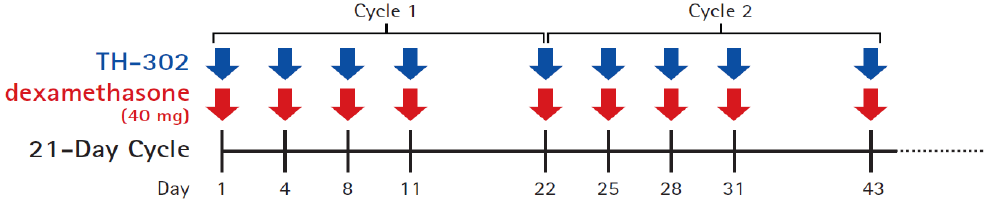
The first part dose escalation of the Phase I/II trial has been completed. 14 patients received therapy. These patients were heavily pretreated having received 3 to 11 prior treatments (median of 6.5) and all having received a regimen containing bortezomib, an immunomodulatory agent lenalidomide and/or thalidomide, and an alkylating agent. Patients received one to 19 cycles (median of 4 cycles) of therapy with TH-302 and dexamethasone. The maximum tolerated dose was determined to be 340 mg/m2 TH-302. The most frequent Grade 3/4 side effects were thrombocytopenia, leukopenia, anemia, and neutropenia.
New Data from the ACSO Presentation
Enrollment of the second part dose-expansion of the study is now complete. The ASCO presentation includes data from 24 patients enrolled at the maximum tolerated dose of TH-302 (340 mg/m2) from dose escalation and dose expansion portions. According to the presentation, patients had received a median of 6.5 systemic therapies prior to enrollment. The patients initiated treatment prior to March 1, 2014 and analyses reflected the clinical database as of May 19, 2014. Of these 24 patients, 23 were evaluable for response, and 17 were treated at the maximum tolerated dose of TH-302 (16 evaluable).
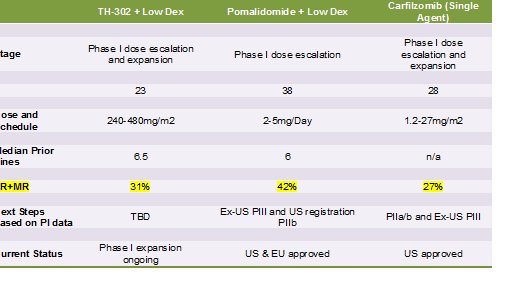
Best responses included four partial responses (4 PR), two minimal responses (2 MR), and 15 stable disease (15 SD) assessments; two patients had progressive disease (2 PD). The clinical benefit rate for patients treated at the maximum tolerated dose of TH-302 (n=16 evaluable patients) was 31% (comprised of 3 PR and 2 MR).
The most common adverse events were nausea and fatigue. The most common Grade 3/4 hematologic adverse events were thrombocytopenia (29%) and leukopenia (25%). Dose-limiting toxicities of Grade 3 stomatitis were reported during the first treatment cycle for the first two patients treated at 480 mg/m2 TH-302.
The clinical benefit rate from TH-302 in combination with low dexamethasone for multiple myeloma is comparable to early data as listed below from two of the most recently approved agents for advanced multiple myeloma, i.e., pomalidomide and carfilzomib.
The Company expects to initiate the third part of the trial to investigate the combination of TH-302 and bortezomib by year-end 2014.
There are few treatment options for patients with advanced multiple myeloma that stop responding to bortezomib and lenalidomide, and responses to subsequent salvage therapy have historically been extremely low. The preliminary results suggest that the combination of TH-302 with dexamethasone is active in some heavily pretreated patients who have failed conventional therapy.
New Data Presented at ASCO for TH-302 + Avastin in Recurrent Glioblastoma
Background
Glioblastoma multiforme (GBM), also called glioblastoma, is the most common and most aggressive type of primary brain tumor and accounts for approximately 50% to 60% of all primary brain tumors. It is estimated that 23,130 people were diagnosed with and 14,080 people died of cancer of the brain and other nervous system in 2013 in the US.
Glioblastomas are among the most aggressively malignant human neoplasms. The median survival time from the time of diagnosis without any treatment is usually less than 1 year. Despite multimodality treatment, median survival is about 14.6 months. The overall 5-year survival is less than 10% with the standard of care today.
Chemotherapy (temozolomide) with radiotherapy (RT) is standard care for newly diagnosed glioblastoma. Avastin (bevacizumab, Roche) is approved in the U.S. for progressive disease following prior therapy. After disease progression on bevacizumab, patients may start a subsequent bevacizumab-containing regimen. These patients typically progress in 5 to 8 weeks.
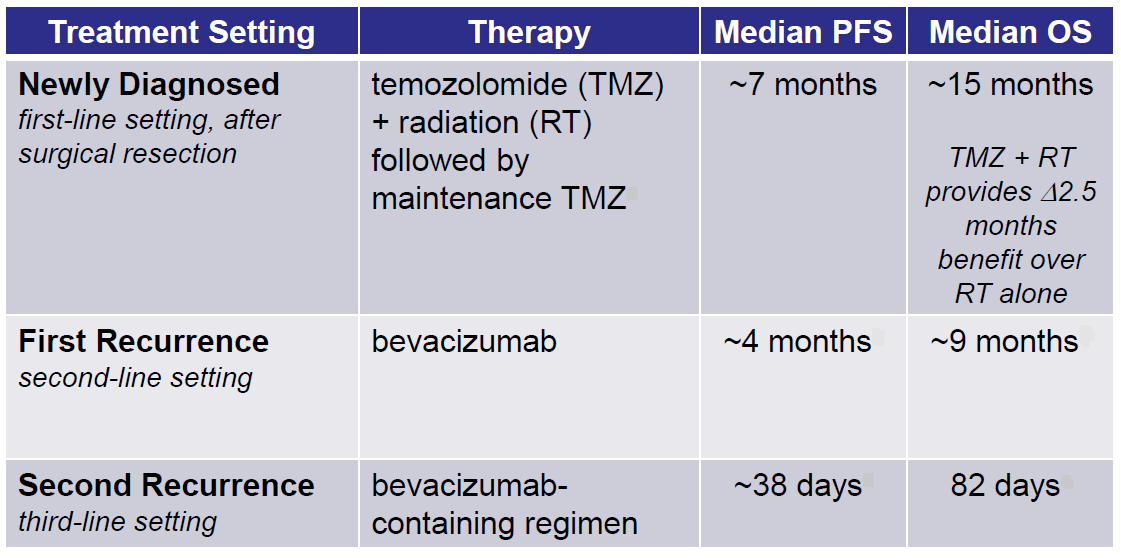
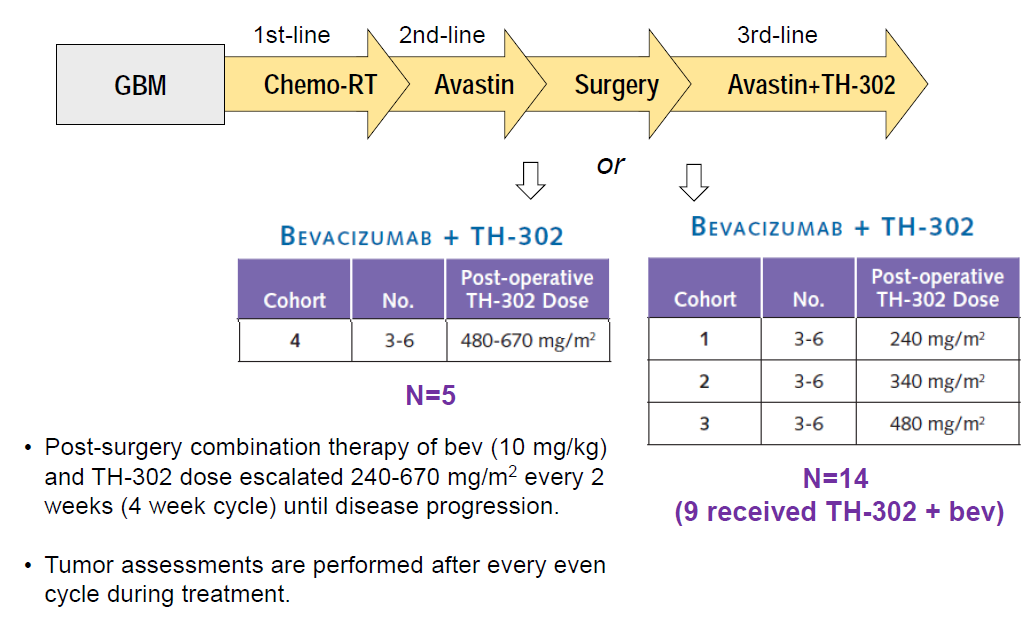
An investigator-sponsored Phase I/II trial (the 4003 trial) to evaluate TH-302 in combination with Avastin® (bevacizumab) in patients with recurrent glioblastoma following bevacizumab failure is ongoing.
The Updated Data from ASCO
The ASCO post presentation reported on a total of 17 patients treated with bevacizumab 10 mg/kg every two weeks and TH-302 dose escalated 240-670 mg/m2 every two weeks (four-week cycle) until disease progression. Patients had received a median of three prior systemic anticancer regimens including both chemoradiation and bevacizumab.
In 17 patients evaluable for response,
· best responses included one complete response (1CR) and three partial responses (3PR) for a response rate of 24%, and eight stable disease (8 SD) assessments for a clinical benefit rate of 65%; five patients had progressive disease (5 PD). The longest disease stabilization is ongoing at 30 months;
· The median progression-free survival (PFS) was 3.1 months on combination therapy vs. 2.4 months on prior single-agent bevacizumab; the 4-month PFS rate was 26%;
· Median overall survival of patients treated with TH-302 plus bevacizumab was 4.9 months;
No Grade 4 adverse events were observed at any dose. Three Grade 3 adverse events were observed: skin ulceration at 340 mg/m2, oral mucositis at 670 mg/m2, and thrombocytopenia at 670 mg/m2. The primary TH-302 related toxicities were mucosal.
Patients continue to be enrolled in the 670 mg/m2 TH-302 cohort.
We think preliminary data from the ASCO presentation are encouraging. The 24% objective responses are rarely seen at this advanced stage of the disease. The median PFS with TH-302 plus bevacizumab was longer than with prior single-agent bevacizumab (3.1 vs 2.4 months). We look forward to updating investors when new data are available.
READ THE LATEST FULL RESEARCH REPORT HERE
SUBSCRIBE TO ZACKS SMALL CAP RESEARCH to receive our articles and reports emailed directly to you each morning.
Please visit our website for additional information on Zacks SCR and to view our disclaimer.
Multimedia Files:
Categories:
Press Releases