By Brian Marckx, CFA
OTC:VNRX
New Data Shows NuQ's Ability to Detect Cancer At All Stages, Including Critical Early Stages:
In September VolitionRx (OTC:VNRX) presented highly encouraging data at the Aegis Capital Healthcare Conference on the initial 938 patients in their retrospective colon cancer study being done at Hvidovre Hospital (Denmark). This morning (10/9/2014) the company announced additional data on 830 of these patients which provided greater support of the ability of the NuQ tests to identify cancer with high accuracy at all stages and also to differentiate between types of cancer.
As a reminder, the preliminary results announced in September came from the analysis of 938 patients from the ~4,800-patient retrospective colon cancer study being done in collaboration with Hvidovre Hospital at the University of Copenhagen in Denmark under the direction of Professor Hans Jorgen Nielsen (Professor of Surgical Oncology at the Department of Surgical Gastroenterology). The study includes samples from patients over 50 years of age which are symptomatic of colorectal cancer. Analysis supported findings from the earlier, smaller studies and showed the three-panel NuQ tests were able to detect 84% of colorectal cancers (60% of polyps) at 78% specificity. While the September presentation noted that the NuQ panel was able to detect cancers at various stages including those at an early stage, it did not provide a specific breakdown of positive samples by cancer type.
The data announced this morning, which was presented at the International Conference of Anticancer Research in Greece, did provide that specific breakdown. Of the 59 colorectal cancer cases identified by colonoscopy, the NuQ panel was able to detect 50 (85%). Importantly the test showed high accuracy at all stages of cancer (table below from VNRX's PR). Given that colorectal cancer is more effectively treated and has a much higher survival rate if found early, the ability of a diagnostic to detect the disease at the earliest stages is critical to maximize chances for patient long-term survival.
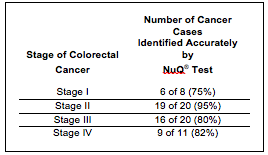
In addition to high accuracy the NuQ panel was able to differentiate between types of cancer - something that the technology has demonstrated in the past. The ability to differentiate is of obvious importance in order to most effectively treat the cancer. As a reminder in March VNRX announced results from a small pilot study which also showed high detection capabilities (80% of prostate cancer) and that NuQ was able to differentiate between colon and prostate cancers.
Of the 59 colorectal cancers presented this morning, 35 were colon and 24 rectal - and while the release does not provide quantitative specifics, VNRX does note that their NuQ panel was able to differentiate between the majority of colorectal cancers as being either colon or rectal cancers.
The company expects to announce data from the full 4,800-sample set in 2015.
VNRX's larger 14k sample (recently increased from 11k samples) prospective study is also now underway. This is also being done in collaboration with Hvidovre Hospital. Patients will be screened with a fecal immunological test (FIT) as part of the Danish national screening program. Patients (both FIT-negative and positive) will then tested using VNRX's NuQ assay panel. These results will then be confirmed by colonoscopy. Sample analysis is expected to commence in 2015 which should provide even more insight into the utility of NuQ.
We view the preliminary results from the retrospective study which have been announced over the last two months, particularly in consideration of the totality of the positive data from earlier studies, as highly encouraging in terms of the utility of the NuQ technology for the detection of colorectal cancer. This also adds clear support for the potential approvability of NuQ. As a gauge, an FDA advisory panel recently recommended PMA approval of Epigneomics' Epi proColon colorectal cancer test which in a pivotal trial versus FIT showed sensitivity of 79% and specificity of 68%.
VNRX has indicated that they expect to file for CE Marking by the current year-end. We expect this positive data to-date will be supporting their application. We continue to model launch of a NuQ panel for colorectal cancer to launch in Europe next year.
As we have noted in our ongoing coverage of VNRX, we think there would be ample demand for a cancer screening method that didn't suffer the drawbacks of the current techniques - that being the high cost and patient discomfort of colonoscopy and the high rate of false positives of fecal occult blood tests. With expected pricing under $100 per test and sampling using roughly just one drop of blood, combined with what looks to be (so far) high accuracy, we think VNRX s NuQ tests may offer an option that is competitive to colonoscopy in terms of accuracy but with all the convenience and low cost of fecal occult blood tests.
The issues inherent in current colon cancer detection methods may be a contributing factor to the significant percentage of the at-risk population not meeting colon cancer screening guidelines. According to the CDC, as reported in the November 5, 2013 issue of Morbidity and Mortality Weekly Report, one-third of U.S. adults aged 50-75 who should be screened for colon cancer are not being screened. The USPSTF recommends regular screening for colon cancer using fecal occult blood testing, sigmoidoscopy or colonoscopy beginning at age 50 and continuing to age 75.
We are maintaining our Outperform rating and $7/share price target.
READ THE LATEST FULL RESEARCH REPORT HERE
SUBSCRIBE TO ZACKS SMALL CAP RESEARCH to receive our articles and reports emailed directly to you each morning. Please visit our website for additional information on Zacks SCR and to view our disclaimer.