By Brian Marckx, CFA
OTC:VTEQ
Q1 2014 Results: Revenue In-Line With Our Estimate, OpEx Slightly Better…
VeriTeQ (OTC:VTEQ) filed their 10-Q for the period ending March 31, 2014. Revenue came in a hair better than our estimate with operating expenses slightly lower than what we had expected - the net result was operating loss coming in about 8% favorable to our number.
VTEQ recorded initial revenue from the sale of the Q Inside Safety Technology transponders to Establishment Labs (EL) in Q4 2013 in the amount of $18k. Concurrent with the initial order the company noted that they expected follow-on orders to be received on a regular basis. In Q1 they added another $74k in revenue related to this - which was slightly better than our $72k estimate. We continue to look for modest yet sequential revenue growth throughout the current year as VTEQ records revenue from additional EL orders.
Operating expenses were $1.5M compared to our $1.6M estimate. Similarly, operating loss was $1.5M compared to our $1.6M estimate. Excluding non-cash derivative revaluation expenses and non-cash interest, net income and EPS were approximately ($1.6)M and ($0.15) compared to our ($1.6)M and ($0.13) estimates.
Cash used in operating activities in Q1 was $481k. Ex-changes in working capital (which included a $661k increase in A/P), this was $1.2M. Cash balance stood at just $2k, however, subsequent to Q1 quarter-end, another $145k in restricted cash was transferred into the operating account and VTEQ raised $75k via the sale of convertible promissory notes. The restricted cash balance now stands at about $737k. Additional of the restricted cash will be released pro-rata as convertible debt converts to equity. As we've noted in our coverage of VTEQ, the company will need to continue to raise significant capital in order to maintain operations.
Outlook
Our outlook and related financial model reflects our estimates and assumptions related to the various markets that VTEQ is targeting with their Q Inside Safety Technology. As commercialization for any of the targeted applications has either only recently commenced (in the case of breast implants) or is in earlier stages (vascular ports, artificial joints, dosimetry), there are a number of unknowns that we needed to account for. We have made what we believe to be reasonable best-guesses for unknowns related to areas such as regulatory approvals, launch timelines, third-party interest and competitive technologies, pricing and margins, and rates of adoption, among others (which also includes the assumption that VTEQ successfully raises additional capital to fund ongoing operations). Our outlook and model are subject to change based on developments over time.
Breast Implants and Sizers
The breast implants market is where we expect substantially all of the near-term opportunity to lie for VTEQ. Establishment Labs has now placed orders for a total of at least 8k of VTEQ's RFID tags. The company noted in October, with the announcement of the initial 2k order, that follow-on orders could be expected on a (roughly) monthly basis. As such, and with the expectation that EL integrates the chip into other of their breast implant models, we think there will be ongoing orders throughout 2014 and likely beyond. We have modeled a somewhat measured increase in orders from EL throughout 2014. The totality of our modeled revenue in 2014 represents revenue generated from orders from EL.
VTEQ has indicated in recent investor presentations that (since November 2013 or earlier) another breast implant manufacturer of significant size was testing the feasibility of the Q Inside Safety Technology for integration in their silicone implants. The company also notes in the same November presentation that they have been in discussions with "two leading global breast implant manufacturers" relative to their needs to comply with the FDA Final Rule as it relates to their breast implant sizers.
As VTEQ's chip is already FDA cleared for human use, it is currently unclear whether FDA would require formal clearance of a silicone breast implant with the chip inside. Depending on regulatory requirements, commercialization in the U.S. for use in breast implants and/or sizers could potentially come in the relatively near-term (<12 months) or could be a much longer timeframe (>24 months, particularly if PMA is necessary). We do, however, believe FDA has interest in programs, policies and products aimed at improving safety of breast implants which may bode well for the agency supporting technologies such as VTEQ's. The recently established national registry in England to track breast implants provides additional support for the notion that there is real interest throughout the globe (albeit not mandated by FDA) to improve safety of breast implants. As such, combined with the fact that the chip has already been FDA cleared for human use, we think it is reasonable to expect that VTEQ will have the ability to access the U.S. market in the not too distant future.
Our modeled revenue beginning in late 2015 includes the assumption that VTEQ enters into agreements for integration of their chip with other breast implant manufacturers and gains any potential requisite FDA clearances for commercialization in the U.S. While this is speculation on our part, we feel that this is a reasonable assumption based on our reasoning above as well as that competing product marking methods (i.e. - dot peening, laser marking, ink jet marking, electrochemical etching) are either unsuitable for breast implants (and breast implant sizers) or functionally inferior to VTEQ's technology for this application. We think this drives increasing demand for VTEQ's Q Inside Safety Technology from the breast implant industry which is reflected in our modeled step up in revenue growth from 2015 to 2016 and order flow picking up throughout 2016.
Access to the U.S. would greatly expand the potential market for VTEQ in breast implants. Approximately 1.2 million breast augmentation procedures are done every year worldwide with almost 300k of those done in the U.S. (see table for top 20 countries performing breast augmentation procedures). And as the U.S. breast implant market is highly concentrated between J&J and Allergan, VTEQ could potentially quickly ramp commercialization in the U.S. with agreements with these companies. Entry into the U.S. market could also facilitate expansion into other countries and continents, including Mexico and South America. And combined with the distribution reach already afforded by Establishment Labs, we think VTEQ's footprint for the breast implant application could encompass as much as 75% (which we view as the total reachable market) of the total market within a few years. There are approximately 32k plastic surgeons in the world - if we assume 75% of these will fall within VTEQ's reachable market, one reader per plastic surgeon and each reader is replaced every three years, the total reachable reader market is approximately 72k readers annually.
VTEQ disclosed selling prices of ~$10 - $12 per chip (two chips per procedure) with expected gross margins of ~70%. The scanners are expected to be sold for ~$500 with gross margins of ~50%. This implies a total reachable annual market size worth approximately $19.8M (900k procedure reachable mrkt x 2 chips/procedure x $11 avg selling price) in sensor chips revenue and $36.0M (72k readers/year x $500 avg selling price) in readers revenue.
Our model assumes VTEQ captures approximately 2% of their reachable breast implant market by the end 2016 and just under 5% by the end of 2017. We currently model approximately $1.3M and $2.7M in revenue related to this breast implant application in 2016 and 2017, respectively. This is arguable conservative and will be updated if and when warranted.
Breast Augmentation Procedures By Country in 2011[1]
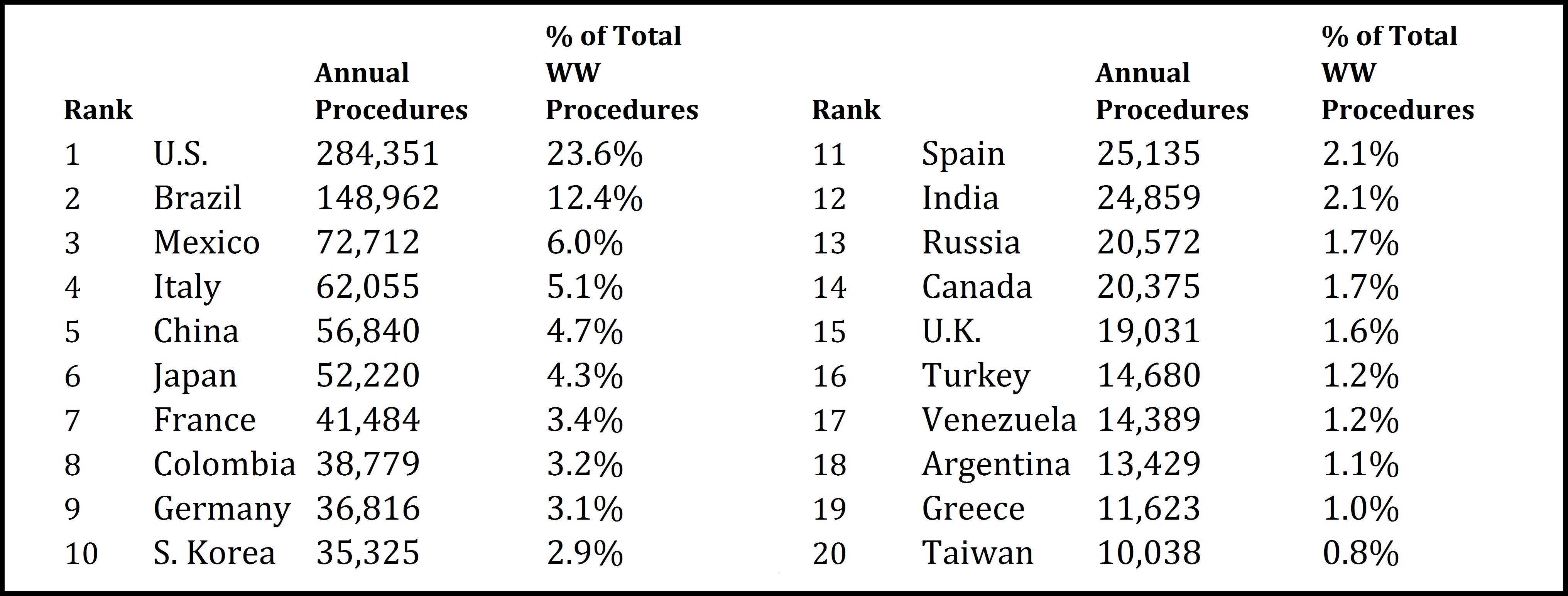
[1] International Society of Aesthetic Plastic Surgery International Survey on Aesthetic/Cosmetic Procedures Performed in 2011
We do not currently model any revenue from the breast implant sizers market. While discussions with manufacturers relative to integration of Q Inside into their implant sizers is an obvious positive step, we feel it's too early to gauge substantive interest at this point. We also note that FDA lists breast implant sizers as "unclassified" devices and the deadline for meeting the UDI mandate for unclassified devices that are intended to be reused is not until September 2020. This means these manufacturers may not gear up to integrate direct part marking into the manufacturing process of their devices until several years from now. We will update our model if and when there is sufficient evidence that there is greater traction from these manufacturers relative to substantial interest in using VTEQ's technology in their breast implant sizers as well as potential timing of when purchase orders would commence.
Vascular Ports
VTEQ's acquisition of the VeriChip and related patents in 2012 also included a development and supply agreement with MedComp, a leading manufacturer of vascular access catheters. Under the agreement, MedComp will embed VTEQ's microchip in their vascular ports. The microchip will allow the ports to be easily identified when implanted in a patient and will also help ensure the correct medication dosage. The initial term of the agreement is for five years and totals over $3 million over that timeframe but is contingent on MedComp receiving FDA clearance (anticipated to be 510k) of the vascular port with the embedded microchip. However, it is currently unclear whether FDA will actually require clearance of the ports with the chip inside as both the chip and the ports are both FDA cleared.
VTEQ's January 2014 investor presentation notes that studies are expected to begin at three hospitals; Northwestern Memorial (Chicago), New York-Presbyterian and either the Cleveland Clinic or MD Anderson Cancer Center (Houston). It's currently unclear as to the scope or status of these studies.
We believe, given the supply and development agreement that is already in place, that MedComp represents a potentially meaningful revenue generating opportunity for VTEQ. However, we will not model any contribution from this relationship until there's more obvious clarity to MedComp's timelines and vested interest in pursuing commercialization in the near-term.
If successfully integrated and commercialized with MedComp's catheters, VTEQ expects to pursue agreements with other vascular port manufacturers.
Artificial Joints and Spacers
We see no obvious hook for VTEQ to gain near term access to the artificial joint market. Given that the final rule did not mandate that implantables must have the UDI mark directly on the part, doing so would be completely voluntary on the part manufacturers. But while it's probably too early to gauge how compelled implantable manufacturers may be in that regard to what would essentially be over compliance, it's possible that orthopedic device manufacturers may follow the lead of makers of breast implants, such as Establishment Labs and potentially others which voluntarily are either going forward with, or considering, integrating VTEQ's Q Inside transponder with their products.
It is probably reasonable to assume that implantable device manufacturers are at least contemplating direct part marking in light of the PIP scandal and the potential related litigation risk that could follow, particularly if there was not a reliable and effective way to track and identify specific implanted devices in the event of a recall. In addition, FDA's decision to implement an identification and tracking system is a clear indication that the agency is encouraging measures to improve safety and information flow for all medical devices - which perhaps will compel a more proactive approach from manufacturers, including those of orthopedic implants.
However, as there is little evidence that orthopedic device manufacturers are currently aggressively pursuing this, along with the fact that there are other potentially viable direct marking methods available that could be used if these manufacturers do pursue direct part marking, we feel it is too early to model any potential financial contribution from artificial joint manufacturers. Regulatory approval may also need to be attained prior to commercialization of an implanted device integrated with VTEQ's transponder.
Relative to artificial joint spacers, orthopedic spacers are either unclassified or Class I devices, both of which must have the UDI directly on the part by September 2020. This provides a long runway for manufacturers to implement a game plan for compliance and they may seek compliance by using VTEQ's technology or one of the other competing methods such as laser marking or dot peening (either of which might be suitable for orthopedic implants). Given that it is several years until compliance is required and no indication that these manufacturers are considering one method more seriously than any other, we feel it is prudent to refrain from modeling any contribution from this potential source for now. We reiterate however, that our model will be updated if and when appropriate which could include a contribution from the orthopedic device channel as well as others if circumstances warrant.
Biosensors
VTEQ's biosensor products benefit from already being FDA cleared, having clinical trial experience with positive results (and published in a peer-reviewed journal) and being covered by at least some level of third party reimbursement. We also view the opportunity with the biosensor products as holding the most upside potential given the relatively large target markets for the products.
The target market for the external sensors is the ~1.1M people that receive external beam radiation therapy in the U.S. each year. The expanded market could include (assuming requisite regulatory approvals) patients undergoing CT scans (~75M/year in the U.S.) and fluoroscopy procedures (~5M/year in the U.S.). VTEQ disclosed selling prices of ~$500 per external sensor kit for each patient. Gross margins are expected to be ~80%.
The target market for the internal sensors is the ~82k patients which undergo external beam radiation treatment for breast or prostate cancer in which a gold seed is used. Gold seeds are non-radioactive pellets implanted near the tumor and used as a marker in order to more accurately deliver the radiation dose. VTEQ's implanted sensor serves a similar purpose but, unlike gold seeds, VTEQ's biosensor also measures the radiation dose delivered. VTEQ disclosed selling prices of ~$1,200 per internal sensor kit for each patient. Gross margins are expected to be ~80%.
We expect commercialization of the biosensors would initially focus on awareness building which may potentially include investigator led studies at a small number of hospitals in order to build on the clinical experience of the devices. The company's general game plan is to sell the technology directly and through distributors to radiation oncologists and medical dosimetrists. However, commercialization of the biosensors is likely not a near-term event as this will undoubtedly require additional financial resources and VTEQ is currently focused on the launch of the direct part marking applications.
Our model assumes a soft launch towards the back half of 2015 with a combination of a small sales force and initial distribution agreement(s). As a placeholder we assume less than one percent penetration of both the external (excluding the external sensor expanded markets) and internal sensor markets by the end of 2017. We currently model approximately $3.2M in revenue from the biosensors in 2017. This is subject to updating depending on how developments unfold. We also note that the size of potential biosensor market, at approximately $650M annually (in just the U.S. alone), is more than 10 times as large as what we characterize as VTEQ's worldwide reachable breast implant market. As such, and depending on VTEQ's success in penetrating the biosensor market, this could prove to be the area that holds the most upside opportunity for the company, particularly over the long term.
See below for access to our full report on VTEQ which includes further discussion about the competitive landscape of VeriTeQ's target markets, our financial model and valuation methodology.
READ THE LATEST FULL RESEARCH REPORT HERE
SUBSCRIBE TO ZACKS SMALL CAP RESEARCH to receive our articles and reports emailed directly to you each morning.
Please visit our website for additional information on Zacks SCR and to view our disclaimer.