By: Nisha Hirani, MD & David Bautz, PhD
NASDAQ:ADMA
On July 31, 2015, ADMA Biologics, Inc. (NASDAQ:ADMA) announced submission of its RI-002 Biologics License Application (BLA) to the FDA, seeking marketing authorization of its lead product candidate. The FDA will have 60 days to review the application to determine whether ADMA’s BLA submission for RI-002 is complete and acceptable for filing. If all goes well and the BLA is approved, we could see a potential approval of RI-002 and the first commercial sales during the second half of 2016. Under PDUFA V the BLA filing fee is usually $2.3 million, but since ADMA submitted a small business waiver application that was approved the company will not have to pay this fee. We view this as meaningful, and believe the company is on the right track towards approval and commercialization.
An Overview of RI-002
ADMA’s lead candidate, RI-002, is a specialty intravenous immunoglobulin (IVIG) product that contains polyclonal antibodies against various infectious agents that are derived from human plasma. RI-002 contains standardized, high levels of antibodies to respiratory syncytial virus (RSV) in addition to naturally occurring polyclonal antibodies (such as Streptococcus pneumoniae, Haemophilus influenzae type B, Cytomegalovirus, measles, tetanus, etc.). RI-002 is intended to prevent infections in a subset of patients diagnosed with Primary Immunodeficiency Disease (PIDD), and in particular Primary Humoral Immunodeficiency. The polyclonal antibodies that are found in RI-002 are expected to prevent infections in this population group. ADMA plans to seek approval for RI-002 for a target population range of approximately 8,000 to 15,000 patients primarily suffering from PIDD presentations. Potential off-label follow-on indications include:
- Hematopoietic stem cell transplant (HSCT): Approximately 25,000 HSCT procedures are performed annually in the U.S.
- Solid organ transplant (lung, heart, liver, and multi-organ): Approximately 11,000 solid organ transplants are performed annually in the U.S. (excluding kidney transplants)
- Cancer patients receiving chemotherapy: Approximately 375,000 patients receive chemotherapy in the U.S. during the winter months
Management believes that there is no other IGIV product currently on the market that contains standardized, high levels of RSV antibodies. Additionally, RI-002 is produced with reported consistent lot-to-lot potency. We believe that these features are what differentiates RI-002 from currently marketed IVIG products. More importantly, if approved, physicians and patients would have an additional selection for IVIG therapy, which in our opinion, could lead to enhanced quality of life for patients. The goal is for RI-002 to replace standard IVIG therapy during the winter months for the subset of patients with PIDD.
Manufacturing & Supply of RI-002
ADMA works closely with Biotest Pharmaceuticals for the manufacturing of RI-002. In addition to purchasing plasma from Biotest, ADMA operates ADMA BioCenters Plasma Collections Centers in Norcross, GA and Marietta, GA. The Norcross center is an FDA-licensed, GHA (German Health Authority) certified, MFDS (Korean Ministry of Food and Safety) certified source plasma collection facility that provides a portion of human blood plasma for the manufacturing of lead product candidate, RI-002, in addition to a revenue stream. Once the Marietta center receives FDA approval, plasma that is not used to manufacture RI-002 will be released for sale, generating accretive revenues. ADMA has stated publicly that a fully operational plasma center can generate more than $6 million/year.
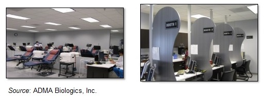
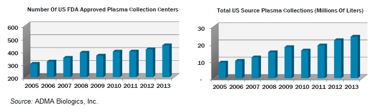
We believe there may be future opportunity for the company to add additional centers, and in turn would result in additional source plasma necessary for RI-002 production as well as additional revenue for the company by selling unused amounts in the U.S. and abroad. There are hundreds of diseases that rely on products made from human plasma as treatment, and there we believe there continues to be a demand for plasma. The trends show that the number of U.S. FDA approved plasma collection centers as well as total U.S. source plasma collections continue to increase (below).
ADMA’s proprietary testing assay allows for the identification of plasma donors that have naturally occurring, elevated levels of RSV antibodies. Additionally, the assay is used during the manufacturing process to ensure lot-to-lot consistency of RSV antibody titer potency. ADMA currently has a contract manufacturing agreement in place with Biotest Pharmaceuticals for the fractionation of RI-002, which allows for both clinical and commercial drug supply of the product, and is set to expire at the end of 2023, with the option to renew for two additional 5 year periods. ADMA also has a testing services agreement with Quest Diagnostics for exclusive biomarker testing and support services for protocol screening and re-certification.
An Overview of Phase 3 RI-002 Data
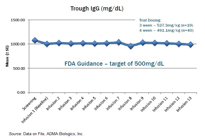
ADMA completed a Phase 3 clinical trial of RI-002 as a treatment for PIDD in accordance with the FDA Guidance for Industry: Safety, Efficacy, and Pharmacokinetic Studies to Support Marketing of Immune Globulin Intravenous (Human) as Replacement Therapy for Primary Humoral Immunodeficiency. The FDA guidance does not require the use of a comparator arm for means of obtaining primary and secondary data outcomes. The Phase 3 trial was designed in accordance with FDA guidance as a multi-site, single arm, open label study in which 59 patients diagnosed with PIDD were treated once every 21 to 28 days for 12 months across 9 treatment centers located throughout the U.S. The patients were then followed for an additional 90 days for follow-up and safety monitoring. The average doses of RI-002 that were administered in the 3 and 4 week groups were 527.3mg/kg and 491.1mg/kg, respectively.
Twenty-one patients (35.6%) had at least 1 study drug related event within 72 hours after completion of RI-002 infusion. There were only 4 symptoms evaluated within this time period that were reported by 3 or more of the subjects (>5%). The four symptoms that were reported as drug related events included headache (8 patients), myalgia/muscle pain (3 patients), pruritus/itchy skin (3 patients), and adverse drug reaction without further specification (3 patients).
On December 3, 2014, ADMA announced that RI-002 demonstrated positive Phase 3 results and achieved its primary endpoint of preventing serious bacterial infections (SBI) in immunocompromised patients with PIDD. As per the FDA, SBI are defined as bacteremia/sepsis, bacterial meningitis, osteomyelitis/septic arthritis, bacterial pneumonia, and/or visceral abscess. No SBI were reported in patients during the course of the study. These results more than meet the requirement specified by FDA guidance of ≤ 1 SBI per patient-year. Secondary endpoints were reported in February 2015 at the American Academy of Allergy Asthma & Immunology Annual Meeting. Secondary endpoints included safety, pharmacokinetic (PK) data points including antibody titers for certain agents, including RSV antibody levels at various time points after infusion, incidence of all serious and non-serious infections, lost days of work or school, hospitalizations, emergency room visits, and antibiotic use among others.
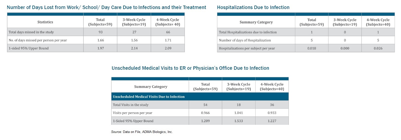
Scientific investigators reported on the secondary outcomes that included: a total of 93 days (or 1.66 days per patient per year) lost from work or school due to infection; 1 hospitalization due to an infection of 5 days duration in the entire study (above); and IgG trough levels above those required by the FDA for IVIG products (below).
Specific antibody levels were also measured for H. influenzae, CMV, measles, S. pneumoniae (12 serotypes), RSV, and tetanus. An increase in all of the measured specific anti-pathogen antibodies in PK subjects (n=31) was also observed. The mean of maximum fold increases in specific antibody levels after infusion of RI-002 ranged from 1.9 fold (S. pneumoniae type 19A) to 5.3 fold (RSV), which were statistically significant fold increases from the pathogen's specific measured baselines. As per ADMA, the safety profile of RI-002 was comparable to that of other immunoglobulins. As per the company, over 790 infusions of RI-002 were administered to 59 patients, and were well tolerated with no reported serious adverse events attributable by investigators to the study drug.
Overall, we see these results as excellent news for ADMA, and they suggest that RI-002 is safe and effective, and could be an important new superior therapy for a subset of individuals with PIDD. We think utilizing standardized high levels of anti-RSV neutralizing antibodies is a unique approach, and believe the data supports moving forward with the drug. We believe that the data compares favorably with historical clinical data for other marketed immunoglobulin products, and the results from the Phase 3 RI-002 trial may allow for the differentiation of the drug candidate from other commercially available immunoglobulins. For instance, with ADMA’s RI-002 therapy, only 1.66 days per patient per year were lost from work or school due to infection as compared to 8.7 days missed with Gammaplex®, and 3 days missed with Flebogamma® (Schroeder, et. al, 2012).
Now that the BLA is submitted to the FDA, we believe that approval, if granted, could take place within approximately one year, with potential sales as early as the second half of 2016. If approved, we believe the proposed dosage would be 300-800 mg/kg every 21 or 28 days during the winter months in the select PIDD population (or approximately 3-5 doses per year). Management believes based on guidance documented from the U.S. FDA that a successful single Phase 3 trial and complete BLA submission should lead to final approval of RI-002 as a treatment for patients with Primary Humoral Immune Deficiency.
Intellectual Property Protection in Place
On June 30, 2015, ADMA announced that the U.S. Patent and Trademark Office (USPTO) had issued a Notice of Allowance for U.S. patent application 14/592,721 entitled “Compositions and Methods for the Treatment of Immunodeficiency.” We believe this is great news for ADMA as it not only strengthens the company’s intellectual property portfolio, but also offers protection of RI-002 and is an important step towards commercialization of RI-002, if approved.
Moving Forward with RI-002
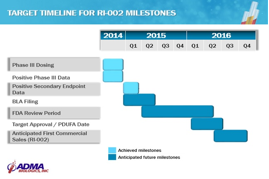
ADMA has several anticipated milestones on the horizon, and in our opinion, the potential approval of RI-002 for the indication of PIDD is of utmost importance. Remaining anticipated milestones in 2015 include: (1) Obtain FDA approval of second plasma center in Marietta, Georgia; and, (2) Initiate new specialty plasma collection programs at ADMA BioCenters. We note that the current management team has met prior commitments and milestones in a timely fashion (for instance, most recently with the BLA filing), and we are hoping that the trend continues. ADMA’s current strategy for moving RI-002 forward includes:
- Obtaining FDA approval to manufacture and market RI-002 for the treatment of PIDD patients
- Exploring other possible indications for RI-002.
- Developing additional plasma-derived products for the treatment of infectious diseases in immunocompromised patient populations.
- Expanding the network of ADMA BioCenters facilities, both to maintain control of a portion of the raw material supply and to generate additional revenue through the collection and sale of source plasma to third party customers.
We expect ADMA to continue to build out its commercial infrastructure once the BLA has been accepted. In order to move forward with U.S. commercialization plans, ADMA plans to hire a small, specialized sales force to market RI-002 to physician offices/clinics, hospitals, as well as other specialty treatment organizations. We expect ADMA to hire between 25-30 sales reps initially. We believe that ADMA will focus on physicians that are concerned with the identification of infections in the immunocompromised patient population, which primary attention placed on immunologists, and infectious disease doctors. We also believe that other specialists such as pulmonologists, and hematologists may also be included.
The company has recently appointed some new hires to strengthen the commercial team. ADMA also expects to add additional personnel for patient support, medical affairs, quality assurance, regulatory affairs, scientific affairs, reimbursement, inventory and logistics, human resources, and financial and operational management. In order to fulfill orders for RI-002, ADMA may also use a network of national distributors. We believe that the company will need to secure additional financing prior to launching RI-002 in order to support commercial efforts as well as launch expenses.
Valuation
For valuation purposes we utilize a full DCF model based on some reasonable estimates of sales with the following limiting sets of parameters:
We have assumed a current total target population of 250,000 patients in the U.S. with some form of Primary Immunodeficiency Disease. We believe 50% of that population is seeking treatment through IVIG. We assume the company will initially target around 5,000 patients, and over time will grow this target to approximately 15,000 individuals with PIDD. We have assumed pricing that is in line with the existing hyperimmune drugs on the market, as mentioned above, with a modest 5% price increase per year. We model initial penetration of 1% in 2016, growing to a peak penetration rate of 30% by 2024, and believe that long-term gross margins for this business will be approximately 50-60%.
We believe that RI-002 revenues in transplantation patients (HSTC/SOT) to begin in 2017, and we have modeled max transplant penetration of 20% and chemotherapy penetration of 5% by 2023. We believe that the cost will run about $55,000 per patient per year due to higher dosage requirements in transplant and chemotherapy patients relative to PIDD growing, and have it increasing at 5% per year. We are assuming long-term gross margins for this business to be approximately 50-60%.
We assume the company's second plasma center will receive FDA approval in the fourth quarter of 2015, and will be fully operational in the first half of 2016. We model long-term gross margins for this business to be up to 40%, with net income up to 10%.
Our DCF model further makes the following assumptions in regards to operating expenses:
- R&D of approximately $9 million and G&A expenses that drop to below 14% by 2018.
- Effective tax rate of 25% beginning in 2019 after $75 million of NOLs are utilized.
- We used a blended probability of success for RI-002 revenues of 67% and plasma centers of 100%. To take into account the risks discussed above, we use a 15% discount rate.
- Since we are valuing cash flows, we are adding in the cash balance of $16.6 million as of March 31, 2015 less the long-term debt of $16 million.
Based on our assumptions, we calculate a fair value for ADMA of approximately $245 million. With a fully diluted share count of 12.2 million as of March 31, 2015, this equates to a fair value target price of approximately $20 per share ($23 per share on basic share count). Should RI-002 prove to be an effective treatment for PIDD or additional indications, there is the possibility for significant upside to this valuation. We view ADMA as a compelling investment opportunity, and look forward to seeing management execute on its strategy.
SUBSCRIBE TO ZACKS SMALL CAP RESEARCH to receive our articles and reports emailed directly to you each morning. Please visit our website for additional information on Zacks SCR and to view our disclaimer.