By Grant Zeng, CFA
NASDAQ:ADXS
On Feb 3, ADXS (NASDAQ:ADXS) held its Analyst & Investor Day in New York City. At this conference, the company and experts in the field of immunotherapy presented updates on its ongoing clinical trials of three candidates: ADXS-HPV, ADXS-PSA and ADXS-cHER2.
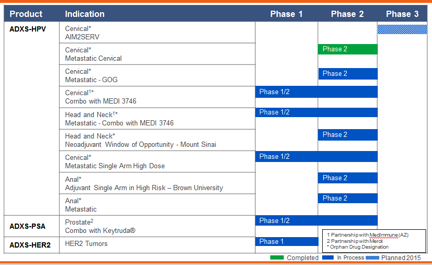
Following are the highlights presented at the Analyst & Investor Day.
Updates on ADXS-HPV
ADXS-HPV is the company’s most advanced immunotherapy candidate. The company has multiple Phase I or Phase II clinical programs targeting cervical, head & neck, and anal cancer.
ADXS-HPV for Cervical Cancer
Dr. Larry Copeland, Professor of Obstetrics and Gynecology, at The Ohio State University College of Medicine, and Vice President at the Gynecologic Oncology Group (GOG) Foundation, Inc, presented update on the clinical trial GOG 265: a Phase II trial run bay GOG for the evaluation of ADXS-HPV in the treatment of persistent or recurrent cervical cancer.
The Phase II GOG 265 trial is an open-label, single arm 2-stage study designed to evaluate the safety, tolerability and efficacy of ADXS-HPV in approximately 67 patients. Patients receive one cycle (three doses) of ADXS-HPV at 1 x 10⁹ cfu every 28 days. The primary efficacy endpoint is 12-month survival, with secondary efficacy endpoints of progression-free survival, overall survival and objective tumor response. The primary safety endpoints are the number of patients with dose-limiting toxicities and the frequency and severity of adverse effects. Stage 1 enrolled 29 patients and stage 2 is set to enroll another 38.
The first stage has been completed and has met the predetermined safety and efficacy criteria required to proceed into the second stage of patient enrollment. Dr. Copeland mentioned that a minimum 12-month survival rate of 20% was used as the efficacy threshold for this trial since a persistent or recurrent cervical cancer patient has a 1 year survival rate between 10% and 15%. As of the presenting day, the 12-month survival rate for the first stage was 24% (7/29), which exceeded the 20% predetermined rate. When follow-up data continue to come out, we believe the final 12-month survival data for the first stage of the trial will be higher than the current 24%.
One more important thing about the GOG 265 trial is that all patients treated in the first stage of the trial had advanced disease and some had experienced five to seven rounds of chemo- or radiation therapies. These data are encouraging since they confirmed the 12-month survival rate of 29% achieved in the Indian Phase II study that included patients with less severe disease.
ADXS-HPV was safe and well tolerated in both studies.
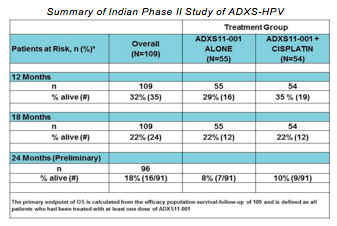
Data from both the Indian Phase II and the GOG Phase II are comparable to the results for the landmark 2004 Moore Phase III study conducted by the Gynecologic Oncology Group of cisplatin alone and cisplatin plus paclitaxel in recurrent cervical cancer patients. In that study, 12-month survival was presented as 35% for cisplatin alone and 32% for the combination and 18-month survival was presented as 20% for combination therapy and 12% for cisplatin, alone.
Based on the encouraging data from the above two Phase II trials, Advaxis and GOG has entered into a clinical trial collaboration to evaluate the safety and efficacy of ADXS-HPV n a global Phase III cervical cancer trial. Under the proposed collaboration, the GOG Foundation and Advaxis will conduct an adequate and well-controlled Phase III clinical trial of concurrent chemotherapy and radiation therapy (CCRT) compared to CCRT combined with ADXS-HPV in women diagnosed with high-risk, locally advanced cervical cancer.
Advaxis plans to request a Special Protocol Assessment (SPA) from the FDA prior to commencing this collaborative study.
Long-term survivors in recurrent cervical cancer are rare. ADXS-HPV appears to be the first immunotherapy associated with objective tumor responses and long-term survival. The LTS included patients with poor performance status, those who had progressed after combination chemotherapy in the recurrent setting, and several patients whose best tumor response was progressive disease during the trial. To achieve these results from a single cycle of an immunotherapy in patients with poor prognoses is remarkable and supports further development.
This program is granted Orphan Drug Designation for the treatment of Stage II-IV invasive cervical cancer.
ADXS-HPV for Head and Neck Cancer
Dr. Andrew Sikora from Baylor College of Medicine presented updates on Advaxis’ head and neck cancer program. The Phase I/II clinical trial of ADXS-HPV for HPV-related Oropharynx Cancer (HPVOPC) was initiated in November 2013. The trial will enroll 25 patients.
The trial is designed to determine the immunogenicity of ADXS-HPV treatment in patients with HPV+ squamous cell carcinoma of the oropharynx and to evaluate the tolerability, safety, and nature and degree of toxicity of ADX-HPV in HPVOPC. Primary endpoints include the change in HPV E6/E7-specific CD8+ cytotoxic lymphocyte (CTL) responses in the peripheral blood at time of surgery, with respect to baseline and the toxicity of ADXS-HPV.
As of Feb 3, 10 patients have been enrolled and 7 patients have been fully treated and 1 in-process (total 8). Overall the preliminary data from the first 8 patients are encouraging with regard to safety and tolerability of ADXS-HPV in the HPVOPC population. After the treatment for the first 9 patients is completed, preliminary assessment will be performed to determine whether or not to move to second-phase of study.
ADXS-HPV for Anal Cancer
Dr. Howard Safran from the Brown University Oncology Group presented updates on the ongoing Phase I/II trial of ADXS-HPV for anal cancer, which was initiated in February of 2013.
The primary objectives are to evaluate the safety of the addition of ADXS-HPV to standard chemoradiation for patients with anal cancer and to evaluate the 6-month clinical complete response rate for patients with anal cancer treated with ADXS-HPV, mitomycin, 5-FU and IMRT.
10 patients have been treated since April 2013. ADXS-HPV is well tolerated thus far with the most common adverse effect (flu-like symptoms) lasting for about 24 hours.
All 10 patients on study have demonstrated a complete response. No patients have developed recurrence.
We are very pleased with the preliminary data, which have demonstrated the safety of ADXS-HPV in anal cancer patients. More importantly, the initial data have also demonstrated efficacy for the treatment of anal cancer when combined with standard of care.
The 100% complete response rate exceeds the 80% benchmark which is part of the trial design. The study protocol stipulates that the addition of ADXS-HPV with standard of care for anal cancer will be considered promising if the 6 month complete response rate is greater than 80%. These criteria are based on historical clinical experience in similar high-risk patients. The Company and BrUOG are in the process of expanding the study to two additional sites, which will accelerate the completion of the trial. We look forward to seeing more data in the near future. Discussions with NRG have also been initiated to conduct a randomized Phase II/III study of Mitomycin/5-FU/RT +/- ADXS-HPV for newly diagnosed high risk anal cancer.
Update on ADXS-PSA for Prostate Cancer
Dr. Naomi B. Haas from the University of Pennsylvania, Abramson Cancer Center presented updates on the planned Phase I/II trial of ADXS-PSA for prostate cancer.
In Nov, 2014, ADXS announced its plan to initiate a Phase I/II clinical study to evaluate ADXS-PSA for the treatment of metastatic castration resistant prostate cancer (mCRPC). The FDA cleared the application in Dec 2014.
The planned Phase I/II protocol is designed to evaluate the safety and efficacy of ADXS-SPA as a monotherapy and in combination with Keytruda® (pembrolizumab). Keytruda is the first anti-PD-1 therapy approved in the United States by Merck.
The Phase I portion of the trial will identify a recommended dose for ADXS-SPA when used alone and when combined with KEYTRUDA. The Phase II part of the trial will assess the safety and efficacy of the combination regimen.
Advaxis entered into a clinical trial collaboration agreement with Merck in August, 2014 to evaluate the combination of ADXS-PSA with pembrolizumab.
Advaxis will sponsor and fund the study and Merck will provide pembrolizumab. The companies will collaboratively oversee the conduct of the study, which is planned to begin in early 2015. Results from the study will be used to determine the path for further clinical development of the combination.
According to management, if the combination of drugs shows an added effect, the companies would likely continue their collaboration, which, in our view, could lead to a license opportunity for ADXS.
Update on ADXS-c-HER2 in Dogs
Dr. Nicola J. Mason from the University of Pennsylvania’s School of Veterinary Medicine presented the updates on Phase I of ADXS-cHER2 in Canine Osteosarcoma.
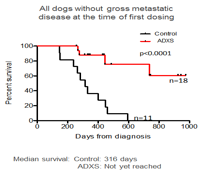
The Phase I enrolled 18 dogs with osteosarcoma. The objectives of the Phase I trial are to determine the MTD of ADXS-cHER2, to determine the safety and if ADXS-cHER2 is capable of eliciting tumor-specific immunity and if ADXS-HER2 can prevent metastatic disease and prolong overall survival.
Preliminary data from the Phase I study showed that ADXS-cHER2 was safe and well tolerated with no evidence of systemic toxicities. Currently, two-thirds of animals receiving treatment in the trial are still alive; however, untreated animals undergoing standard of care treatment exhibited a median survival of only 316 days.
Data from the Phase I also showed that induction of HER2-specific immune responses appear to correlate with overall survival.
Currently, the investigator is evaluating the combination therapy with radiation in primary osteosarcoma. Preliminary data have shown that ADXS-HER2 may delay progression of primary tumor, improve mobility and improve quality of life.
The Company plans to initiate a Phase I clinical trial of ADXS-cHER2 for the treatment of patients with metastatic HER2 expressing solid tumors. The FDA has cleared the application and the clinical trial is expected to begin patient enrollment in the first half of 2015.
ADXS-cHER2 Could Generate Revenue for ADXS As early As in Late 2015
Coupled with this positive data in canines, on July 2, 2014, Advaxis filed a product license from the United States Department of Agriculture (USDA) for ADXS-cHER2 for the treatment of canine osteosarcoma and other HER2-overexpressing cancers.
The filing was submitted by Aratana Therapeutics, Inc., which was granted exclusive worldwide rights by Advaxis to develop and commercialize ADXS-cHER2 in animals. The companies expect a response from the USDA in the next 12 to 18 months. We believe that with positive data thus far it’s likely the USDA will approve ADXS-cHER2 for canine osteosarcoma, which could generate revenue for ADXS as soon as in late 2015.
We Raise Our Price Target to $15
We maintain our Outperform rating for ADXS and raise our 12-month price target to $15.00 per share from previous $10.00 per share based on the recent clinical achievements.
We are optimistic about Advaxis’ live, attenuated Listeria technology, which is a unique immunotherapeutic platform that can target various cancer indications and infectious diseases. This technology has advantages over other immunotherapies and has generated positive clinical data. Combination of its technology with checkpoint inhibitors has the potential to become new standard of care for cancer treatment.
The recent deals are especially encouraging in our view. The deal with Aratana could get ADXS-cHER2 the first approved immunotherapy for animals in 2015. The deals with Biocon and GBP expand the usage of ADXS-HPV therapy for cervical cancer in the world two largest markets of cervical cancer in terms of patient population. The favorable terms in the deals not only strengthen Advaxis’ balance sheet in a non-dilutive way, but also validate the Company’s technology and clinical programs.
The collaborations with Merck and MedImmune may lead to license deals.
We look forward to the announcement of initiation of the pivotal Phase III trials of ADXS-HPV for recurring cervical cancer in 2015.
Advaxis has developed a robust pipeline based on its proprietary platform technology. In addition to cervical cancer, ADXS-HPV has potential to target other HPV-mediated cancers, such as head & neck cancer as well as anal cancer. The Company plans to initiate two clinical programs of ADXS-cHER2 targeting breast cancer and pediatric osteosarcoma respectively. A Phase I/II trial of ADXS-PSA is also planned for the treatment of prostate cancer.
ADXS-HPV has a huge market potential. Cervical cancer is a worldwide problem and ranks as the 2nd leading cause of cancer death of women in the world. According to WHO, about 630 million people are infected with one of the over 100 strains of HPV. Global prevalence of clinically pre-malignant HPV infections is between 28 to 40 million women. Approximately 500,000 women are diagnosed of cervical cancer each year and about 11.4% of women in the general population are estimated to harbor cervical HPV infection. In the US, about 12000 new cases of cervical cancer are diagnosed each year. Prevalence of cervical cancer is higher in developing countries and India, China and South America are the three regions with highest cervical cancer prevalence (50% of cervical cancer burden).
The Company’s balance sheet is relatively strong. As of July 31, 2014, Advaxis held $22 million in cash. In December 2014, Advaxis raised $17 million by issuing 3.9 million shares. Current cash can last 2H16 according to our financial model.
In terms of valuation, we think Advaxis is undervalued in our view. Currently, the Company shares are trading at about $7.7 per share which values the Company at about $183 million in market cap based on 24 million outstanding shares. This is certainly a deep discount.
We predict ADXS-HPV to be approved in the US in late 2017 or early 2018. Sales will reach $100 million in 2020 with earnings per share of $1.27. Using a relative valuation model, we come up with our new price target of $15.00 per share by using 30 x P/E multiple and discounted at 20% for 5 years.
Our price target of $15.00 per share values the Company at $360 million in market cap, which is still conservative in our view. Apparently, risk is still high for Advaxis at this stage. We will keep a close eye on cash balance and clinical program advances.
READ THE LATEST FULL RESEARCH REPORT HERE
SUBSCRIBE TO ZACKS SMALL CAP RESEARCH to receive our articles and reports emailed directly to you each morning. Please visit our website for additional information on Zacks SCR and to view our disclaimer.