By Grant Zeng, CFA
OTC:AMBS
On December 8, Amarantus (OTC:AMBS) announced positive data for Eltoprazine in a Phase II clinical trial of elderly patients with Alzheimer's dementia who are aggressive.
The Phase II trial was a multi-center parallel-group study in demented elderly with aggressive behavior. Following screening subjects were directly randomized per block of 3 to receive eltoprazine or placebo (2:1) in the double-blind treatment phase. Before entering the double-blind treatment phase all subjects were placed in a single-blind placebo run-in period over 3-weeks to establish a baseline of aggressive behavior. Other psychotropic medications were anticipated to have been washed-out before the on-drug portion of the study.
Primary objectives include:
- To evaluate the safety and tolerability of multiple dose treatment of Eltoprazine in elderly subjects;
- To evaluate the feasibility of the assessment methods;
- To obtain information on the effects of Eltoprazine on hostile or disruptive behaviour in hospitalized demented elderly;
- To obtain preliminary information on possible relations between plasma concentrations and eventual side-effects.
Twenty nine (29) subjects entered the study. Twenty (20) were randomized to receive Eltoprazine, with a mean age of 83.6 years (range 74-92); 14 were female, 6 were male. Nine subjects were randomized to receive placebo, with a mean age of 81.1 years (range 70-86); 6 were female, 3 were male.
Of the 20 subjects randomized to receive Eltoprazine, two dropped out during the placebo run-in phase, one because of fatal lung infection, the other subject refusing to eat or drink. One subject was prematurely withdrawn because of physical deterioration due to lung carcinoma. One subject had to be excluded from the efficacy analysis because of an erratic dosing regimen.
Of the 9 subjects randomized to receive placebo, one dropped out during the placebo run-in phase due to a heart failure.
In general, eltorpazine was reasonably well tolerated. Treatment emergent signs and symptoms were confusion (4 subjects), insomnia (2), somnolence (3) and anxiety (2). One male experienced delusions, which spontaneously disappeared within one week.
The Phase II data demonstrated a significant improvement in eltoprazine-treated patients in the severely aggressive eltoprazine-treated population (25.1 to 16.9) versus placebo (22.5 to 21.5), p<0.05 as measured by the Social Dysfunction and Aggression Scale (SDAS) at the end of the four-week treatment regimen, which followed a washout from previous psychoactive treatments and a 3-week placebo-lead-in period.
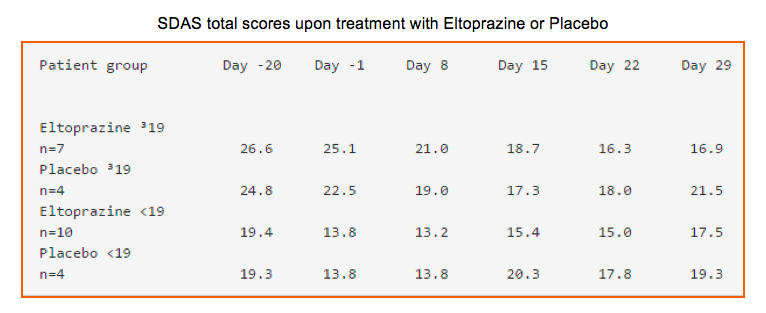
There was no influence of Eltoprazine on the demented state per se. The overall aggression level was modest and mainly of a verbal or mild physical nature. Clinically significant reductions in aggressive behavior in Eltoprazine-treated subjects were especially apparent from the descriptions in the case summaries, which were partly substantiated by the scorings on the Social Dysfunction and Aggression Scale.
Further evaluation of the complete data package is underway prior to submission for publication.
SUBSCRIBE TO ZACKS SMALL CAP RESEARCH to receive our articles and reports emailed directly to you each morning. Please visit our website for additional information on Zacks SCR and to view our disclaimer.