By Grant Zeng, CFA
OTC:AMBS
Earlier today (Sept. 14), Amarantus BioScience Holdings (OTC:AMBS) announced that the US FDA has granted the company's drug candidate mesencephalic-astrocyte-derived neurotrophic factor (MANF) orphan drug designation for the treatment of retinal artery occlusion (RAO).
Background of RAO
RAO is a rare eye condition caused by a loss of blood supply to the inner layer of the retina resulting in acute and often severe vision loss. According to a research by Klein R (Arch Ophthalmol. 2003 Oct. 121(10):1446-51), the incidence of retinal artery occlusion is at 0.85 per 100,000 per year, with a 10-year cumulative incidence of retinal emboli of 1.5%.
Patients with visualized retinal artery emboli, whether or not obstruction is present, have 56% mortality over 9 years, compared to 27% for an age-matched population without retinal artery emboli. Life expectancy of patients with central RAO (CRAO) is 5.5 years, compared to 15.4 years for an age-matched population without CRAO. RAO is associated with smoking and cardiovascular disease, with an increased incidence of stroke in patients who have suffered RAO. Both eyes have an equal incidence of disease, with bilateral involvement in 1-2%.
No specific prehospital treatment is available for retinal artery occlusion. The currently-available treatments are aimed at opening the occluded artery before irreversible damage occurs and most often do not improve visual acuity above natural history. There are no effective neuroprotective agents for the treatment of acute retinal ischemia available.
Immediate intervention improves chances of visual recovery, but, even then, prognosis is poor, with only 21-35% of eyes retaining useful vision. Although restoration of vision is of immediate concern, retinal artery occlusion is a harbinger for other systemic diseases that must be evaluated immediately.
MANF has the Potential to Become a Broad Ophthalmic Therapeutic Franchise
MANF is a naturally-occurring protein that reduces and prevents apoptosis (programmed cell death) in response to injury or disease. It was discovered utilizing Amarantus' proprietary PhenoGuard(TM) Protein Discovery Engine.
Pre-clinical data demonstrated that MANF provided protective functional effects in an animal model of RAO. Moreover, toxicology studies have demonstrated that MANF was well-tolerated following a single intravitreal administration of a therapeutically relevant dose.
Amarantus filed two Orphan Drug applications in 2014. One was already granted in both in the U.S. and in the EU for Retinitis Pigmentosa (RP). This time is the central retinal artery occlusion (RAO). This additional designation is an important milestone in the company’s regulatory strategy, which makes us believe that MANF has the potential to become a broad ophthalmic therapeutic franchise.
The FDA Orphan Drug Designation program provides a special status to drugs and biologics intended to treat, diagnose or prevent so-called orphan diseases and disorders that affect fewer than 200,000 people in the U.S. This designation provides for a seven-year marketing exclusivity period against competition.
In the meantime, the company is currently conducting preclinical IND-enabling studies with MANF, with a goal of filing the U.S. IND application in early 2016. Because MANF is a naturally-occurring protein we do not anticipate any significant safety or tolerability issues.
With the Orphan Drug indications, we believe MANF is highly attractive to potential partners. The candidate could help AMBS negotiate a favorable terms with potential partners for non-dilutive funding for Phase I and Phase II clinical trials.
Valuation and Recommendation
We maintain our Buy rating for Amarantus shares and adjust our price target to $15.00 per share reflecting the 1-to-150 reverse stock split.
Amarantus is a biotech company with two business divisions: A Diagnostic division with two commercially ready assets and a Therapeutic division with three candidates in different stages of development targeting different indications, including PD-LID, severe skin burn, adult ADHD and Parkinson’s disease.
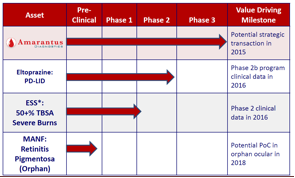
With respect to valuation, we admit that it’s always difficult to get an accurate value for a development stage small biotech company. Amarantus is no exception. According to current market data and our experience, most small cap development stage biotech companies are valued from $50 million to $2 billion in market cap based on how advanced the pipeline is and the market potential of the candidates.
Currently, Amarantus shares are trading at about $2.15 per share, which values the company at roughly $17 million in market cap. We think this is a huge discount when compared to its peers. Amarantus is a mid-stage biotech company with two candidates in Phase II trials. We estimate eltoprazine will be approved by the FDA in mid-2019, while ESS will be approved in late 2019. The company’s diagnostics may generate revenue in late 2015. If everything goes Amarantus’ way, combined revenue from the diagnostics and therapeutics will reach $100 million in 2020 with an EPS of $1.31 per share. Currently, the biotech industry is trading at a 35 x P/E multiple, which also is appropriate for Amarantus. If we use the 35x P/E ratio, discount at 25% for 5 years, we come up with the fair value of $15.00 per share for Amarantus. Our target price values the company at $120 million in market cap which is still conservative in our view. As long as management can execute on its growth strategy, the price target is achievable.
We believe the up-list will act as a major catalyst to drive institutional awareness in the story, and that several pending catalysts over the next 15 months, including the AMDX sales / spin-off, starting human clinical trials with MANF, reporting results from the eltoprazine Phase IIb data, and the ESS Phase IIa data should allow for the realization of a significantly higher stock price.
Cash burn is our chief short term concern when the company needs to raise new money to fund its operations. Longer term, we are more than willing to focus on the clinical advancement and potential commercial opportunity for its diagnostic business. Volatility in the broad market will also impact the company’s share price performance. But overall, Amarantus is an interesting name for investors with a long term investment horizon and high risk tolerance.
SUBSCRIBE TO ZACKS SMALL CAP RESEARCH to receive our articles and reports emailed directly to you each morning. Please visit our website for additional information on Zacks SCR and to view our disclaimer.