By Grant Zeng, CFA
OTC:AMBS
On August 17, Amarantus (OTC:AMBS) announced its financial results for the second quarter ended June 30, 2015.
No revenue was recorded for the second quarter of 2015, as compared to no revenue for the second quarter of 2014. Currently the company is developing two molecular diagnostics for Alzheimer's disease (AD) and one diagnostics for multiple sclerosis (MS). Revenue could be generated from diagnostics in late 2015.
R&D expenses for 2Q15 were $2.3 million, as compared to $1.6 million for 2Q14, an increase of $0.62 million. The increase was primarily due to increase in clinical related costs and research arrangements.
G&A expenses for 2Q15 increased to $3.3 million, as compared to $2.1 million for 2Q14, an increase of $1.2 million. The increase in G&A expenses was primarily due to increased spending on Lonza Option payments, acquisition costs and other professional services, including consulting costs.
Amarantus reported operating net loss of $5.6 million for the three months ended June 30, 2015, as compared to a net loss of $4.0 million for the three months ended June 30, 2014. The increase in loss was primarily driven by R&D costs, consulting, Lonza Option payments, professional services and acquisition costs.
Net loss for 2Q15 was $8.9 million ($1.08 per share), as compared to net loss of $4.0 million ($0.82 per share) for 2Q14.
As of June 30, 2015, the Company had cash of $0.32 million. Cash burn from operating activities in the first half of 2015 was $12.8 million.
Up-listing to NASDAQ will Raise Visibility Significantly
Management has demonstrated that up-listing of the company’s shares to NASDAQ is a priority. The company has submitted the listing application, and currently is waiting for response from NASDAQ.
There is currently a limited market for the Company’s common stock, which is quoted on the over-the-counter market. Trading in stock quoted on the over-the-counter market is often thin and characterized by wide fluctuations in trading prices, due to many factors that may have little to do with the Company’s operations or business prospects.
Moreover, the over-the-counter market is not a stock exchange, and trading of securities there is often more sporadic than the trading of securities listed on a quotation system like NASDAQ or a stock exchange like NYSE. There is no assurance that a sufficient market will develop or remain stable in the stock, in which case it could be difficult for stockholders to resell their stocks. Liquidity is also an issue for institutional investors.
However, we are happy to know that the company is addressing this issue. In order to fulfill the uplisting requirements, the company completed the capital restructuring in early June. Specifically, Amarantus completed the 1-for-150 reverse split of its common stock effective at the close of trading on Tuesday, June 9, 2015. As a result of the stock split, every 150 shares of issued and outstanding common stock will be converted into 1 share of common stock. Following the reverse split, there will be approximately 7 million common shares outstanding.
To complete the uplisting to the NASDAQ, Amarantus will offer shares via an initial public offering (IPO). This will both secure significant funding for the company and bring in quality institutional investors interested in taking a long-term position in the stock. Earlier in May 2015, the company filed a Form S-3 allowing the company to raise gross proceeds up to $150 million. We do not believe the plan is to raise anywhere near this level. In fact, we suspect the IPO will raise in the area of $20 million, which based on the company’s estimated $1.5 to $2.0 million per month burn rate, should sustain operations for at least one year. Once listed on the NASDAQ, we assume the basic share count will be around 12 million shares, with a fully-diluted count of approximately 15 million.
Another important reason why Amarantus seeks an uplisting to the NASDAQ is because the company is planning to begin the process of selling or spinning-off Amarantus Diagnostics (AMDX). In fact, management has retained a CEO search firm to find the right candidate to head up the division. Given the recent transaction to acquire DioGenix, and with it MSPrecise®, along with the option agreement entered into with Georgetown University, it is clear that building a self-sustained CNS-focused diagnostic division is among the top priorities for management. The benefit of being listed on the NASDAQ prior to the deal is that should Amarantus chose to spin-off AMDX, it would likely remain also listed on the NASDAQ assuming it met listing requirements. This has the added benefit of allowing AMDX to raise capital and attract quality investors or offers once independently owned.
We expect the NASDAQ uplisting to complete in the third quarter 2015. This upgrade will significantly increase the Company’s visibility and attract institutional investors, therefore increase the liquidity of the Company’s shares.
Valuation and Recommendation
We maintain our Buy rating for Amarantus shares and adjust our price target to $15.00 per share reflecting the 1-to-150 reverse stock split.
Amarantus is a biotech company with two business divisions: A Diagnostic division with two commercially ready assets and a Therapeutic division with three candidates in different stages of development targeting different indications, including PD-LID, severe skin burn, adult ADHD and Parkinson’s disease.
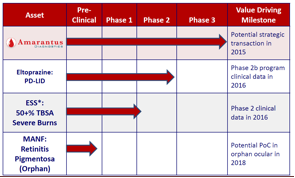
It is understandable why the shares have been under pressure lately. The company has to raise money to fund its operations on a regular basis and has to continuously dilute existing shareholder base. However, money raising is not necessarily a bad thing, especially for a development stage company like Amarantus. These small cap companies need the cash to move their pipeline forward and generate meaningful clinical data. We believe data is the ultimate driver of valuation, and we believe once the eltoprazine and ESS trials get underway, institutional interest in the NASDAQ-listed company will become significant. We noted two examples of companies with similar late-stage CNS assets, Acadia Pharmaceuticals with pimavanserin and Auspex Pharmaceuticals with SD-809. Six months following positive Phase III data, these stocks were up 700% and 733%, respectively. However, what investors may not know is that their respective share counts were also up 45% and 33% during that same time period of six months before to six months after data. In this regard, we encourage Amarantus investors to focus on the pipeline and what the core assets might be worth if successful.
With respect to valuation, we admit that it’s always difficult to get an accurate value for a development stage small biotech company. Amarantus is no exception. According to current market data and our experience, most small cap development stage biotech companies are valued from $50 million to $2 billion in market cap based on how advanced the pipeline is and the market potential of the candidates.
Currently, Amarantus shares are trading at about $2.15 per share, which values the company at roughly $17 million in market cap. We think this is a huge discount when compared to its peers. Amarantus is a mid-stage biotech company with two candidates in Phase II trials. We estimate eltoprazine will be approved by the FDA in mid-2019, while ESS will be approved in late 2019. The company’s diagnostics may generate revenue in late 2015. If everything goes Amarantus’ way, combined revenue from the diagnostics and therapeutics will reach $100 million in 2020 with an EPS of $1.31 per share. Currently, the biotech industry is trading at a 35 x P/E multiple, which also is appropriate for Amarantus. If we use the 35x P/E ratio, discount at 25% for 5 years, we come up with the fair value of $15.00 per share for Amarantus. Our target price values the company at $120 million in market cap which is still conservative in our view. As long as management can execute on its growth strategy, the price target is achievable.
Our target is far more consistent with that we see as a peer-valuation for similar-stage NASDAQ listed companies. We believe the uplist will act as a major catalyst to drive institutional awareness in the story, and that several pending catalysts over the next 15 months, including the AMDX sales / spin-off, starting human clinical trials with MANF, reporting results from the eltoprazine Phase IIb data, and the ESS Phase IIa data should allow for the realization of a significantly higher stock price.
Cash burn is our chief short term concern when the company needs to raise new money to fund its operations. Longer term, we are more than willing to focus on the clinical advancement and potential commercial opportunity for its diagnostic business. Volatility in the broad market will also impact the company’s share price performance. But overall, Amarantus is an interesting name for investors with a long term investment horizon and high risk tolerance.
READ THE LATEST FULL RESEARCH REPORT HERE
SUBSCRIBE TO ZACKS SMALL CAP RESEARCH to receive our articles and reports emailed directly to you each morning. Please visit our website for additional information on Zacks SCR and to view our disclaimer.