By: Nisha Hirani, MD & David Bautz, PhD
OTC:ANTB
Financial Update
On November 16, 2015, AntriaBio, Inc. (OTC:ANTB) filed its Form 10-Q reporting financial results for the first quarter of fiscal year 2016 ended September 30, 2015. As expected, the company did not generate any revenues for the 2016 quarter. Net loss for the quarter was $3.3 million, or $0.14 per share, which was in-line with expectations.
Research and development costs were approximately $2 million in the 2016 quarter compared to $0.1 million in the same quarter in 2015, and the increase is due to the company starting significant R&D activities during the 2nd quarter of fiscal year 2015. The company has also hired significant staff and has started preparing to manufacture clinical material in the 2016 quarter as compared to the 2015 quarter in which the company was still getting the facilities established. General and administrative costs were approximately $1.3 million in the 2016 quarter compared to $2.1 million in the 2015 quarter. The decrease is due to a reduced consulting fees and investor relations fees for the 2016 quarter as the company has hired staff and brought significant portions of those roles in house. R&D expenses were in-line with expectations while G&A was below expectations.
As of September 30, 2015, the company held $2.8 million in cash and cash equivalents. AntriaBio burned $2.9 million in cash from operations and investments for the three-month period ended September 30, 2015. Burn for the previous quarter ended June 30, 2015 was approximately $4.2 million. Although the burn rate decreased for the quarter ended September 30, 2015 in comparison to the previous quarter, we continue to believe the burn rate will rise over the next few quarters as the company prepares for IND filing for AB101, the clinical trial programs for AB101 and newly announced pipeline candidate AB301, and manufacturing materials at the newly completed cGMP facility. We believe AntriaBio will need to raise more cash immediately as it will likely burn through most of its cash balance early in its fiscal second quarter 2016. We believe that in order to accomplish the primary objective of conducting its first clinical study for AB101, which is now anticipated to begin during the second half of 2016 as per the recently adjusted timeline, the company will require additional funding. We expect this study to cost approximately $4-5 million, and believe AntriaBio will require an additional $15-20 million in capital to get them through the end of calendar year 2016. We believe that AntriaBio is actively pursuing financing options at this point. Raising capital, in our opinion, should be of utmost importance for the company in order to continue to move forward with AB101 and AB301.
Business Update
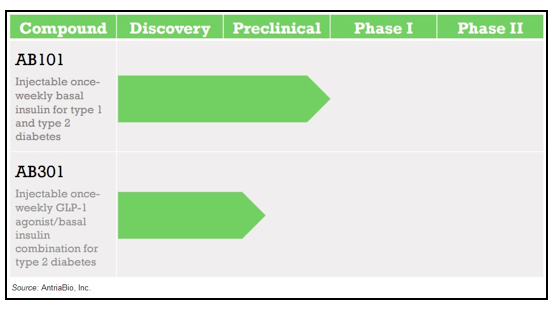
AntriaBio management recently adjusted the timeline for the AB101 U.S. IND filing and clinical trial initiation due to the FDA requiring an additional 5 months of stability data. We now expect that AntriaBio will file the U.S. IND by the first half of 2016, and that the Phase 1 clinical trial should commence during the second half of 2016. AntriaBio also recently added a once-weekly injectable GLP-1 agonist/basal insulin product for type 2 diabetes to its pipeline (AB301), and we will provide more details regarding this candidate below. We will also provide a quick review of the AntriaBio story and conclude with some thoughts on valuation, and long-term potential for investors.
The Path Forward for AB101
AntriaBio has now completed all preclinical pharmacology and toxicology studies in dogs and rats, as well as the build-out of the manufacturing facility in Louisville, CO and plans to produce AB101 material in accordance with current good manufacturing practices (cGMP). AntriaBio is in the process of getting the appropriate certifications for the facility, and we believe that facility will begin to produce fresh cGMP clinical material by the end of calendar year 2015 in preparation for the upcoming Phase 1 trial set to start during the second half of 2016.
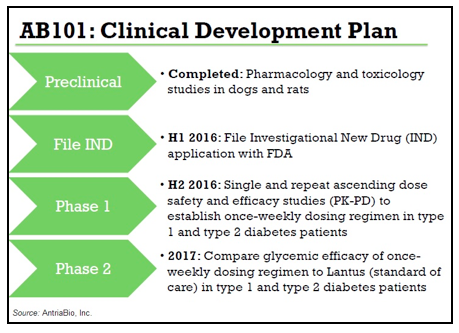
AntriaBio has a near-term AB101 clinical development plan in place, and it consists of:
- Step 1. File U.S. IND
Management has adjusted the timeline for filing the IND application to the first half of 2016. We were hoping to see the IND filed prior to the end of the fourth quarter of calendar year 2015, but we have learned that AntriaBio was in contact with the FDA through a pre-IND meeting request in order to gain guidance regarding its preclinical and clinical trials for AB101, and that the timeline has been slightly adjusted. Management initially believed that the FDA would require one month of stability data for AB101’s drug substance (peginsulin) for the filing of the IND, however the FDA came back stating that it would like at least six months of stability data. Management is working with the appropriate regulatory consultants, and does not believe that there will be any issues providing or regarding the stability data. This additional data requirement will result in a delay in the IND filing and initiation of the Phase 1 trial and subsequent trials. We hope that AntriaBio will be able to file the IND by the end of the first half of 2016 with no other hurdles so that clinical work can commence. We believe that AntriaBio remains focused on getting the IND filed in a timely fashion once the stability data is collected.
AntriaBio believes that AB101 will likely qualify as a new molecular entity (NME) for listing in the U.S. FDA’s Orange Book. However, because the company plans to reference significant historical information on insulin, PEGylation, dissolution, and emulsification, management believes the regulatory hurdle may be more favorable, including the low likelihood the company would have to conduct a dedicated cardiovascular (CV) outcomes study to gain approval or marketing rights. With the FDA requesting more stability data before filing the IND application for AB101, we are not sure if there will be more hurdles down the road. We will have to wait and see.
AntriaBio believes the AB101 intellectual property will be protected by existing patents around the PEG attachment to insulin and the mixture of the PEG-insulin with PLGA that do not expire until 2024. New patents have been filed around the manufacturing process that would likely protect AB101 until 2034-2035 based on priority date. On November 17, 2015, AntriaBio received a Notice of Allowance from the United States Patent and Trademark Office (USPTO) for U.S. Patent Application No. 14/324,734 titled, "Solvent Extraction From Biodegradable Microparticles." The application covers the methods around solvent extraction and rinse in the manufacturing process for product candidates AB101 and AB301, as well as other internal and external potential pipeline therapies that use AntriaBio's proprietary microsphere drug delivery platform. This Notice of Allowance indicates that the review of the patient application is complete, and that issuance of the patent is pending.
- Step 2. Initiate Phase 1 Clinical Study in the U.S.
The objectives of the first clinical study will be to assess the single dose of AB101 in type 1 and type 2 diabetes patients currently using Sanofi’s Lantus (insulin glargine). The Phase 1 study will be a single-center, randomized, open label, single ascending dose trial. This will be an in-hospital stay where roughly 40-50 patients will come in stable on Lantus and transitioned to receive one dose of AB101 and then monitored continuously for the next week. The euglycemic clamp technique will be performed on dosing day and at selected time points throughout the anticipated duration of action and is a way to quantify insulin sensitivity. The goal of the study is to demonstrate absence of peak and sustained duration of insulin levels. We believe results will be pretty cut-and-dry with respect to the utility of AB101. If a patient can effectively transition from daily Lantus to once-weekly AB101 with no issues over the following week in terms of glucose control and safety/tolerability, AntriaBio has a blockbuster on its hands. If there are significant issues in terms of patients experiencing hypo- or hyperglycemia or severe adverse events, then AntriaBio needs to go back to the drawing board with respect to the formulation of AB101.
Management was hoping for the first study for AB101 to commence in the fourth quarter of 2015, but with the FDA now requiring six months of stability data prior to the IND filing, this will delay initiation of the AB101 clinical program. According to the new timeline, management now believes that the study should begin at some point during the second half of 2016. We will have a better sense of the exact timing of this first study once the IND has been filed. With the adjusted timeline, we now believe data from the first clinical study can be generated by the end of 2016. We believe this study will cost an estimated $4-5 million all-in for AntriaBio.
- Step 3. Move into Phase 2 Clinical Studies in the U.S.
Following successful completion of the Phase 1 clinical studies noted above, Phase 2 trials should begin in both type 1 and type 2 diabetics. These will primarily be longer-duration safety and tolerability studies, with accepted biomarkers for glucose efficacy (i.e. HbA1c) comparing AB101 to a standard of care basal insulin such as Sanofi’s Lantus. If the proof-of-concept trials are successful, we expect the company to expand the clinical program to include Phase 3 registration trials in various regions around the world, including the U.S. and Europe.
Ultimately, if all goes well and the data are positive, we expect AntriaBio to look to partner AB101 with a larger pharmaceutical company with a heavy presence in the diabetes market, such as Novo Nordisk, Sanofi, and Eli Lilly. Other major players include Merck, Bristol-Myers, Roche, Novartis, Boehringer Ingelheim, and AstraZeneca. However, to get to the point where partnering AB101 is feasible, we believe the company will need to complete through Phase 2 clinical testing in the U.S. The goal is to show endpoints of glycemic control and safety comparable to a product like Lantus. Management believes there may also be an earlier opportunity to evaluate whether a partnership would make sense after the data readout from the Phase 1 clinical trial (in advance of completion of Phase 2 testing).
AB301: New Product Enters the Pipeline
On September 16, 2015, AntriaBio announced the addition of a new product candidate to its pipeline. AB301 is a weekly injectable combination of a PEGylated human glucagon-like peptide-1 (GLP-1) agonist and AB101, AntriaBio's basal insulin lead product candidate for the potential treatment for patients with type 2 diabetes. As per management, in vitro and in vivo studies that have been completed to date show that AB301 has the potential to be a well-tolerated, effective therapy for type 2 diabetes. Currently, AntriaBio is working on additional ongoing preclinical studies of AB301, and believes that a combination therapy has the potential to complement glycemic control while attenuating weight gain and hypoglycemic risk. Although it is still early on in the process, we will have a better sense of the potential when preclinical data and additional details become available.
GLP-1 agonists are now well-established treatment options for type 2 diabetes, and so we view this as good news for AntriaBio. There are numerous marketed daily and weekly GLP-1 agonists, and so AB301 hopes to differentiate itself by offering a combination therapy with extended duration of action. GLP-1 agonists work by stimulating the pancreas to produce and secrete insulin in response to eating meals. The benefit of this type of state-dependent stimulation is that once the blood sugar levels decrease to normal, the pancreatic response to produce insulin is reduced, unlike exogenously delivered insulin which can be over-dosed and creates the risk of hypoglycemia. GLP-1 agonists also work by suppressing the pancreatic release of glucagon in response to eating, which helps stop the liver from over-producing unneeded sugar. This helps to reduce the risk of hyperglycemia.
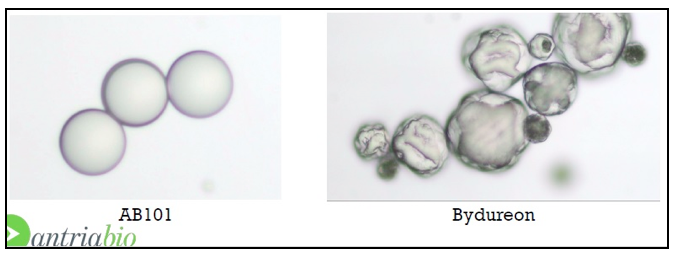
Amylin/Astrazeneca’s Bydureon (exenatide), a currently marketed GLP-1 agonist for type 2 diabetes, is also formulated using PLGA microspheres (below). We have discussed Bydureon in previous updates, but as a quick recap, it is a long-acting form of the medication Byetta. Bydureon had worldwide sales of $440 million in 2014, and is projected to have over $1 billion in peak sales.
We would also like to point out that there are currently some big players in the GLP-1 agonist/basal insulin combination therapy space but they are targeting once-daily dosing, as opposed to AntriaBio’s AB301 which is proposed to be a weekly injectable. Novo Nordisk’s Xultophy (IDegLira) is a fixed-dose once-daily combination of Tresiba (insulin degludec) and Victoza (liraglutide), and recently completed Phase 3 development in the U.S. and was approved in all 28 EU member states and Switzerland in September 2014. Novo Nordisk submitted the NDA for Xultophy to the FDA in September 2015. As way of background, Tresiba, the basil insulin component of Xultophy, was not approved by the FDA in 2013 due to concerns related to cardiovascular risk. Xultophy could not be submitted to the FDA until Tresiba received FDA approval, which finally occurred on September 25, 2015. We are not exactly sure when Xultophy will be approved in the U.S., but want to reiterate that it is a once-daily combination therapy.
Sanofi’s LixiLan is a fixed-ratio once-daily combination of Lantus (insulin glargine) and Lyxumia (lixisenatide) that is currently in Phase 3 development in the U.S. Sanofi reported positive Phase 3 top-line results Phase 3 with LixiLan meeting the primary endpoint of showing superior reduction in HbA1c vs. insulin glargine. We believe regulatory submissions are planned for the fourth quarter 2015 in the United States and the first quarter 2016 in the EU. Once again, LixiLan is proposed to be a once-daily dosing for type 2 diabetes.
We believe that pursuing this combination therapy was the next logical step for AntriaBio, given the success with GLP-1 agonists, and some larger names moving forward with GLP-1 agonists/basil insulin combination therapies. We think the combination of a GLP-1 agonist with basal insulin on a weekly dosing regimen makes a lot of sense as we continue to believe that there is a need for effective sustained release drug delivery systems that would minimize dosing frequency, improve patient compliance and therapeutic effectiveness, as well as potentially reduce costs. Although it is still early on in the process, we believe that AntriaBio plans to continue with preclinical studies and plans to submit an abstract by the end of calendar year 2015 to the ADA, in hopes to present AB301 data at the American Diabetes Association 76th Scientific Sessions® in June 2016. We are looking forward to reviewing the data once it is available.
Conclusion
Diabetes is a major public health challenge. According to the American Diabetes Association, 29.1 million Americans, or 9.3% of the population, had diabetes in 2012. In 2012, 86 million Americans over the age of 20 had pre-diabetes, which is up from 79 million in 2010. The International Diabetes Federation estimates that there are 387 million individuals worldwide with diabetes, and this number is projected to grow to over 470 million by 2035.
We believe there is a need for novel, and safe therapeutics that allow for proper glucose control, less frequent dosing in addition to slow and uniform insulin release without an adverse initial burst. We believe that if the clinical data for AB101 resembles the preclinical data and are positive, AntriaBio could have a blockbuster product on its hands. If there are any issues with hypo- or hyperglycemia or severe adverse events, then AntriaBio will need look at reformulation of AB101.
With the recent news of the FDA requiring six months of stability data, we view the delay in filing the IND for AB101 to be unfortunate, however we do believe that AntriaBio remains focused and on track to get this done by the end of the first half of 2016. We are not sure if the FDA will have any other regulatory requirements down the road, but if there are any, there may be additional delays to the timeline. We believe that path forward for AB101 may not be as straightforward for as AntriaBio had hoped, and there may be several other hiccups along the way that could further derail the timeframe. That being said, we continue to view AB101 as a promising new insulin option for individuals with diabetes.
We also believe that AntriaBio will need to raise an additional $15-20 million to get through calendar year 2016. We have seen the company raise over $20 million in 2014/early 2015, and we are hopeful that they will be able to do it again in order to continue with development for AB101 and AB301. However, we are unsure if AntriaBio will be able to do it in a timely fashion in order to adhere to the newly adjusted timeline. We will have a better sense of the path forward once the IND is filed and the clinical program for AB101 has commenced. Other upcoming milestones that the company is focused on achieving include preparing for the initiation of AB101 Phase 1 first-in-human clinical study, and the continuation of preclinical studies for new product candidate AB301.
Upon reviewing the preclinical proof of concept pharmacology data for June 2015, we continue to remain optimistic regarding the AB101 story. In our opinion, it was very reassuring to see that no acute undesirable insulin bursts or glucose reductions were observed. Furthermore, we believe that the slow onset, sustained insulin increases with corresponding glucose reductions over the course of about one week in both the dog and rat species support a once-weekly dosing of basal insulin for patients with diabetes. Obviously, it is still early on in the process, but we view these results as encouraging. We are hopeful that the efficacious doses used in the animal models will be readily translated to human clinically relevant doses and dose volumes. Management believes that the inter-species homology of insulin/receptor predicts insulin activity in humans, and we are hoping, that in the future, results from human trials show this predictable pattern. At this point, we continue to view AB101 as a promising new insulin therapy option for individuals with diabetes as well as clinicians. The preclinical data shows that the once-weekly injection offers a reproducible, slow and sustained release of insulin and reduction in glucose over the intended weekly dosing period, which if translated to patients with diabetes should provide uniform glycemic control with the convenience and compliance of a once-weekly injection and a lower risk of hyperglycemia.
We also believe that AntriaBio’s new pipeline candidate, AB301, could have potential if all goes well with AB101 and if the data are positive. It is still early for us, but as mentioned above, we believe that the combination of a GLP-1 agonist with basal insulin on a weekly dosing regimen makes a lot of sense as there is a need for effective sustained release drug delivery systems that would minimize dosing frequency, improve patient compliance and therapeutic effectiveness. AntriaBio’s product is proposed to be a once weekly candidate, while other big pharmaceutical companies are developing daily candidates.
We believe AB101 has peak sales in the area of $3.5 billion by 2028 if the clinical data are positive. We believe there are a number of value-creating inflection points on the horizon over the next several years, culminating with the signing of a major development and commercialization partnership for AB101 after the Phase 1/2 data has been generated. As noted above, we expect the results of the Phase 1 proof-of-concept study to be pretty straightforward and hope to see the data by the end of 2016. We will be able to see the insulin profile, and either AB101 works or it does not. If it works, we believe that AB101 could see a ten-fold increase in valuation as big pharmaceutical companies like Sanofi, Novo Nordisk and Eli Lilly, now become interested in acquiring the company.
Based on historical “big pharma / small-biotech” take-outs, we believe a deal will get done prior to the initiation of the pivotal registration program if the Phase 1/2 data are positive. We believe a company like Sanofi or Eli Lilly would be quite comfortable paying a premium to acquire AB101 if their internal numbers agree with our modeling that peak sales are in the $3.5 billion range by 2028.
We have built a financial model forecasting the risk-adjusted potential cash flow from selling AB101 on a global basis. Our assumptions include filing the U.S. NDA in 2020 and launching the product in 2021. We model peak sales of $3.5 billion in 2028 with 70% net operating margin at peak. We assuming exclusivity at 100% until 2024 and then risk-adjust the cash flow from 2025 to 2035 down by 50% until the new patents around the manufacturing process have been granted. At this stage, we are still assuming 10% probability of success. Positive AB101 Phase 1/2 data would provide meaningful upside to the AntriaBio story and increased probability of success. We have not yet factored in AB301 to our model, as it is still early and we believe it is largely dependent on what happens with AB101.
READ THE LATEST FULL RESEARCH REPORT HERE
SUBSCRIBE TO ZACKS SMALL CAP RESEARCH to receive our articles and reports emailed directly to you each morning. Please visit our website for additional information on Zacks SCR and to view our disclaimer.