By David Bautz, PhD
NYSE:APHB
Financial Update
On November 16, 2015, AmpliPhi Biosciences (NYSE:APHB) filed its Form 10Q with financial results for the third quarter of 2015. The company had $0.1 million in revenues that were related to sublicensing agreements involving the company’s former gene therapy program. Net loss for the quarter was $1.7 million, or $0.30 per share, which was comprised of $1.6 million in G&A and $0.7 million in R&D expenses. The company also had a non-cash gain of $0.7 million related to a change in the fair value of the company’s warrant liability and $7.0 million related to a change in the fair value of the company’s Preferred B stock derivative liability. Actual cash burn during the third quarter 2015 totaled $2.6 million.
AmpliPhi exited the third quarter of 2015 with $11.7 million in cash on the books. In March 2015, the company raised approximately $13 million in gross proceeds through the private placement of approximately 1.6 million shares of common stock at $8.25 per share (adjusted for the recent 1:50 reverse split). The offering also included approximately 0.49 million five-year warrants exercisable at $10.75 per share. Based on the company’s current cash position, we believe AmpliPhi has sufficient resources to fund operations into the second half of 2016.
Uplisting Complete
On August 4, 2015, AmpliPhi announced a 1-for-50 reverse stock split effective as of August 7, 2015 in anticipation of uplisting to the NYSE MKT. This decreased the number of common shares outstanding from approximately 289 million to approximately 5.8 million. On August 18, 2015, the company announced approval for listing on the NYSE MKT and the stock would begin trading on the NYSE MKT on August 21, 2015. This was an important milestone for the company as it will both increase liquidity in the company’s shares as well as enhance the company’s profile among potential investors.
Brief recap of the AmpliPhi stor
AmpliPhi is focused on the discovery, development and commercialization of bacteriophage treatments for bacterial infections. Bacteriophages are viruses that infect, replicate in, and kill bacterial cells while not harming eukaryotic cells. This exclusivity is vital to their use in combating infectious diseases, and their unique mechanism of action compared to traditional antibiotics means they can be used in place of or in conjunction with those therapies. In addition, with the rise of antibiotic resistant bacteria, there is a pressing need for more and better treatments for bacterial infections that are resistant to the effects of antibiotics.
While bacteriophages have been known for over 100 years, up until now their use as anti-infectious agents has been restricted to limited geographic regions (mainly Eastern Europe and Russia). This is due to the rise of antibiotics during the middle part of the 20th century that proved to be cheap, plentiful, and effective therapeutics. However, the rise of antibiotic resistant organisms has resulted in a clear need for alternative treatment options, specifically for ones that no longer respond to once effective antibiotic therapies.
Bacteriophage therapies potentially hold a number of advantages over antibiotics, including:
- Multiple modes of application
- Less severe side effects
- Localized and highly specific effect
- Very low doses
- Can treat antibiotic-resistant strains
- Unique mechanism of action makes resistance less likely
Below we provide an update on each major program at AmpliPhi.
AB-PA01 (formerly AmpliPhage-001)
AB-PA01 (formerly AmpliPhage-001) is being developed for the treatment of Pseudomonas aeruginosa lung infections in cystic fibrosis (CF) patients. CF is an autosomal recessive genetic disorder that affects close to 30,000 individuals in the U.S. and a total of 70,000 people worldwide. The most serious complication of the disease is recurrent lung infections, with the majority of CF-related morbidity and mortality being the result of chronic pulmonary sepsis, with the major infecting pathogen in CF lungs being P. aeruginosa.
AmpliPhi is developing AB-PA01 in collaboration with the Royal Brompton Hospital in London, England. During 2014, the company continued to optimize the phage mixture for treating mild to moderate CF and also conducted a productive meeting with the Medicines and Healthcare Products Regulatory Authority (MHRA) in the UK, where the company discussed the characteristics of the phage mixture being taken into the clinic as well as the study design for the clinical trial. The outcome of the meeting was extremely positive, with the authorities expressing a keen desire to see antibiotic alternatives move into the clinic.
AmpliPhi has already demonstrated that AB-PA01 can effectively kill P. aeruginosa in vitro. Additional preclinical animal studies will be occurring in 2015 to select the proper phage mixture, at which point the company will move on to scale up manufacturing for a GLP inhalation toxicology study. In June 2015, the company presented data showing that bacteriophages against P. aeruginosa retained their biological activity after nebulization. The phages were tested after nebulization through three different commercially available nebulizers, with results showing that four separate anti-Pseudomonas bacteriophages retained biological activity after nebulization with titer drops within the variability of the assay. This is important confirmation that nebulization could be a proper means of administering bacteriophages in future clinical trials.
Manufacturing of GMP product is expected to commence at the company’s brand new 4,000 sq. ft. facility in Ljubljana, Slovenia before the end of 2015. The company will then perform nebulizer studies in the first half of 2016 with an IND filing likely by mid-2016 and the initiation of a Phase 1/2 clinical trial in patients with mild to moderate CF at the Royal Brompton Hospital in the second half of 2016.
On March 31, 2015, AmpliPhi announced that the European Patent Office granted European patent No. EP 2570130 “Bacteriophage-containing Therapeutic Agents”. The claims of the European patent cover various bacteriophage preparations for use in combination with antibiotics for the treatment of biofilm-related infections caused by the bacterium Pseudomonas aeruginosa. Examples of specific treatment regimens covered include the treatment of human and animal infections resulting from a skin burn or skin wound, lung infections such as hospital acquired pneumonia (HAP) and cystic fibrosis (CF), urinary tract infection (UTI), or an infection associated with a medical device or implant.
AB-SA01 (formerly AmpliPhage-002)
AB-SA01 (formerly AmpliPhage-002) is being developed for the treatment of Staphylococcus aureus infections, including methicillin-resistant S. aureus (MRSA) infections. On November 19, 2015, AmpliPhi announced a clinical trial research agreement has been entered into with the University of Adelaide for the purpose of conducting a Phase 1 clinical trial of AB-SA01. The study is titled “A Phase 1 Investigator Initiated Study to Evaluate the Safety, Tolerability and Preliminary Effectiveness of AB-SA01 in Patients with Chronic Rhinosinusitis Associated with Staphylococcus aureus infection”.
The trial will be conducted at the Queen Elizabeth Hospital, Adelaide, Australia and AmpliPhi will supply the bacteriophage drug product for the clinical study. In addition, AmpliPhi will provide scientific input, protocol recommendation, and assist the study’s principal investigator with data management support. This represents a significant step forward for the company and we will be quite interested to see the data from this initial study.
The trial is expected to enroll nine patients who suffer from chronic rhinosinusitis and are also positive for S. aureus by nasal swab. Since this is a Phase 1 study, the primary endpoint is safety, however the company will also be collecting anecdotal evidence about how bacteriophage treatment affects the patients symptoms. As part of the standard of care these patients flush their sinuses twice a day with a sterile saline solution. The trial will involve the addition of different concentrations of bacteriophage to the saline solution that the patients use to flush out their sinuses. Cohort 1 will be dosed with 108 phage/mL in sterile saline twice daily for one week. Cohort 2 will be dosed with 109 phage/mL in sterile saline twice daily for one week. Cohort 3 will be dosed with the same concentration of phage as Cohort 2, but their treatment will last two weeks. The side effects for Cohort 1 will be evaluated to determine if any safety signals arise before Cohort 2 can be dosed, with the same thing happening before Cohort 3 can be dosed. The first patient is likely to be enrolled at some point over the next few weeks, and with only nine patients and a short treatment period, we anticipate the trial being conducted fairly quickly.
The treatment of chronic rhinosinusitis is one development pathway that the company is currently taking for AB-SA01, as the company’s collaboration with the U.S. Army is continuing for the development of a topical treatment for wound infections. We anticipate an Investigational New Drug (IND) application being filed before the end of the year such that the company can initiate a Phase 1 safety study of AB-SA01 in a topical formulation. The study will involve the use of healthy volunteers on intact skin, as the FDA is interested in whether there will be any type of allergic reaction to the bacteriophage. Assuming there are no safety signals, the company could move into a Phase 1b study in patients with infected wounds before the end of 2016.
Bacteriophage Against S. aureus Effective in Mouse Lung Infection Model
On September 18, 2015, AmpliPhi announced that data demonstrating the company’s bacteriophage cocktail demonstrated comparable efficacy to vancomycin in reduction of S. aureus in a murine lung infection model. The study was conducted in collaboration with the Hearts Consulting Group and the University of North Texas (UNT) Health Science Center and was presented at the ICAAC/ICC 2015 meeting.
To assess the in vivo efficacy of using bacteriophage to treat lung infections, neutropenic immunocompromised (ICR) mice were inoculated intranasally with S. aureus. At two and six hours post infection, bacteriophage cocktail or vancomycin was administered to various groups of mice as follows:
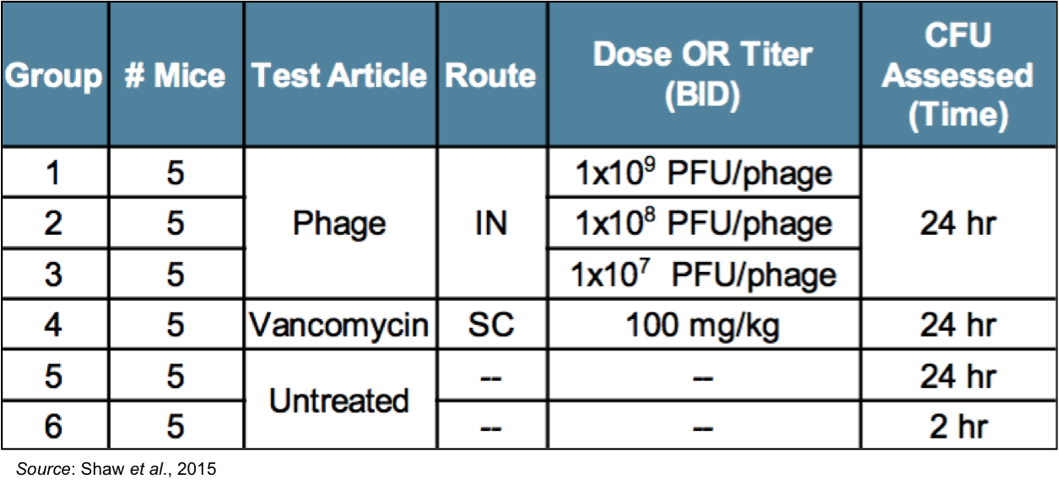
The following graph shows that in infected, untreated controls, the titers of bacteria in the lungs increased approximately two logs between two hours and 24 hours post-infection. In addition, administration of the two highest concentrations of bacteriophage cocktail resulted in a three-log reduction in bacterial counts in the lungs compared to the 24 hour non-treated control. Importantly, these two treatments were similar to the vancomycin-treated control group.
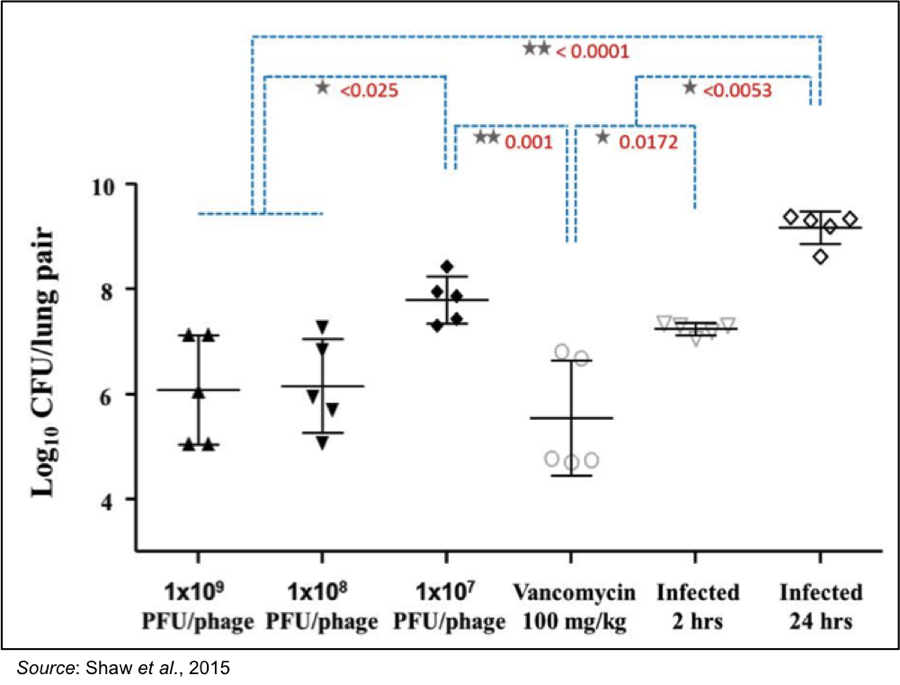
The demonstration of comparable efficacy between the bacteriophage cocktail and vancomycin is very encouraging, and further validates bacteriophage therapy as a potential solution for treating bacterial infections.
AB-CD01 (formerly AmpliPhage-004)
AB-CD01 (formerly AmpliPhage-004) is under development for the treatment of Clostridium difficile infections. C. difficile is a gram-positive, spore-forming bacterium that is best known for causing antibiotic-associated diarrhea. According to the U.S. CDC, It is estimated to cause upwards of 300,000 infections and 30,000 deaths every year in the U.S.
There are only two antibiotics approved for the treatment of C. difficile infections, thus there is a need for more treatment options as relapse rates are very high. Approximately 20% of patients will have a relapse infection, and once a patient has had one recurrence the chance of having another recurrence rises to 65%.
Earlier in the year, Dr. Martha Clokie provided an update on the research currently being conducted in regards to AB-CD01 at the University of Leicester. During 2014, research showed that the panel of bacteriophages capable of targeting C. difficile that has been assembled thus far kills 86% of the clinically relevant ribotypes, including the most prevalent and virulent ribotypes of C. difficile. Dr. Clokie discussed a number of successful pre-clinical studies that have taken place in a hamster model, a standard model that is very susceptible to the toxins produced by C. difficile. As of today, according to the company’s SEC filings, that number is now >90%, with some of the most clinically relevant strains, R014/020 and R027, on the list of ribotypes AB-CD01 kills. We anticipate a publication highlighting the preclinical results obtained thus far at some point in the near future.
During 2015, research will continue on phage optimization, formulation development, and the potential for combination therapies with antibiotics. We believe an IND will be filed in 2016, with first in human studies to potentially start in 2017.
Key Additions to Management and the Board of Directors
On September 2, 2015, AmpliPhi announced the appointment of Alexander Gaidamaka, PhD, DVM as the new Vice President of Chemistry, Manufacturing and Control. Prior to his role at AmpliPhi, Dr. Gaidamaka served as CEO and CSO of Personalized OncoTherapeutics Inc. He has held executive R&D, product development, and quality control roles at Pharma Green LLD, Merial, Sanofi Pasteur, Bioniche Life Sciences Inc. and Biopharm JSC. Dr. Gaidamaka was also previously head of the Department of Immunopharmacology & Allergology at the All-Union Research Institute of Drug Chemistry and Technology, Ukraine. He received a Ph.D. in immunology and microbiology and D.V.M from the Kharkov State Veterinary Academy, Ukraine.
On November 10, 2015, AmpliPhi announced the appointment of Vijay B. Samant and Paul C. Grint, MD to the Board of Directors. Mr. Samant is President and CEO of Vical, Inc., a developer of biopharmaceutical products for the prevention and treatment of chronic life-threatening infectious diseases. Dr. Grint is President and CEO of Regulus Therapeutics, Inc., a company focused on the discovery and development of microRNA therapeutics. Both individuals have extensive experience serving on the boards of publicly-traded companies and should provide valuable leadership experience to AmpliPhi has it moves to become a clinical stage company.
Conclusion
AmpliPhi has achieved important goals in 2015 that include uplisting of the company’s shares to the NYSE MKT and acquiring cGMP certification for the company’s manufacturing facility in Slovenia. In addition, the company continues to make steady progress toward getting bacteriophage therapies into clinical testing, as the first clinical trial involving AB-SA01 should begin in the next few weeks.
For valuation purposes, we use a probability-adjusted discounted cash flow model to value the company’s lead programs. We have assigned a probability of success of 25% for each of those programs and apply a 20% discount rate.
AB-PA01: We estimate that approximately 70% of CF patients will develop a P. aeruginosa infection that could be treated with AB-PA01. We forecast peak market share of 25%, although this number could be adjusted higher were AB-PA01 shown to eradicate P. aeruginosa in patients’ lungs, which translates into peak worldwide sales of approximately $550 million. This leads to a net present value for AB-PA01 of $54 million.
AB-SA01: For our model we estimate there are approximately 400,000 S. aureus infections in the U.S. every year and another 700,000 in the rest of the world. Approximately 70% of S. aureus infections now are MRSA, which we believe AB-SA01 will be best targeted for. With 20% market share we forecast peak worldwide sales of approximately $750 million. This leads to a net present value for AB-SA01 of $56 million.
AB-CD01: There are approximately 300,000 C. difficile infections in the U.S. every year and another 350,000 in the rest of the world. We estimate that AB-CD01 will cover 90% of the ribotypes for C. difficile and with peak market share of 25% we forecast peak worldwide revenues of approximately $900 million. This leads to a net present value for AB-CD01 of $56 million.
After factoring in $25 million of operating burn, this leads to a net present value for the company of approximately $141 million, and dividing this by the fully diluted share count of 9.2 million shares results in a price target of approximately $15.
We have previously stated that a reverse split and uplist were necessary before we get aggressive recommending the company, and now that the first clinical trial with SA-AB01 is set to begin we are ready to jump in and are assigning a ‘Buy’ rating to the stock. With a market cap of only $35 million, we see significant upside to an investment in AmpliPhi. Any investor that is interested in treatments that combat the growing threat of antibiotic resistance should seriously consider adding AmpliPhi to their portfolio.
READ THE LATEST FULL RESEARCH REPORT HERE
SUBSCRIBE TO ZACKS SMALL CAP RESEARCH to receive our articles and reports emailed directly to you each morning. Please visit our website for additional information on Zacks SCR and to view our disclaimer.