By Grant Zeng, CFA
NASDAQ:ARWR
On December 7, 2015, Arrowhead (NASDAQ:ARWR) presented chimpanzees data of ARC-520 at HEP DART 2015.
The Chimpanzee Study
The study included nine chimpanzees (5 males, 4 females; 9-37 years-old) chronically infected with HBV. Deep sequencing and phylogenetic analyses indicated that the HBV sequence is a chimpanzee variant of human HBV. At start of study, five chimps were HBeAg positive (HBeAg+), baseline DNA 8-9 log10 IU/mL serum; and four were HBeAg negative (HBeAg-), baseline DNA ≤3 log10 IU/mL. HBsAg levels ranged from 250-3190 µg/mL in HBeAg+ chimps and from 1.2-200 µg/mL in HBeAg- chimps.
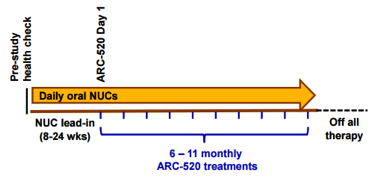
To reduce viral replication prior to treatment with ARC- 520, chimps were treated for 8-24 weeks with entecavir (ETV) or in one case (chimp Michele) with ETV+ tenofovir (TDF). Following the NUC lead-in period, animals were administered ARC-520 intravenously at 4- week intervals (q4w). Dose levels were 2, 3, or 4 mg/kg ARC-520, along with maintenance doses of ETV or ETV+TDF. Chimps were monitored for up to 31 weeks off all treatment.
The Data
Data showed that NUC only therapy had minimal effect on serum HBsAg levels while ARC-520+NUC demonstrated deep reduction in HBsAg levels. HBsAg was reduced at nadir in HBeAg+ chimps by 2.1 log10 (avg.) and in HBeAgchimps by 0.7 log10 (avg.) by treatment of NUC+ARC-520. Serum HBsAg was deeply reduced in HBeAg+ chimps, less so in HBeAg- chimps.
Molecular biology approaches were used to elucidate the differences in HBV biology in the HBeAg+ vs. HBeAg- chimps. The HBeAg+ chimps had high levels of cccDNA in the liver, whereas almost all the HBV DNA in the liver of HBeAg- chimps (95%) appeared to be integrated.
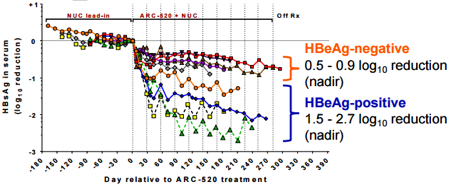
Specifically, two HBeAg positive chimps, Manetta and Tattoo, seroconverted for HBeAg.
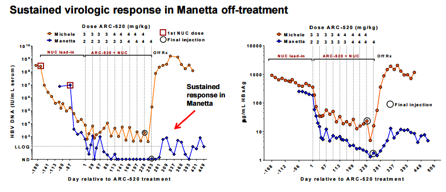
Chimp Manetta exhibited deep decreases in HBV DNA, RNA and viral proteins during ARC-520/NUC treatment. The sustained induction of CXCL9 in Manetta was associated with a therapeutic ALT flare (218 U/L) followed by HBeAg seroconversion. Sustained virologic improvements were still observed 31 weeks after all treatment was removed. At this final time point, serum HBV DNA was 5 log10 lower, HBsAg was 1.7 log10 lower, and liver HBV RNA was 99% lower than pre-study.
Tattoo had decreasing levels of HBeAg prior to and during NUC lead-in. Anti-HBe first detected 28 days prior to 1st ARC-520 injection. HBeAg lost following 1st ARC-520 dose and was sustained off-therapy.
8 out of 9 chimps exhibited episodes of serum cytokine CXCL9 elevation. For 7 chimps these occurred during ARC-520 treatment and in one chimp (Tattoo) these coincided with seroclearance of HBeAg that began prior to study. In Manetta and Michele, IFN-gamma induction on ARC-520 treatment was followed by induction of chemokines CXCL9 and CXCL10.
HBV suppresses the immune system to allow chronic HBV infection. Interferon gamma (IFN-γ) is a key antiviral cytokine critical to innate and adaptive immune responses. IFN-γ produced by natural killer cells and natural killer T cells induces the chemokines CXCL9 and CXCL10 to mediate a T-cell response. An elevation of CXCL9 in the chimps studied is a promising sign of immune system reactivation.
Our Takeaway
We are impressed by the data presented at HEP DART 2015 showing that in chronically HBV-infected chimpanzees treated with ARC-520 in combination with nucleoside analogs, 7 of 9 (78%) exhibited signs of immune reactivation, which is likely a necessary step for achieving a functional cure of chronic HBV. One chimpanzee also exhibited an on-treatment therapeutic ALT flare and sustained virologic improvements 31 weeks off all treatment.
The higher response rate is a big deal. We believe the elevations in T-cell responsive serum cytokines observed in this study represent a strong proof of principle that ARC-520 can begin the process of immune reconstitution that can lead to functional cure.
These data are particularly encouraging when combined with the recent Phase IIa human data of ARC-520. The Phase IIa data showed that ARC-520 can dramatically reduce s-antigen, e-antigen, and core-related antigen in humans after a single dose.
Update on Arrowhead’s ARC-520 Phase IIa HBV Program
Updated Data Presented at AASLD
In November 2015, Arrowhead presented updated data from its Phase IIa clinical study at The AASLD Liver Meeting 2015.
In the clinical study, 58 patients with chronic HBV received doses of 1mg/kg - 4 mg/kg of ARC-520 in 7 cohorts. The cohorts varied by ARC-520 dose, HBeAg status, and prior NUC treatment status. The primary objective of the study was to measure the depth and duration of HBsAg reduction in response to a single dose or two doses (cohort 6) of ARC-520 in combination with entecavir. Arrowhead also assessed safety and tolerability and additional secondary and exploratory endpoints.
In this presentation, Dr. Yuen and co-authors showed that in the Heparc-2001 clinical study, ARC-520 in combination with entecavir achieved maximum reductions of HBsAg, HBV DNA, HBeAg, and core-related antigen (HBcrAg) of 1.9 logs (99%), 4.3 logs (99.995%), 1.7 logs (98%), and 1.2 logs (93.7%), respectively.
HBeAg-positive, treatment naïve patients achieved consistent reductions in HBsAg with a mean maximal reduction of 1.5 logs (96.8%). ARC-520 caused a direct antiviral effect after a single dose that was still evident after 57 days, which was the last time-point available.
Consistent with findings from the chimpanzee study, HBeAg-positive treatment naïve patients experienced a greater relative reduction in HBsAg than patients that were HBeAg-negative or treatment experienced. One transitional patient in cohort 7 was HBeAg-positive at baseline and became HBeAg-negative at days 3 to 43. This patient experienced an intermediate response initially, however HBsAg continued to trend downward through day 57, the last time-point available.
The explanation: NUC treatment and HBeAg loss are associated with sharp reduction in cccDNA. As cccDNA is reduced, integrated DNA emerges as unexpected source of persistent HBsAg production.
Since ARC-520 is specifically designed to silence cccDNA, it shows deep knockdown of cccDNA derived gene products such as HBeAg. However, ARC-520 would not be expected to silence most integrated-derived HBsAg. NUC-naïve HBeAg-positive patients are expected to be richest in cccDNA.
ARC-520 was well tolerated with no serious adverse events (AE), no dose limiting toxicities, no discontinuations due to medication AEs. A modest occurrence rate (23%) of AEs were all deemed unrelated to study drug. No AE occurred more than once. There were no AEs amongst 10 patients receiving placebo. There was a low occurrence rate of abnormal laboratory tests, with no observed relationship to timing or dose.
The rationale for testing ARC-520 in HBeAg positive patients is based on Chimp study we discussed above. Clearly, from these chimp data and the data from the ARC-520 Phase IIa trial, ARC-520 seems to work better in the HBeAg positive subjects.
Pipeline further Expanded by New Candidates
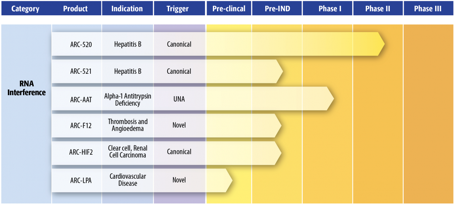
In September, 2015, Arrowhead nominated ARC-HIF2 as its first therapeutic candidate delivered using a new Dynamic Polyconjugate™ (DPC™) designed to target tissues outside of the liver. Arrowhead believes that ARC-HIF2, which uses RNA interference to silence transcription factor hypoxia-inducible factor 2α (HIF-2α), is a promising new candidate for the treatment of clear cell renal cell carcinoma (ccRCC).
ARC-HIF2 is designed to inhibit the production of HIF-2α, which has been linked to tumor progression and metastasis in ccRCC. Using ARC-HIF2 in a preclinical ccRCC tumor model, mice treated with weekly injections led to greater than 80% knockdown of HIF-2α mRNA in tumors. Furthermore, tumors from treated mice exhibited statistically significant reductions in size and weight, extensive tumor cell death, reduction in the tumor-expressed VEGF-A biomarker, and destruction of the blood vessels feeding the tumors.
The company presented positive preclinical data at the European Cancer Congress 2015 (ECC2015) in Vienna on September 27 in a poster titled "HIF-2α targeting with a novel RNAi delivery platform as therapy for renal cell carcinoma," (abstract #353).
The company is in the process of manufacturing scale up to allow for initiation of IND-enabling studies. Timing for anticipated regulatory submission will be announced in the future.
In October 2015, Arrowhead presented data from a new program, ARC-LPA, which is designed to reduce production of apolipoprotein A (apo(a)), a key component of lipoprotein(a) (LPa). LPa has been genetically linked with increased risk of cardiovascular diseases, independent of cholesterol and LDL levels.
Using a new subcutaneous delivery construct that Arrowhead has developed, an initial lead compound has achieved up to 90% knockdown of apo(a) in mice.
Arrowhead is also developing a preclinical program ARC-F12 for hereditary angioedema.
With a platform technology, we believe the pipeline can be further expanded with ease.
READ THE LATEST FULL RESEARCH REPORT HERE
SUBSCRIBE TO ZACKS SMALL CAP RESEARCH to receive our articles and reports emailed directly to you each morning. Please visit our website for additional information on Zacks SCR and to view our disclaimer.