By Grant Zeng, CFA
NASDAQ:ARWR
On Sept 24, 2015, Arrowhead (NASDAQ:ARWR) held an Analyst and Investor Day in NYC to provide recent clinical and non-clinical progress the company has made in its lead HBV program ARC-520.
The Background
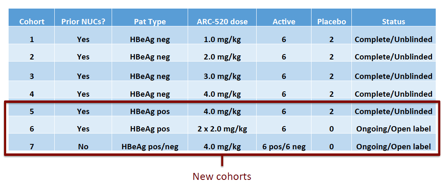
The Phase IIa trial (Heparc-2001) began doing patients on March 24, 2014 in Hong Kong. The ongoing Phase IIa is a randomized, double blind, placebo controlled study. The original trial plan was to enroll patients in three dose cohorts (1, 2, and 3 mg/kg) with patients receiving either ARC-520 or placebo in combination with entecavir. The trial expanded into four doses (1, 2, 3, and 4 mg/kg) in 7 cohorts later with the last three cohorts in HBeAg positive patients. Patients are randomized to placebo or ARC-520 at a ratio of 1:3 and continue daily entecavir. Primary endpoints will be safety and tolerability as well as depth and duration of surface antigen knock down. Patients will be followed until surface antigen levels return to baseline.
Interim Data Presented at AASLD
On November 10, 2014,Arrowhead presented the interim data from the ongoing Phase IIa ARC-520 in a late-breaking poster titled "Phase II, dose ranging study of ARC-520, a siRNA-based therapeutic, in patients with chronic hepatitis B virus infection" at the 2014 American Association for the Study of Liver Diseases (AASLD) Liver Meeting being held on November 7-11, 2014, in Boston.
As of the presentation, the Phase IIa study had enrolled three dose cohorts including 24 patients, 18 receiving drug and 6 receiving placebo. Unblinded data were available for the first two cohorts. Cohort 3 data collection was ongoing and this cohort was blinded then. Full results for the first two dose cohorts at 1.0 mg/kg and 2.0 mg/kg and partial (blinded) safety results from the 3.0 mg/kg dose cohort were included in the poster.
Per the poster, ARC-520 was safe and well tolerated in all three cohorts. There were no SAEs, no signs of hypersensitivity, no dose limiting toxicities and no discontinuations due to AEs. There were no treatment emergent changes in vital signs, physical exams or ECGs rated clinically significant by the investigator. There have been few abnormal laboratory values, with no clinically significant, treatment emergent, changes in ALT, AST, GGT, LDH, bilirubin, BUN or creatinine or apparent trends. All AEs reported to date (n=6) have been mild or moderate and rated as unrelated to study drug by the investigator.
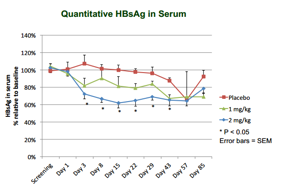
Efficacy of ARC-520 was measured as HBsAg decline from baseline. In the 1 mg/kg cohort, mean nadir HBsAg was -39% (range -22 to -57) with a mean change on day 85 of -31% (range -14 to -39). In the 2 mg/kg cohort, mean nadir HBsAg was – 51% (range -46 to -59) with a mean change on day 85 of -22% (range -7 to -40). For 2 mg/kg cohort, the HBsAg reduction was statistically significant vs placebo for Days 3 through 43 post dose. For cohort 2, the mean day of HBsAg nadir was day 33 with a range of day 8 to day 57.
Update on the Phase IIa ARC-520 on the Analyst Day
On the analyst day, Arrowhead presented the data from the 3rd, 4th and 5th cohorts (3, 4mg/kg).
Based on the animal model, the company interpreted the 1 and 2 mg/kg data as indicating that ARC-520 is on the low end of the response curve. Since dosing in healthy subjects to 4 mg/kg appeared safe, the company added 3 and 4 mg/kg cohorts to the Phase IIa trial, still in HBeAg negative patients on chronic entecavir.
However, the peak knockdown of HBsAg in best responders in HBeAg negative patients in the 3 and 4 mg/kg cohorts continued to be around 60% (cohort 3 and 4). Even with the HBeAg positive patients, the best knockdown of HBsAg is still around 80% after a single dose (cohort 5). This is a surprise to us.
The explanation: NUC treatment and HBeAg loss are associated with sharp reduction in cccDNA. As cccDNA is reduced, integrated DNA emerges as unexpected source of persistent HBsAg production.
Since ARC-520 is specifically designed to silence cccDNA, it shows deep knockdown of cccDNA derived gene products such as HBeAg. However, ARC-520 would not be expected to silence most integrated-derived HBsAg. NUC-naïve HBeAg-positive patients are expected to be richest in cccDNA.
Data form HBeAg Positive/NUC Naive Patients Provide Different Insight into the ACR-520 Program
Preliminary data from the HBeAg positive/NUC naïve patients (cohort 7) are encouraging.
HBeAg-positive patients on a background of chronic entecavir receiving a 4 mg/kg single-dose of ARC-520 showed a mean maximal 92% (1.2 log) reduction (knockdown, KD) in circulating HBeAg and a best reduction of 98% (1.7 log).

In the cohort of NUC-naïve, HBeAg-positive patients, best peak HBsAg reduction has been 99% (1.9 log) and the mean maximum HBsAg reduction has been 1.05 log through 15 days post ARC-520 treatment. This open-label cohort is fully enrolled; data collection is ongoing and will be continued through Day 85 post ARC-520 treatment. These reductions are substantially higher than results from NUC treatment-experienced cohorts
Similar mean maximal reductions were also demonstrated in HBV core-related antigen (HBcrAg) from both HBeAg-negative and -positive patients. ARC-520 is designed to silence all gene products expressed by HBV cccDNA, so this data suggests that it may be substantially disrupting additional viral functions.
The Rationale for Testing ARC-520 in HBeAg Positive Patients
The rationale for testing ARC-520 in HBeAg positive patients is based on Chimp study. Almost at the same time the company was collecting data from the dose cohorts of 3 and 4 mg/kg in HBeAg negative patients, Arrowhead started to receive chimp data from multiple dose of ARC-520.
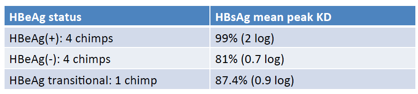
9 chimps, which are chronically infected with HBV for multiple years, were first suppressed with NUCs and then treated with 6 – 11 monthly doses of ARC-520 (2, 3 and 4 mg/kg).
- 4 HBeAg-positive chimps demonstrated 99% (2 log) mean peak reduction in HBsAg, and 1 of the 4 experienced signs of immune reactivation during therapy;
- 4 HBeAg-negative chimps demonstrated 81% (0.7 log) mean peak reduction in HBsAg; and
- 1 chimp transitioning from HBeAg-positive to HBeAg-negative demonstrated peak HBsAg reduction of 87% (0.9 log).
ARC-520 was well tolerated in all 9 chimps.
Clearly, from these chimp data and the data from the last three cohorts of the ARC-520 Phase IIa trial, ARC-520 seems to work better in the HBeAg positive subjects.
ARC-520 has Been Well Tolerated
So far, total of 84 humans have received ARC-520 and to date no adverse events have been rated as serious or severe, no discontinuations have occurred due to an adverse event, and no laboratory results have indicated any end organ toxicity.
Additionally, 9 chimps received 6-11 monthly doses of ARC-520 and no safety signals were detected in any chimp.
New Development Plan for the HBV Program
Based on the chimp data and data from the Phase IIa trial, Arrowhead updated its new development plan for its HBV program.
ARC-520 will continue development including focus on the significant market of e-antigen positive, treatment-naïve chronic HBV patients.
The company plans to initiate trial Heparc-2008 (Monarch cohorts). This study is intended to be a study of various dosing regimens and combinations (multi-drug cocktail). It will have a flexible iterative design, which means that the company can ask specific questions about ARC-520 in small open-label cohorts and quickly initiate additional cohorts based on the answers that it gets or the availability of new agents to be tested in combination.
The company plans to begin Monarc as soon as possible. We expect it will be initiated in the fourth quarter. We expect to see deep knockdown of all gene products, especially in HBeAg positive patients.
It is estimated in the U.S. that 95% of people chronically infected with HBV are currently NUC-naïve and at least 50% of them are likely to be HBeAg-positive. In West Europe, 90% of estimated CHB patients are naïve, and about 33% of them are HBeAg positive. The effect on HBsAg in NUC-naïve HBeAg-positive patients makes this group especially attractive to study and a key focus for multi-dose studies going forward.
Arrowhead also has nominated a new candidate ARC-521, which is being developed to target both cccDNA and also integrated DNA, which appears to be a more significant producer of HBsAg in patients who have been treated with NUCs or who are e-antigen negative.
ARC-521 is also derived from the company’s DPC platform; therefore its safety profile is expected to be similar to ARC-520. While ARC-520 is designed to target cccDNA, ARC-521 is designed to target both cccDNA and integrated DNA. Therefore, ARC-521 is a complement to ARC-520.
In HBeAg-negative chimps predicted to have higher levels of integrated DNA, administration of ARC-521 led to 99% (2 logs) of additional HBsAg reduction. ARC-521 is in GMP manufacturing now and is expected to enter GLP toxicity this fall. The Company expects to file an IND or equivalent for ARC-521 by mid-2016.
Pipeline further Expanded by ARC-HIF2
On Sept 11, 2015, Arrowhead announced that it has nominated ARC-HIF2 as its first therapeutic candidate delivered using a new Dynamic Polyconjugate™ (DPC™) designed to target tissues outside of the liver. Arrowhead believes that ARC-HIF2, which uses RNA interference to silence transcription factor hypoxia-inducible factor 2α (HIF-2α), is a promising new candidate for the treatment of clear cell renal cell carcinoma (ccRCC).
ARC-HIF2 is designed to inhibit the production of HIF-2α, which has been linked to tumor progression and metastasis in ccRCC. Using ARC-HIF2 in a preclinical ccRCC tumor model, mice treated with weekly injections led to greater than 80% knockdown of HIF-2α mRNA in tumors. Furthermore, tumors from treated mice exhibited statistically significant reductions in size and weight, extensive tumor cell death, reduction in the tumor-expressed VEGF-A biomarker, and destruction of the blood vessels feeding the tumors.
The company presented positive preclinical data at the European Cancer Congress 2015 (ECC2015) in Vienna on September 27 in a poster titled "HIF-2α targeting with a novel RNAi delivery platform as therapy for renal cell carcinoma," (abstract #353).
The company is in the process of manufacturing scale up to allow for initiation of IND-enabling studies. Timing for anticipated regulatory submission will be announced in the future.
READ THE LATEST FULL RESEARCH REPORT HERE
SUBSCRIBE TO ZACKS SMALL CAP RESEARCH to receive our articles and reports emailed directly to you each morning. Please visit our website for additional information on Zacks SCR and to view our disclaimer.