By Grant Zeng, CFA
NASDAQ:ARWR
In April, the FDA has cleared the multiple-dose Phase IIb clinical study of ARC-520 for the treatment of chronic hepatitis B infection. Arrowhead (NASDAQ:ARWR) expects to begin dosing patients in the U.S. in 2Q15. The company has filed with various regulatory authorities in Europe and Asia to explore additional multi-dose studies of ARC-520 outside of the U.S. The company expects to start international studies in the summer.
The clinical study, titled Heparc-2004, is a multicenter, randomized, double-blind, placebo-controlled, multi-dose study of ARC-520 administered intravenously to patients with chronic immune active HBV infection maintained on entecavir or tenofovir therapy. The study is planned to enroll up to 12 patients who will be randomized at a ratio of 2:1 with 8 patients receiving 1 mg/kg of ARC-520 and 4 patients receiving placebo. Each patient will receive 3 total doses, once every 4 weeks. Patients will be followed through Day 147.
The primary objective of Heparc-2004 is to evaluate the depth of hepatitis B surface antigen (HBsAg) decline in response to multiple doses of ARC-520 compared to placebo in patients with chronic, immune active HBV infection as a measure of drug activity. Secondary objectives are to measure safety and tolerability and pharmacokinetics of ARC-520, and to evaluate the effect of ARC-520 on entecavir or tenofovir pharmacokinetics, in addition to other exploratory safety and pharmacodynamic objectives.
Originally, Arrowhead proposed a parallel design multiple-dose Phase IIb study testing doses of 2 mg/kg and 4 mg/kg simultaneously. However, in January 2015, the FDA placed a partial clinical hold on the program. In order to proceed with the proposed parallel design study, the FDA requested that the Company provide additional information including data from the single-dose Phase IIa study in patients who receive 1-4 mg/kg ARC-520, data from an ongoing multiple-dose non-clinical study, and data from Heparc-2004 which is now cleared to begin.
The company’s plan is still to seek approval for parallel design ex-US.
Based on the current situation, we estimate top line data from the Phase IIb trial will be available in mid-2006. We expect Arrowhead will be able to initiate pivotal Phase III trial of ARC-520 in late 2016, and data should be available in mid-2017. NDA could be filed in late 2017, and the FDA approval is in late 2018.
We think ARC-520 is the primary value driver in near- and mid-term for Arrowhead. The successful development of ARC-520 is critical to Arrowhead because the HBV market offers opportunities for substantial revenues, and because validation of the Company’s RNAi delivery technology opens broad opportunities both for other therapeutic programs and licensing opportunities.
In this regard, the ongoing Phase IIa study and the initiation of the Phase IIb of ARC-520 represent an important milestone for Arrowhead in achieving its long term growth goal. One of the attractive features of RNAi and of DPCs specifically is once the safety profile in man for the delivery system has been established; additional targets and candidates can be studied rapidly. Therefore the Phase II trials of ARC-520 will provide the company with the data needed to accelerate the development of its pipeline and bring additional candidates into the clinic.
Update on the Phase IIa of ARC-520 for HBV Infection
On November 10, Arrowhead presented interim data on ARC-520 in a late-breaking poster titled "Phase II, dose ranging study of ARC-520, a siRNA-based therapeutic, in patients with chronic hepatitis B virus infection" at the 2014 American Association for the Study of Liver Diseases (AASLD) Liver Meeting being held on November 7-11, 2014, in Boston.
The ongoing Phase IIa is a randomized, double blind, placebo controlled study, which will enroll up to 24 chronic HBV patients in three dose cohorts with patients receiving either ARC-520 or placebo in combination with entecavir. Patients are randomized to placebo or ARC-520 at a ratio of 1:3 and continue daily entecavir. Primary endpoints will be safety and tolerability as well as depth and duration of surface antigen knock down. Patients will be followed until surface antigen levels return to baseline.
The Phase IIa trial began doing patients on March 24, 2014 in Hong Kong. The Phase IIa study has enrolled three dose cohorts including 24 patients, 18 receiving drug and 6 receiving placebo. Unblinded data are available for the first two cohorts. Cohort 3 data collection is ongoing and this cohort remains blinded. Full results for the first two dose cohorts at 1.0 mg/kg and 2.0 mg/kg and partial (blinded) safety results from the 3.0 mg/kg dose cohort were included in the poster.
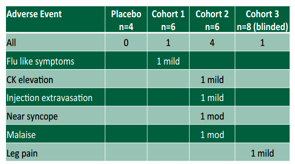
Per the poster, ARC-520 was safe and well tolerated in all three cohorts. There were no SAEs, no signs of hypersensitivity, no dose limiting toxicities and no discontinuations due to AEs. There were no treatment emergent changes in vital signs, physical exams or ECGs rated clinically significant by the investigator. There have been few abnormal laboratory values, with no clinically significant, treatment emergent, changes in ALT, AST, GGT, LDH, bilirubin, BUN or creatinine or apparent trends. All AEs reported to date (n=6) have been mild or moderate and rated as unrelated to study drug by the investigator.
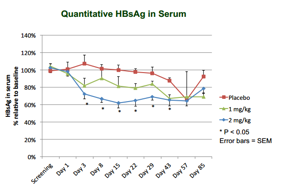
Efficacy of ARC-520 was measured as HBsAg decline from baseline. In the 1 mg/kg cohort, mean nadir HBsAg was -39% (range -22 to -57) with a mean change on day 85 of -31% (range -14 to -39). In the 2 mg/kg cohort, mean nadir HBsAg was – 51% (range -46 to -59) with a mean change on day 85 of -22% (range -7 to -40). For 2 mg/kg cohort, the HBsAg reduction was statistically significant vs placebo for Days 3 through 43 post dose. For cohort 2, the mean day of HBsAg nadir was day 33 with a range of day 8 to day 57.
The company has completed dosing, both 3 and 4 mg/kg cohorts and is still following the 4 mg/kg cohort.
During second quarter conference call, management disclosed that the company is expanding the Phase IIa trial to three additional dose cohorts. According to management, the company already enrolled and dosed 7 of 8 patients in the first new cohort and hopes to dose the last patient shortly. The second additional cohort is recruiting patients now. Arrowhead plans to discuss the new cohorts at the Analyst Day in third quarter.
As a result of the three new additional cohorts, the full data from the Phase IIa study will be announced in 3Q15 instead of 2Q15.
Arrowhead Completed Part A of Phase I Trial of ARC-AAT
In late February, Arrowhead initiated dosing in a Phase I clinical trial of ARC-AAT for the treatment of liver disease associated with Alpha-1 Antitrypsin Deficiency (AATD) in Australia.
The Phase I trial is a multi-center, randomized, placebo-controlled, double-blind, single dose-escalation study to evaluate the safety, tolerability, pharmacokinetics of ARC-AAT and the effect on circulating alpha-1 antitrypsin (AAT) levels. The study plans to enroll in dose cohorts of six participants each, with participants randomized at a ratio of 2:1 (active:placebo) to receive a single intravenous injection of either ARC-AAT or placebo (normal saline). The study will consist of two parts, with Part A planned to be conducted in healthy volunteers and Part B planned to be conducted in patients with PiZZ genotype AATD. In Part A, dose escalation will proceed until the achievement of certain target knockdown parameters. That target is at least 30% reduction of serum AAT levels in 3 subjects or greater than 60% reduction in a single subject. When these AAT knockdown parameters are achieved, dose escalation in healthy volunteers (Part A) is planned to stop and dosing in patients with AATD (Part B) is planned to begin at the highest dose level used in Part A and then dose escalation will proceed. Participants will be evaluated for 28 days following dosing with additional follow-up every 2 weeks until AAT levels return to baseline.
In early May, the company completed dosing healthy volunteers and will begin dosing patients.
ARC-AAT is comprised of novel unlocked nucleobase analog containing RNAi trigger molecules (UNA) that are co-administered with Dynamic Polyconjugates (DPCs) to enable the escape of the UNA from endosomes. The ratio of UNA to DPC is 2:1 by weight. In Part A of the study, three cohorts of six participants each received ARC-AAT at doses of 0.38 mg/kg, 1.0 mg/kg, and 2.0 mg/kg of UNA, and 0.19 mg/kg, 0.5 mg/kg, and 1.0 mg/kg of DPC, respectively.
The knockdown target was met during the third cohort. All three dose levels tested appear to be generally well tolerated and the data safety committee has cleared the study to move into patients with AATD. Dosing in patients may now begin at the highest dose level used in Part A and then continued dose escalation may proceed under the protocol.
The company expects to complete the Phase I study by the end of 2015.
Initial data from this study is expected in late 2015.
Arrowhead has signed an agreement with the Alpha-1 Project (TAP), a subsidiary of the Alpha-1 Foundation. Under the terms of the agreement, TAP will partially fund the development of ARC-AAT. In addition to the funding, TAP will make its scientific advisors available to Arrowhead, assist with patient recruitment for clinical trials thanks to the Alpha-1 Foundation Patient Research Registry, and engage in other collaborative efforts that support the development of ARC-AAT.
ARC-AAT is Arrowhead’s second clinical candidate, which further de-risks its pipeline. In the absence of specific therapy other than liver transplant for AATD associated liver disease, we believe RNAi holds great potential.
With the experience of two candidates ARC-520 and ARC-AAT, the DPC platform, the recently acquired RNAi assets from Novartis, as well as a strong balance sheet, we believe Arrowhead is well positioned to further diversify its pipeline down the road.
READ THE LATEST FULL RESEARCH REPORT HERE
SUBSCRIBE TO ZACKS SMALL CAP RESEARCH to receive our articles and reports emailed directly to you each morning. Please visit our website for additional information on Zacks SCR and to view our disclaimer.