By Grant Zeng, CFA
NASDAQ:CASI
CASI Pharmaceuticals, Inc. (NASDAQ:CASI) is a commercial stage biopharmaceutical company focused on the acquisition, development and commercialization of innovative therapeutics for cancer and autoimmune disease for the global market with a commercial focus on greater China area.
The company aims to become an integrated biopharmaceutical company with significant market share in China, while establishing partnerships for global development and commercialization. In order to achieve this goal, CASI has implemented a unique business model: pursuing its internal proprietary pipeline development and at the same time acquiring additional drug candidates to build a rich product portfolio.
The internal drug development utilizes a dual development strategy to leverage its expertise and resources in North America and China to bring safer, more effective, and/or easier-to-use drugs to patients and to develop them more cost-effectively while its import drug business in China takes advantage of shorter timeframe of the drug registration process in the country.
ENMD-2076 for Multiple Cancers
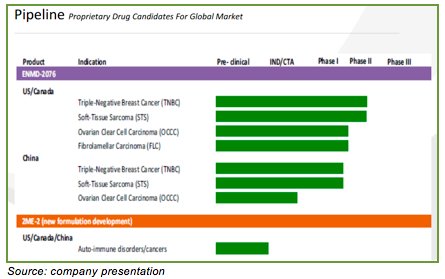
The company’s lead drug candidate is ENMD-2076, a selective Aurora A and angiogenic kinase inhibitor for the treatment of cancer. CASI is developing ENMD-2076 in the U.S. and Canada for approval by the FDA, and has expanded its U.S. trial in triple-negative breast cancer (TNBC) to China sites, and will follow a similar pathway to include China sites for its ongoing U.S./Canada trials in advanced/metastatic soft tissue sarcoma (STS), and in advanced ovarian clear cell carcinomas (OCCC). The combined data can potentially be used to support global filings as well as import drug registrations in China.
ENMD-2076 has demonstrated significant, dose-dependent preclinical anti-cancer efficacy as a single agent in multiple xenograft models (e.g. breast, colon, leukemia and liver), as well as in ex vivo human leukemia patient cells. ENMD-2076 also has shown promising activity in Phase I clinical trials in solid tumors including ovarian, breast, liver, renal and sarcoma, as well as in leukemia and multiple myeloma. In these tumors, ENMD-2076 achieved partial response rate of 3% and stable disease of 85% with overall response rate of 88%, which we think is very promising.
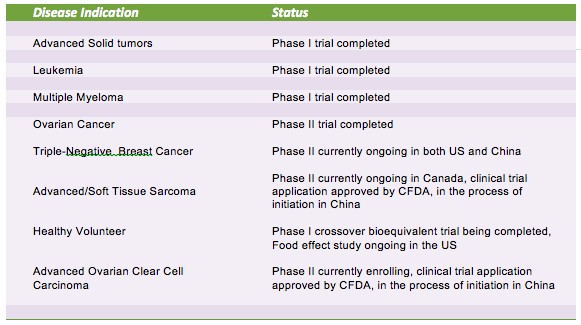
CASI also has completed a Phase II trial of ENMD-2076 in ovarian cancer. The company is currently conducting multiple Phase II studies of ENMD-2076 in triple-negative breast cancer (TNBC), advanced/metastatic soft tissue sarcoma (STS), and in advanced ovarian clear cell carcinomas (OCCC) in North America.
In addition to the clinical trials in the U.S. and Canada, CASI has received approvals from the China Food and Drug Administration (CFDA) to initiate Phase II clinical trials for ENMD-2076 in TNBC, advanced/metastatic sarcoma, and advanced ovarian clear cell carcinoma in the country. The company has initiated the TNBC trial and currently is recruiting patients while is in the planning process for trials in China for the other two indications. The clinical trials in China will supplement the company’s ongoing Phase II trial currently underway in North America.
The status and development of ENMD-2076 is outlined below:
ENMD-2076 has received orphan drug designation from the FDA for the treatment of ovarian cancer, multiple myeloma, acute myeloid leukemia and hepatocellular carcinoma (HCC).
New Indication of ENMD-2076 for FLC
In September 2014, CASI filed an investigational new drug application (IND) with the FDA to conduct a Phase II trial in advanced FLC and received allowance from the Agency soon after. In February 2015, CASI held a meeting with the FDA and received the Agency’s guidance on clinical and regulatory development plan.
Based on the guidance from the FDA,
- CASI plans to conduct a single arm trial to evaluate the objective response rate (ORR) of ENMD-2076 in FLC patients as the primary endpoint.
- The trial will be conducted as a Simon 2-stage study with interim futility analysis released after 16 patients reach a clinical event. Futility would be declared if none of the patients experience an objective response and would result in the termination of the study.
- If, however, one or more patients experience an objective response, the study would continue with additional patients. At that time, the company would expect to meet with the FDA to discuss what clinical efficacy endpoint would be considered reasonably likely to provide clinical benefit and support an accelerated approval based on the surrogate endpoint of tumor response.
- Assuming that the results of the proposed study show that ENMD-2076 improves objective tumor response, CASI would expect to propose a confirmatory clinical trial and, in parallel, submit an NDA for accelerated approval based on objective tumor response rates.
- CASI will submit to the FDA a request for breakthrough therapy designation whenever clinical data meets the appropriate criteria.
We think the feedback from the FDA is very encouraging, which provides ENMD-2076 a clear clinical and regulatory path going forward. We are especially encouraged that ENMD-2076 could potentially gain accelerated approval if the primary endpoint is met in the Phase II study.
FLC is a rare form of liver cancer that usually occurs in young adults who have no history of liver disease.
The typical treatment is surgery. When the tumor cannot be removed surgically or when there is distant spread, systemic treatment is used. Currently, there is no standard systemic therapy regimen for FLC.
FLC comprises approximately 5% of all hepatocellular carcinomas (HCC). The total incidence of HCC is estimated to be 780,000 each year worldwide according to the World Health Organization. Therefore, each year, approximately 39,000 people are diagnosed with FLC worldwide.
Peak sales of ENMD-2076 for FLC alone could be in the neighborhood of $200 million worldwide if we assume a reasonable cost of $50,000 for each patient and about 10% market share of new incidence when ENMD-2076 is approved for FLC.
2ME2 for Autoimmune Disease/Cancer
CASI’s proprietary pipeline also includes 2ME2 for the treatment of autoimmune disease such as rheumatoid arthritis, multiple sclerosis, and cancer.
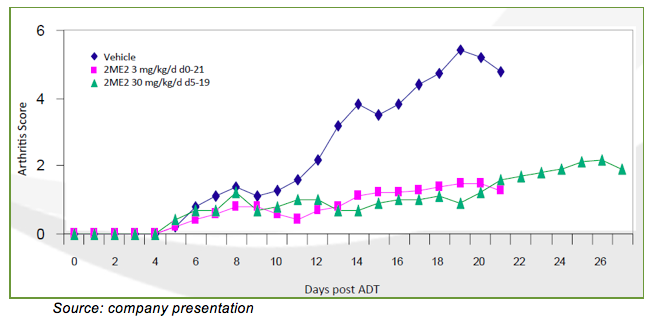
2ME2 (2-methoxyestradiol) is an orally active compound that has antiproliferative, antiangiogenic and anti-inflammatory properties. Preclinical animal studies of 2ME2 have demonstrated significant efficacy for multiple cancers and autoimmune disease, including RA and multiple sclerosis (MS). Additional preclinical studies are ongoing in collaboration with research institutes in the US.
The following picture demonstrates strong efficacy of 2ME2 for arthritis in an animal model.
The company also completed multiple Phase I and II clinical studies in cancer patients with solid tumors and multiple myeloma. 2ME2 has demonstrated excellent safety profile and promising activities in these studies. The previous clinical challenge for the product is attributed to its very poor bioavailability, which prohibited the reach of optimal therapeutic level in patients. The current development focus is to improve product solubility and bioavailability through its internal novel drug delivery technology platform.
CASI has filed an IND of 2ME2 with the FDA for rheumatoid arthritis and is exploring multiple strategies for the development of 2ME2 including potential internal development and partnership opportunities.
Product Sales from Zevalin Will be Generated in 2015
CASI is also dedicated to the expansion of its product pipeline through the acquisition of drug candidates, which, we think, will provide sustainable growth for the company.
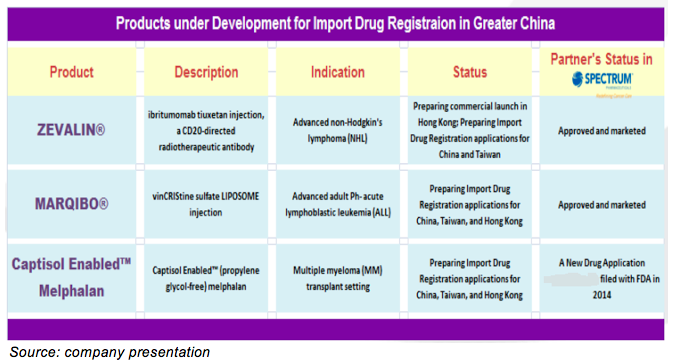
In September 2014, CASI acquired from Spectrum Pharmaceuticals, Inc. exclusive rights for greater China to three oncology products, including Zevalin ® (ibritumomab tiuxetan), approved in the U.S. for advanced non-Hodgkin’s lymphoma, Marqibo® (vincristine sulfate liposome injection), approved in the U.S. for advanced adult Ph- acute lymphoblastic leukemia (ALL), as well as Evomela (captisol enabled ™ melphalan), which is under the FDA review for marketing approval and is expected to be approved by the FDA in October 2015.
The company has initiated the drug registration process to obtain marketing approval for these products in China and will initiate commercial activity of Zevalin® in Hong Kong.
Zevalin IV injection is a CD20-directed radiotherapeutic antibody. It is approved in the US for the treatment of relapsed or refractory, low-grade or follicular B-cell non-Hodgkin’s lymphoma (FNHL). Zevalin is also indicated for the treatment of patients with previously untreated follicular non-Hodgkin’s Lymphoma who achieve a partial or complete response to first-line chemotherapy. A Phase III trial in diffused large B cell lymphoma (DLBCL) is ongoing.
Zevalin has been cleared for marketing in Hong Kong and CASI plans to officially commence commercial activities with the drug in 3Q2015. Since Hong Kong is a relatively small market for oncology, we don’t expect meaningful sales in Hong Kong. However, we think the launch of Zevalin in Hong Kong is strategically important to CASI in a few aspects. First, since Hong Kong is close to mainland China, which has a much larger cancer patient population, launching Zevalin in Hong Kong will raise the drug’s visibility in both Hong Kong and mainland China, which could help penetrate the China market when Zevalin gets final approval in China. Second, CASI will also gain marketing experience from Zevalin launch in Hong Kong, which is important for the future products launch in China. Third, we believe it is the first step of the company’s building up its commercialization capabilities, a record breaking in the company’s history.
CASI is currently registering Zevalin in China. Since Zevalin is already approved in the US, we believe that gaining approval from local regulatory authorities for commercialization in greater China will require a shorter timeframe compared to clinical-stage drugs. It usually takes about 3 to 4 years to get approval of an imported drug in China. We expect Zevalin to be approved by CFDA in 2019.
More Imported Drugs Will be Launched in China
In addition to Zevalin, CASI is also in the process of registering Marqibo in China and we estimate it will be approved in 2020.
Marqibo is a novel, liposome-encapsulated, formulation of vincristine sulfate, a microtubule inhibitor. Marqibo is approved in the US for the treatment of adult patients with Philadelphia chromosome-negative (Ph-) acute lymphoblastic leukemia (ALL) in second or greater relapse or whose disease has progressed following two or more anti-leukemia therapies.
Spectrum is also conducting Phase III trial of Marqibo for front line treatment of aggressive NHL and Phase III trial for front line treatment of adult Ph(-) ALL in the US. Once these new indications are approved by the FDA, CASI plans to expand the same indications in China.
Since Marqibo is already approved in the US, it falls into imported drug registration process category, which takes a shorter timeframe for gaining marketing approval in China than clinical stage candidates.
The third imported drug is Evomela (captisol-enabled PG-free melphalan).
Melphalan inhibits DNA replication and transcription causing cytotoxicity in dividing and non-dividing cells including multiple myeloma. Evomela is a new propylene glycol (PG)-free IV formulation of melphalan developed for patients with multiple myeloma (MM) undergoing hematopoietic stem cell transplant (HSCT). Evomela completely avoids the use of PG, which is used as a co-solvent in the current formulation of melphalan and has been reported to cause renal and cardiac side-effects that limit the ability to deliver higher quantities of intended therapeutic compounds. The use of captisol technology to reformulate melphalan is anticipated to allow for longer administration durations and slower infusion rates, potentially enabling clinicians to avoid reductions and safely achieve a higher dose intensity of pre-transplant chemotherapy.
Spectrum Pharmaceuticals, Inc. filed a NDA with the FDA in December 2014. We expect Evomela to be approved in the by October 2H15. CASI will submit import drug registration application for Evomela in greater China after its approval by the FDA in the US. We estimate Evomela will be approved in China in 2020 if it can get approval in 2015 by the FDA.
Why We Think CASI is Undervalued
When it comes to the valuation, we believe CASI’s shares are undervalued at current market price based on the company’s strong fundamentals. Currently, shares of the company are trading at around $1.40 per share which values the company at $45 million in market cap based on 32.5 million outstanding shares. We believe this undervalue the company based on what we have discussed above.
Based on our long term financial model, we expect CASI to become profitable in 2020 with an EPS of $0.01 based on total revenue of $25 million. EPS will grow to $0.58 while revenue will reach $65 million in fiscal 2021. If we use the average biotech P/E ratio of 30x, using 25% discount rate for six years, we come up with our price target of $4.50 per share. This price target values the company at $146 million in market cap, which is still conservative in our view.
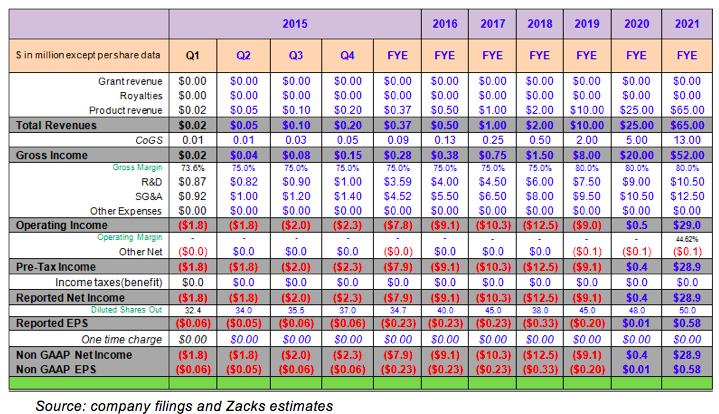
CASI also has a strong balance sheet, which will last through the end of 2016, and an experienced management team, who, we believe, is able to lead the company to the next level.
However, there are some risks associated with our price target.
Our price target assumes the final approval of the three imported drugs in 2019 or 2020 in China and the final approval of ENMD-2076 and 2ME2. Although risks associated with imported drug registration are relatively low in China, we can’t completely rule out the possibility of disapproval, or delay of the approval.
Further, ENMD-2076 and 2ME2 are still in the development stage. The risks associated with drug development are high, especially for early stage candidates. Both ENMD-2076 and 2ME2 have a high hurdle to overcome both clinically and regulatorily. Any delay or failure in clinical development or regulatory approval will cost share price to decline dramatically.
Cash burn is also a concern. While current cash can last into the end of calendar 2016, CASI may need to raise new funds to finance its clinical programs and operations until it can generate positive cash flow in 2020. We remind investors that any equity financing will dilute existing shareholder base and may cause share price to fall.
READ THE LATEST FULL RESEARCH REPORT HERE
SUBSCRIBE TO ZACKS SMALL CAP RESEARCH to receive our articles and reports emailed directly to you each morning. Please visit our website for additional information on Zacks SCR and to view our disclaimer.