By Grant Zeng, CFA
NASDAQ:CASI
There was no revenue reported for the third quarter (NASDAQ:CASI) ended September 30, 2015.
R&D expenses for third quarter of 2015 were $0.9 million, as compared to 0.7 million for the third quarter of 2014. This increase was primarily related to costs associated with the company’s food effect study of ENMD-2076 in healthy human subjects in advance of the initiation of the FLC trial clinical trial, along with increased costs associated with research and development activities in China in 2015.
G&A expenses for third quarter of 2015 were $0.67 million, as compared to $1.15 million for the third quarter of 2014. The decrease reflected lower non-cash stock-based compensation expense.
CASI reported a net loss for the third quarter of 2015 of $1.6 million ($0.05 per share), as compared to a net loss of $21.5 million ($0.77 per share) for the same period last year.
The 2014 net loss was primarily attributable to non-cash expense of $19.7 million associated with the September 2014 in-license agreements with Spectrum Pharmaceuticals. Excluding this non-cash expense, net loss for the third quarter of 2014 was $1.9 million ($0.07 per share).
The financial results for third quarter of 2015 were in line with our expectations. We see the financial report as a non-event for CASI. Investors should be focused on CASI’s clinical development as well as the company’s import drug business. In this regard, we think CASI has made great progress in the Third quarter of 2015.
New Financing Boosts CASI’s Balance Sheet
As of September 30, 2015, CASI had cash and cash equivalents of approximately $6.4 million.
On Sept. 21, 2015, CASI Pharmaceuticals (CASI) announced that it has entered into definitive agreements for a $25.1 million financing led by a China investment fund manager affiliated with the same management team of the company’s current largest shareholder, IDG-Accel China Growth Fund III, L.P.
Pursuant to the agreement, CASI agreed to sell a total of 20,658,434 shares of common stock, at $1.190 per share, based on the closing bid price of the Company's common stock on the Nasdaq Capital Market on September 18, 2015, and a total of 4,131,686 warrants, representing a 20% warrant coverage, with a purchase price of $0.125 per whole warrant share. The warrants will become exercisable three months after issuance at $1.69 per share exercise price, and will expire three years from the date the warrants become exercisable.
The Company intends to use the net proceeds primarily to accelerate its clinical and regulatory activities, expand its product pipeline, and to support its marketing and commercial planning activities.
We welcome the new financing and believe it’s necessary in order to accelerate the company’s advancement of its pipeline.
We understand that investors are concerned about the dilution of the existing shareholder base. But we remind investors that not every financing is bad. In this case, we believe the financing is positive to the company.
First, this financing immediately boosts the company’s balance sheet immediately. With proceeds from the new financing, the company’s cash balance should be able to fund the company’s operations into the end of 2018 according to our financial model. Investors do not need to worry about a new dilutive financing in more than two years.
Second, the deal further validates CASI’s business model and its clinical programs. CASI also received investments from IDG ACCEL and Kleiner Perkins Caufield & Byers China, two major venture capital firms in China. These firms tend to have long-term investment strategies, have representatives on the company’s Board of Directors and are in line with the company’s mission.
The Phase II Trial of ENMD-2076 for FLC in the US Initiated
In previous Phase I trials of ENMD-2076, partial response and 6-month progression free survival (PFS) patients not only included TNBC, STS and ovarian cancer, but also included advanced fibrolamellar carcinoma (FLC). The following chart showed very promising result of ENMD-2076 for the treatment of FLC patient in the Phase I trial.
Scientifically there is a strong rationale that ENMD-2076 may provide clinical benefits to FLC patients due to the fact that VEGFR, FGFR and aurora kinase are generally over expressed in liver cancer patients.
In September 2014, CASI filed an investigational new drug application (IND) with the FDA to conduct a Phase II trial in advanced FLC and received allowance from the Agency soon after. In February 2015, CASI held a meeting with the FDA and received the Agency’s guidance on clinical and regulatory development plan.
Based on the guidance from the FDA,
- CASI plans to conduct a single arm trial to evaluate the objective response rate (ORR) of ENMD-2076 in FLC patients as the primary endpoint.
- The trial will be conducted as a Simon 2-stage study with interim futility analysis released after 16 patients reach a clinical event. Futility would be declared if none of the patients experience an objective response and would result in the termination of the study.
- If, however, one or more patients experience an objective response, the study would continue with additional patients. At that time, the company would expect to meet with the FDA to discuss what clinical efficacy endpoint would be considered reasonably likely to provide clinical benefit and support an accelerated approval based on the surrogate endpoint of tumor response.
- Assuming that the results of the proposed study show that ENMD-2076 improves objective tumor response, CASI would expect to propose a confirmatory clinical trial and, in parallel, submit an NDA for accelerated approval based on objective tumor response rates.
- CASI will submit to the FDA a request for breakthrough therapy designation whenever clinical data meets the appropriate criteria.
We think the feedback from the FDA is very encouraging, which provides ENMD-2076 a clear clinical and regulatory path going forward. We are especially encouraged that ENMD-2076 could potentially gain accelerated approval if the primary endpoint is met in the Phase II study.
On Nov. 4, 2015, CASI announced the dosing of the first patient in the above Phase II clinical trial at Memorial Sloan-Kettering Cancer Center. The trial will enroll up to 30 patients. The primary endpoint is to determine the 6-month progression free survival (PFS6) rate when patients with advanced fibrolamellar carcinoma (FLC) are treated with daily oral ENMD 2076. Secondary Objectives include the overall response rate using RECIST v 1.1 criteria, the median progression free survival (PFS), time to progression (TTP), and overall survival (OS).
Top line data will be available in late 2016.
FLC is a rare form of liver cancer that usually occurs in young adults who have no history of liver disease.
FLC patients typically present with a palpable abdominal mass but no symptoms, although pain, weight loss and jaundice may occur. The typical treatment is surgical removal of the tumor. When the tumor cannot be removed surgically or when there is distant spread, systemic treatment is used. Currently, there is no standard systemic therapy regimen for FLC.
Studies have shown that FLC appears to have a better prognosis than typical HCC. The population-based relative survival of patients with FLC in the US is 73% at 1 year and 32% at 5 years. In contrast, HCC relative survival is 26% at 1 year and 7% at 5 years.
FLC comprises approximately 5% of all hepatocellular carcinomas (HCC). The total incidence of HCC is estimated to be 780,000 each year worldwide according to the World Health Organization. Therefore, each year, approximately 39,000 people are diagnosed with FLC worldwide.
Peak sales of ENMD-2076 for FLC alone could be in the neighborhood of $200 million worldwide if we assume a reasonable cost of $50,000 for each patient and about 10% market share of new incidence when ENMD-2076 is approved for FLC.
Update on ENMD-2076 in Soft Tissue Sarcoma (STS)
On Nov. 5, 2015, CASI presented data from its Phase II study of ENMD-2076 (NCT01719744) in soft tissue sarcoma (STS) at the 2015 Connective Tissue Oncology Society (CTOS) annual meeting in Salt Lake City (poster presentation).
The Phase II trial is conducted at University of Toronto, Canada.
The primary endpoint is 6-month progression free survival. Secondary endpoints include:
- number of and severity of adverse events per participant
- number of participants with an objective response, including duration of response
- number of certain biomarkers in participants compared to progression free survival.
Data presented at the CTOS meeting are based on total of 23 evaluable patients.
ENMD-2076 is generally safe and well tolerated in patients. High grade toxicities include hypertension (56%), ALT increase (35%) and diarrhea (17%).
ENMD-2076 has shown clinical activity in patients with advanced STS, with clinical benefits and side effects profile typical of this class of agent. 2 patients had partial response, and 8 patients had stable disease. Clinical benefit rate (PR+SD>6 months) was 17% (4/23). Median overall survival has not reached and median progress free survival was 2.1 months.
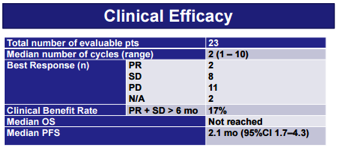
All 4 patients who derived clinical benefit (2 PR and 2 SD > 6months) received ENMD-2076 in the first-line setting.
Genetic variations in CCL11 and FLNB (FilaminB) are potentially associated with benefit from ENMD-2076 while gene variations in EGFR, and CYP4B1 polymorphism could be associated with lack of benefit.
The findings from the Phase II clinical trial confirms the rationale that ENMD-2076 may provide clinical benefit to a subset of STS patients, which may lead to the development of personalized target therapy. The identification of potential clinical correlative biomarkers provides valuable information for the next step in the continued development of ENMD-2076 in STS. The company is on track to initiate the Phase II trial for STS in China, which will be conducted under the same protocol and will allow the company to investigate and further validate the drug’s clinical activities and correlative biomarkers in an expanded patient population.
We believe the company will decide the next step in the development of ENMD-2706 after they gain more data from the China clinical trial.
Update on ENMD-2076 in Triple Negative Breast Cancer (TNBC)
On November 8, 2015, CASI announced a poster presentation by investigators of the University of Colorado, on a study of ENMD-2076 in p53 mutated triple negative breast cancer (TNBC) animal models at the AACR-NCI-EORTC International Conference, November 5-9 in Boston, Massachusetts.
Three TNBC patient derived tumor xenografts (PDTX) models harboring different p53 mutations were used for ENMD-2076 treatment studies.
ENMD-2076 had robust anti-tumor activity against the CU_002 and CU_005 TNBC PDTX models. Tumor growth inhibition (TGI) compared to vehicle at day 30 for models CU_TNBC_002, CU_TNBC_005, and CU_TNBC_004 were 71.3%, 66.1% and 37.0%, respectively. The growth curves for individual tumors that developed acquired resistance to treatment are depicted in blue with the dark blue circle indicating the time of tumor collection. **** p < 0.0001, ***p < 0.001.
The CU_004 TNBC PDTX model was intrinsically resistant to ENMD-2076 treatment (TGI 37%, p value 0.07). In the two sensitive PDTX models, an increase in p53, p73, BAX and the apoptotic marker CC3 and a decrease in the anti-apoptotic protein BCL2 and Ki67 following treatment at Day 30 were observed.
Consistent with Aurora kinase A inhibition, a decrease in pAA and an increase in pHH3 expression in both sensitive and resistant PDTX models following treatment at Day 4 and Day 30 was detected. At the time of acquired resistance, defined by at least doubling of tumor volumes from the maximal response, the loss of p73, p53, and BAX expression and an increase in p16 staining and SA β-gal activity were observed. These findings were also observed in the intrinsically resistant CU_004 model.
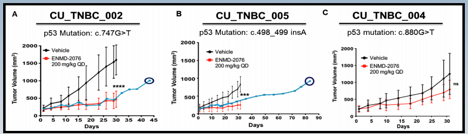
The conclusion is that ENMD-2076 has pro-apoptotic anti-cancer activity in a subset of p53 mutated TNBC PDTX models. Sensitivity is associated with the induction of p73 which may mediate the response in the absence of functional p53. Intrinsic and acquired resistance to ENMD-2076 in TNBC PTDX models is associated with loss of p73 expression and an increase in markers associated with senescence including p16 expression and SA β-gal activity. These data support the role of senescence as a potential mechanism of resistance to Aurora kinase inhibitors in p53 mutated TNBC and support the continued development of combination therapies including with inhibitors of pathways
The TNBC Phase II trial in the U.S. has completed patient recruitment and study treatment. Efficacy activities were observed in a subset of patients while correlative biomarker analysis with clinical benefit is currently underway at the University of Colorado.
As part of the US Phase II trial and under the same protocol, the company has begun patient recruitment and treatment at multi-center sites in China, where the company is studying efficacy and safety as well as correlative biomarkers of ENMD-2076 in an expanded patient population.
CASI’s goal is to reach a clinical inflection point with the identification of clinically correlative biomarker(s) prior to the end of next year in order to support a Phase III trial in a well-defined subset of a TNBC patient population.
READ THE LATEST FULL RESEARCH REPORT HERE
SUBSCRIBE TO ZACKS SMALL CAP RESEARCH to receive our articles and reports emailed directly to you each morning. Please visit our website for additional information on Zacks SCR and to view our disclaimer.