By Brian Marckx, CFA
NASDAQ:CBMX
Q3: 23% YoY Revenue Growth, PGS Off to Strong Start, Reimbursement Relatively Strong. Continue to Look for Accelerating Growth into 2016
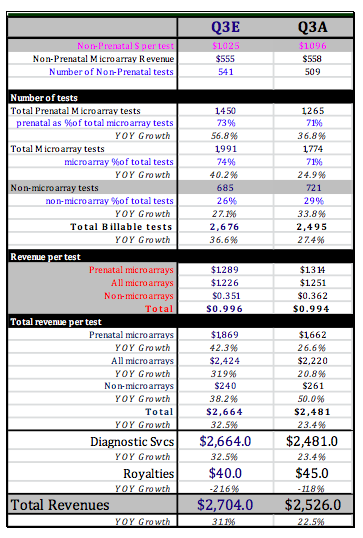
CombiMatrix (NASDAQ:CBMX) reported financial results for the third quarter ending September 30th. While the streak of record revenue was ended at 7 quarters with sales falling a hair from Q2, the top line continued to show impressive yoy growth, increasing by almost 23% from the comparable period in 2014. Importantly, revenue growth is broad-based across the entire business with every category of tests increasing on both volumes and revenue from Q3 2014. And while revenue came in lower than our estimate (we were looking for 31% yoy growth), net loss and EPS handily beat our numbers with service margin inline and operating expenses well below what we had estimated.
And there were some meaningful highlights within the operating metrics including average reimbursement of all combined tests as well as for reproductive health tests coming in at the highest levels since Q3 2014, a 34% increase in the number of billable customers and cash collections maintained at the ~95% level.
And there are several catalysts that should push revenue to new heights including a strong start from the newly launched IVF test (CombiPGS), the recent addition of six new sales reps (bringing the total to 18) and NYS approval of the company’s SNP array (prenatal test). Combined with what we expect to be continued strong growth of miscarriage analysis (+21% yoy in Q3 and representing 46% of diagnostic services revenue), we continue to think revenue growth will remain over 20% in the near term and steepen to better than 30% through 2016. CBMX also expects to bring at least one new test to market over the next 6 – 9 months which could add incrementally to our forecasts.
The PGS test already looks like it could be a big winner for CBMX and they are putting additional resources behind it, recently bringing on two experienced IVF-related specialists to help detail the product. After barely two full quarters since its introduction, PGS is already contributing 6% of total diagnostic services revenue. The IVF market offers not only the benefit of diversifying the company’s target market but also reduces their overall exposure to reimbursement risk as this is a cash pay segment. Management noted on the Q3 call that they have another IVF-related test that is currently under development that they expect will supplement the PGS assay.
And a more macro view also indicates that the market for prenatal molecular diagnostics should generate more interest. CBMX has been actively involved in building awareness about the benefits of their technology over other CMA platforms as well as the fallibility of non-invasive prenatal testing (NIPT).
NIPT is commonly used but prone to error and given their high rates of false positives, it is recommended that an amniocentesis or chronic villus sampling is performed when NIPT has a positive result. In October CMBX presented data from a self-sponsored study at the 2015 American Society of Human Genetics conference which indicated NIPT is prone to high false positive rates for microdeletions, as well as for common aneuploidies. Data showed NIPT false positive rates as high as 56% for some chromosome-specific aneuploidies and over 70% for certain microdeletions. This further supports the need for follow-on with more reliable and accurate testing following a positive NIPT result with products such as CBMX’s recently launched SNP prenatal targeted array.
Q3 Numbers: Revenue Below Our Estimate But Lower OpEx Results in Beat on Income, EPS…
With the recent addition of PGS (as well as two other products including the targeted prenatal array) to the product portfolio CBMX updated the way that they categorize their various products for reporting purposes. The prenatal, miscarriage analysis and PGS tests are now categorized as “Reproductive Health” – which currently accounts for approximately 67% of diagnostic services and is where the majority of future revenue growth is expected to come from.
Reproductive health revenue has shown consistent growth over the last several years and came in at $1.66M in the most recent quarter. While volumes were down 3% from Q2 of this year, sequential improvement in average reimbursement pushed reproductive health revenue to a new high, besting the previous peak (from Q2) by less than 1%. The sequential contraction in volumes mostly relates to prenatal tests which have been relatively strong over the recent past, growing sequentially every quarter since at least early 2013. And while prenatal volumes fell 20% q-o-q, they were up by 3% y-o-y. And we don’t expect the recent dip in prenatal to be the beginning of a trend and model this to come back to sequential growth, driven by the beefed-up sales force, additional payor contracts and the recent entry of the SNP array into New York State.
Meanwhile, miscarriage analysis volume was down a hair (5%) sequentially but up 31% yoy. CombiPGS, the IVF test, recorded 127 tests in Q3 – up from just 30 for the entire first half of 2015. The test has received a warm welcome and, as noted, CBMX will put additional resources behind it. We think reproductive health can turn in low double-digit sequential growth through the final quarter of this year and see the growth rate steepening in 2016.
Non-microarray also remains meaningful, accounting for 29% of total test volume in Q3 as well as through the first nine months of the year. But, with non-microarray reimbursed at a much lower level than the rest of the product portfolio, it accounts for only about 10% of total diagnostic services revenue. But non-microarray continues to exhibit very strong volume growth, up 34% in Q3 and +70% through the first nine month of 2015. This rapid uptick has been attributed to additional activity from CBMX's partner Sequenom. As a reminder, CBMX employs a mutli-channel commercialization strategy. This includes sales through their direct reps, alliances with partners such as Sequenom (which has significant customer reach) and partnerships with pathology groups. While most of the revenue growth traction to-date has been with expansion of the direct sales force and into new territories (and dually supported by new payer agreements and data supporting CMA) these other channels have recently made a making a more meaningful contribution.
Total billable tests were 2,495 which is the 2nd best in company history – only beaten by the 2,599 tests billed in Q2 of this year. It is, however, lower than the 2,676 that we had estimated. The sequential contraction mostly relates to a combination of the aforementioned slide in prenatal microarray (which we think turns a corner in Q4) and a 12% decrease in pediatric microarray volumes – which have been somewhat less regular and which we think runs fairly flattish going forward.
Relative to reimbursement, as we have discussed in our coverage of CBMX, sliding average reimbursement has been an issue in trying to maximize revenue. But the last three quarters have been encouraging as the first half of the year saw a lower rate of deterioration in average reimbursement than what had been the case just prior to that period. And in Q3 average reimbursement actually increased sequentially – albeit only slightly. Total average reimbursement from Q2 to Q3 increased from $971 to $994 (+2%) and, perhaps even more encouraging was that average reimbursement of the bread-and-butter portfolio of reproductive health tests went from $1,286 in Q2 to $1,314 in Q3, also a 2% increase. And while we will refrain from suggesting this is definitely the beginning of a trend towards firming reimbursement, there is reason to believe that the collections picture could improve further. CBMX has been targeting favorable payor territories, recently hired additional payer-relations and billing professionals and new tests such as CombiPGS which are cash pay and not impacted by reimbursement. These all could benefit average reimbursement going forward and almost certainly contributed to the high collection rates over the last two or three quarters. Cash collections were 96% of revenue in Q2 (a record) and 95% in Q3.
Q3 total revenue of $2.6M was up 23% yoy, down 1% sequentially and about 7% lower than our $2.7M estimate. The miss to our number came from lower volumes of microarray tests which was partially offset by higher non-microarray volumes and across-the-board higher than expected average reimbursement.
Service margin has held up very well despite the slight slippage in average test pricing. Service margin was 46.2% in Q1, 44.6% in Q2 and 43.6% in Q3 of this year - or an average of 45.6% through the first nine months of the year. This compares to 44.2%, 44.8% and 43.9% (45.4% average) in the year earlier comparable periods. Lab efficiencies, higher testing volumes and benefits realized from recently implemented reimbursement initiatives have us continuing to model improvement in GM for the full year 2015 as compared to 2014. We look for service margin of 45.5% for fiscal 2015, compared to 43.8% in 2014.
Q3 OpEx was $2.7M, significantly better than our $3.0M estimate - most of this relates to lower than modeled ($2.5M A vs. $2.9M E) G&A expense. CBMX continues to experience increasing operating leverage and at 106% of revenue, OpEx was at the lowest level in at least the last several years. We continue to model further improvement in operating leverage with ramping revenue and a relative flattening of operating expenses. Q3 net loss and EPS, excluding a $97k asset impairment charge (asset was non-fundamental to the business) were $1.6M and ($0.13), better than our $1.9M and ($0.15) estimates.
OUTLOOK
Our 2015 revenue growth, including +42% from reproductive health services testing, is driven from the recent and ongoing expansion of the sales force, new payor contracts, increasing number of billable customers, greater awareness and some incremental growth from new products.
Beyond 2015 we think contribution from the additional, aforementioned catalysts begin to make a more substantial impact. We also think it is not unreasonable to believe that additional future studies and publications will provide further insight into the human genome, soften certain current headwinds to adoption of CMA (i.e. - provide more knowledge related to variants of unknown significance) and provide support for the utility of chromosomal microarray analysis in the prenatal space. These catalysts should result in steepening of the rate of adoption of chromosomal microarray analysis. This, coupled with the company's competitive positioning and our assumption that CBMX continues to grow their distribution footprint via incremental expansion of their sales force and, possibly, additional partnerships, provide what we believe will be a position of strength for CBMX in terms of being able to increase penetration of their target prenatal markets and grow revenue over the long-term.
We currently model CBMX achieving just under 2% penetration of the targeted prenatal microarray markets in 2015 and this growing to ~mid-single digit penetration by 2018 and approximately 10% by 2022. Additional new product launches could prompt an upward revision to our forecast, particularly as it relates to our out-years. We look for incremental widening of services margin as prenatal microarray, the highest priced of the company's tests, grows to account for an ever larger proportion of total revenue and increased testing volumes provides greater scale. We model improvement in leverage in operating expenses during the current year, reflecting lower litigation expense compared to 2014 and increased efficiencies from the sales force.
We are maintaining our Buy recommendation. See below for access to our updated report on CBMX.
READ THE LATEST FULL RESEARCH REPORT HERE
SUBSCRIBE TO ZACKS SMALL CAP RESEARCH to receive our articles and reports emailed directly to you each morning. Please visit our website for additional information on Zacks SCR and to view our disclaimer.