By Brian Marckx, CFA
NASDAQ:CBMX
Q2: 7th Straight Quarter of Record Prenatal Microarray Revenue/Volumes. Beefed-Up Sales Force Could Steepen Revenue Curve Further…
CombiMatrix (NASDAQ:CBMX) reported financial results for the second quarter ending June 30th. Results, again, came in very close with our estimates - on both the top and bottom lines, although there were some slight variances in itemized product volumes. Q2 marked the seventh straight quarter of setting a new record for prenatal microarray revenue and testing volumes and eight consecutive quarters of increasing total diagnostic revenue. Reimbursement stayed just about flat from Q1 - an encouraging sign given the fairly regular erosion throughout 2014. Gross margin is holding up nicely and slightly better than the first half of last year - we expect this to continue to widen with higher testing volumes. OpEx was flat from Q1 on revenue growth of almost 10%, resulting in a meaningful q-o-q improvement to operating and net loss.
And the company made substantive progress on the operational side in Q2 as well. This includes a significant increase in billable customers (+224, up 27% y-o-y), consummation of a new payer contract (Highmark W. Virginia, BC/BS) an almost 40% increase in the outside sales force and additions to the billing, genetic counseling and laboratory areas. These new reps will afford deeper penetration of existing territories, expansion into other favorable (reimbursement, demographics, etc) markets and also further support the rollout of new product introductions - including the recently launched pediatric buccal swab, IVF test and prenatal targeted array. The sales force currently stands at 18 and management is guiding to grow it to about 20 by current year-end. This should all indicate that the streak of revenue records will continue.
And we think reimbursement could firm up further benefitting from targeting of favorable payor territories, the recent hiring of additional payer-relations and billing professionals and new tests such as CombiPGS which are cash pay and not impacted by reimbursement. These efforts already seem to be paying dividends in the form of flattening of average pricing per test and the record cash collections that the company realized in Q2. Record collections, the recent litigation settlement and improving operating loss will all benefit cash burn. And with over $7M in the bank at Q2 quarter-end, the company has a sufficient runway to implement their near-term growth plans.
Q2 Numbers: In-Line w/ Ours. Maintaining Buy Rec, $3.50/share Price Target…
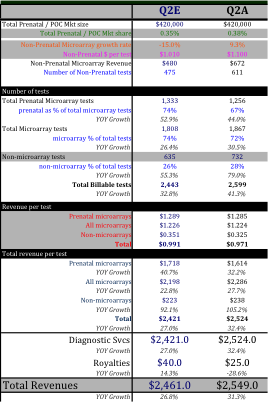
Microarray, CBMX's main focus and bread-and-butter, continues to drive the record revenue with volumes and revenues of 1,867 and $2.3M, both all-time records and representing yoy and sequential growth of 31% (yoy), 12% (sequential) in volume and 28% (yoy), 12% (sequential) in revenue. Prenatal microarray also set a new record at 1,256 tests - up 44% yoy and 4% sequentially.
Non-microarray also remains meaningful, accounting for 28% of total test volume but with a much lower average price, only contributing about 9% of total diagnostic revenue. But non-microarray continues to exhibit very strong growth, up 96% in the first half of 2015. This rapid uptick has been attributed to additional activity from CBMX's partner Sequenom. As a reminder, CBMX employs a mutli-channel commercialization strategy. This includes sales through their direct reps, alliances with partners such as Sequenom (which has significant customer reach) and partnerships with pathology groups. While most of the revenue growth traction to-date has been with expansion of the direct sales force and into new territories (and dually supported by new payer agreements and data supporting CMA) these other channels have recently made a making a more meaningful contribution.
Total billable tests were 2,599 which is also a record and up 41% yoy and 11% from Q1 2015. It's also ahead of our 2,443 estimate by about 6%. Management noted that the three new product launches meaningfully contributed to volumes and revenues in Q2. This includes the CombiPGS (IVF) test - which was launched in late 2014 and not only provides the benefit of not being affected by insurance but also that IVF is a new channel for CBMX and one that could see real upside. The other recent launches include a targeted array for prenatal analysis (late 2014 launch) and the buccal swab DNA collection kit (May 2015 launch). And clearly the significant increase in billable customers - up 27% in just the last 12 months - is also facilitating the volume and revenue ramp. The new product launches, additional payer contracts, ramping customer base and the addition of 7 new reps coming onboard in June should bode very well for further steeping of volumes and revenue.
Relative to reimbursement, as we have discussed in our coverage of CBMX, sliding average reimbursement has been an issue in trying to maximize revenue. But the last two quarters have shown a lower rate of deterioration which may indicate a near-leveling off. Average revenue per test was $975 in Q1 which only dipped very slightly to $971 in Q2. These periods were both better than the $955 average in Q1 2014. And, more importantly, most of the q-o-q slippage in average reimbursement relates to non-microarray tests which saw average reimbursement fall 7% with microarray (CBMX's main focus) remaining largely flat from the prior quarter. And, as noted, the new hires in payer relations and billing as well as new cash-pay only tests such as CombiPGS have the potential to benefit reimbursement levels going forward.
Q2 total revenue of $2.6M was up 31% yoy, up 9% sequentially and about 4% better than our $2.5M estimate. The beat to our number came from a higher volume of non-prenatal microarray tests as well as non-microarray tests, which was partially offset by slightly softer average non-microarray per-test pricing. Q2 marked the eighth straight quarter where testing services revenue set a new all-time record. And while non-microarray has been a larger contributor to total revenue than in the recent past, prenatal microarray continues to be the catalyst driving the top-line, accounting for 65% of total revenue in Q2 and 74% of the yoy revenue growth.
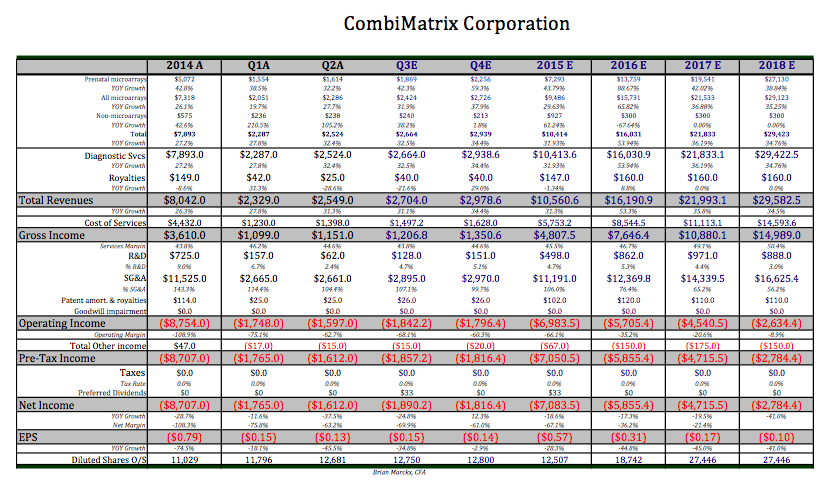
Service margin has held up very well despite the slight slippage in average test pricing. Service margin was 46.2% in Q1 and 44.6% in Q2 of this year - or an average of 45.4% in 1H 2015. This compares to 44.2% and 44.8% in Q1 and Q2 of 2014 - or an average of 44.5% in 1H 2014. Lab efficiencies, higher testing volumes and benefits realized from recently implemented reimbursement initiatives have us continuing to model improvement in GM for the full year 2015 as compared to 2014. We look for service margin of 45.5% for fiscal 2015, compared to 43.8% in 2014.
Q2 OpEx was $2.7M, better than our $2.9M estimate - most of this relates to lower than modeled ($62k A vs. $181 E) R&D expense. R&D expense can be somewhat variable depending on pipeline projects. Q2 net loss and EPS were $1.6M and ($0.13), largely inline with our $1.7M and ($0.13) estimates.
We have made some slight adjustments to our model following the close of Q2. This mostly relates to a slight strengthening in our forecasted service margin as well as additional OpEx related to the new sales and support hires. We look for 2015 revenue and EPS of $10.6M (+31% yoy) and ($0.57), compared to $8.4M and ($0.79) in 2014. We are maintaining our Buy recommendation and $3.50/share price target.
We continue to believe certain perceived risks that have hung over the company have been overblown and, with the recent resolution of the lawsuit, have and will continue to dissipate. We also believe the very recent investments in significantly beefing up of the sales force and support functions signals that management has identified near-term and substantial opportunities for deeper and broader penetration of their products in the prenatal testing space. With an expected almost doubling of the sales force from June 2015 to the end of the year, we think 30%+ revenue growth in 2015 and another 50%+ in 2016 is do-able if not conservative.
Strathman Will Not Pursue Further Litigation
In late April CombiMatrix (CBMX) announced that they and Michael Strathman, the plaintiff (and former employee of CBMX) in the lawsuit against the company, have consummated a settlement agreement. In return for CBMX agreeing to not pursue reimbursement of legal costs, Strathman has relinquished his rights to continue the litigation. This includes any potential appeals to the final decision by the Superior Court of California, which was issued in early March in favor of CBMX, as well as retraction of plaintiff’s motion to vacate that judgment.
As a reminder, Strathman filed the lawsuit in early 2011, claiming CombiMatrix filed false insurance claims related to a prior lawsuit. The lawsuit was dismissed by the court later in 2011. An appeals court reversed this decision in late 2012 and the case was then remanded to the Superior Court of California.
Strathman filed an amended complaint and, following an unsuccessful motion by CBMX for the court to rule in their favor without a trial, on January 6, 2015 the Superior Court issued a tentative ruling in favor of CombiMatrix and against all claims of Michael Strathman. The court specifically determined that the defendants had no fraudulent intent. Plaintiff subsequently filed an objection to the ruling.
Then on March 12th CombiMatrix announced that the Superior Court of California had issued a final decision in favor of CombiMatrix (and the two other defendants named in the lawsuit) and against Strathman. This was the third ruling in CBMX’s favor.
The lawsuit has hung over CombiMatrix like a dark cloud given the ambiguity of potential damages if the company came out on the losing end. Court documents suggested that damages could be as much as $75 million. As we noted following the Court’s decisions in CBMX’s favor in January and March, we felt perceived risks related to this lawsuit were overblown and were a significant headwind to appreciation of the share price towards what we believe is fair value, approximately $3.50.
LDT oversight more bark than bite…
Another potential overhang on the stock has been FDA’s recent guidance on additional regulation of laboratory developed tests (LDTs). FDA has historically had discretion regarding regulation of these tests. But in the summer 2014 FDA issued a guidance document to Congress notifying them that the agency intends to propose risk-based oversight framework for LDTs which are designed, manufactured and used within a single lab. A draft guidance document was issued in October detailing more specifics. This oversight is expected to include premarket review for what the agency will classify as higher-risk tests that compete against already FDA-approved companion diagnostics and a potential phase-in over time of premarket review for other high risk and moderate risk LDTs.
The only requirement so far is for LDT manufacturers to notify FDA that they are currently making and using these tests and to provide information about the tests. The guidance recommends that premarket review begin 12 months after the guidance is finalized for the highest risk LDTs, for it to phase in over four years for the remaining high risk devices and for premarket review to begin five years after the guidance is finalized for moderate risk devices.
Exactly what might be involved in the premarket review still isn’t clear. What is clear, however, is that FDA believes many of the LDTs already on the market have been validated by clinical studies and literature and that the agency will use this as part of its review. Per the draft guidance, “FDA emphasizes that it is the Agency’s practice to leverage such information from the literature in lieu of requiring additional studies to demonstrate clinical validity. In these cases FDA may still require studies demonstrating device performance (e.g., analytical evaluations) but generally intends to rely on the scientific literature to support clinical validity if appropriate. FDA intends to work with the laboratory community, the healthcare professional community and other stakeholders to determine whether an LDT’s clinical validity has already been established in the literature.”
And while this premarket review (i.e. – FDA clearance) requirement will likely apply to most LDTs, including CBMX’s, we think the financial and operational risk to CBMX is minimal. For one, the premarket review phase-in period could be as long as five years. And secondly, and most important, is that as we have highlighted in our coverage of CBMX, there is significant clinical evidence and published studies demonstrating the performance of the company’s tests. We also note that there are over 11,000 LDTs currently commercialized by more than 2,000 labs and we think it is unlikely that FDA will implement an approval process that is so stringent and costly that it could have the effect of potentially decimating this hugely important cog in the medical diagnostics space.
New Product Launches Further Build Out CBMX’s Microarray Testing Menu
CBMA recently launched two new tests which further builds out their women’s health microarray testing menu and which should incrementally benefit revenue growth. In November 2014 CombiPGS, an in-vitro fertilization genetic screening test was launched. CombiPGS is targeting IVF physicians and will be used prior to implantation to assess the embryos for chromosomal abnormalities. CombiPGS not only expands CBMX’s footprint to now include IVF but also provides the benefit that this will be all customer cash-pay, which eliminates any issues of insurance reimbursement.
And in December Targeted Array for Prenatal Analysis was launched which addresses the issue of arrays returning results with variants of unknown significance (VOUS). While chromosomal microarray (CMA) is a very powerful tool in evaluating prenatal development disorders, there is still a lot to learn about the human genome, which means that CMA can return results with uncertain clinical significance. The issue with VOUS is that this can cause patient anxiety and often requires that counselors be available to address this. It has also been cited as perhaps constraining uptake, at least to a certain extent of CMA in place of karyotyping. CBMX’s Targeted Array focuses only on certain chromosomal abnormalities that are specific to the needs of each maternal fetal medicine practice, thereby reducing the risk of VOUS. We think the test could hold meaningful promise and will be eagerly awaiting future updates on demand and uptake of the test.
Add'l Study Data Supports CMA's Superiority Over Standard Genetic Testing…
CBMX presented new study data at the American Society of Human Genetics Annual Meeting in October 2014 which provides additional support of the superiority of CMA as compared to standard prenatal genetic testing. The study included 3,408 samples from both fresh tissue (n = 2,712) and tissue preserved (n = 564) with formalin and embedded paraffin (FFPE) which were analyzed by three CMA platforms; BAC-aCGH, oglio-aCGH and SNP array. SNP, one of the platforms that CBMX utilizes, demonstrated the highest abnormality detection rate at 53.8%.
CMA analysis provided a successful result in 86.5% (2,345/2,712) of the fresh samples and 87.2% (492/564) of the preserved samples. This relatively high success rate is similar to other studies which have shown CMA provides a successful result between 87% and 98% of the time while karyotyping, the standard products of conception testing method, produces a successful result only about 60% - 70% of the time.
The lower success rate of karyotyping is largely due to the need to culture the cells (which is not required with CMA) for a period prior to analysis, during which time the cells may die. This "culture failure" can occur in as many as 20% - 55% of cases, making karyotyping much less reliable than CMA given that the latter can analyze non-living tissue.
OUTLOOK
CombiMatrix's prenatal microarray testing volumes increased 272% (983 to 3,660) from 2012 to 2014 while their non-prenatal microarray testing volumes fell 16% (2,641 to 2,223) over the same period, reflecting the company's deliberate strategic shift to focus on the area that holds the most potential for long-term growth. While recent growth benefitted from the company allocating the bulk of sales efforts towards the prenatal microarray market, as well as potentially from the NEJM articles, the addition of other catalysts along with what we believe are important competitive advantages of CBMX have the potential to extend this growth momentum of prenatal microarray testing over the long-term. And as prenatal microarray per-test revenue and margins are the highest among the company's testing segments, this is also where the bulk of the opportunity for profitability lies.
The ACOG Committee Opinion was published in December 2013 and we also expect this, along with the supporting December 2012 NEJM articles and more recent clinical data presentations, to help build awareness of the benefits of prenatal chromosomal microarray testing - although we view the benefit of these as more longer-term catalysts in helping to shape changes in clinical practice away from the use of karyotyping and towards the use of chromosomal microarray. We also assign real value to CBMX's competitive strengths including; 1) their sales strategy, whereby they will detail to several decision-makers, including the pathologist, in order to increase the number of shots on goal, 2) high-level, high-expertise, on-staff counseling services and 3) test turnaround times that are as fast or faster than their competitors'. And in, addition, new product launches including the CombiPGS (IVF) test and Targeted Array which both launched in late 2014 have the potential to expand to new markets and further penetrate existing markets. And combined with firming up of reimbursement, significant recent increase in the sales force and onboarding of new payers all bode well for the streak of revenue records to continue and further penetration of the prenatal testing market.
We estimate the market size directly related to CBMX's prenatal / POC microarray offerings at approximately $400M or more. As a placeholder for now, we assume this market expands at approximately 5% per year. The company has already made some headway in penetrating this market - particularly in miscarriage analysis, although we think 90%+ of this market remains virtually untapped.
Our 2015 revenue growth, including +44% from prenatal microarray testing, is driven from the recent and ongoing expansion of the sales force, new payor contracts, greater awareness and some incremental growth from new products.
Beyond 2015 we think contribution from the additional, aforementioned catalysts begin to make a more substantial impact. We also think it is not unreasonable to believe that additional future studies and publications will provide further insight into the human genome, soften certain current headwinds to adoption of CMA (i.e. - provide more knowledge related to variants of unknown significance) and provide support for the utility of chromosomal microarray analysis in the prenatal space. These catalysts should result in steepening of the rate of adoption of chromosomal microarray analysis. This, coupled with the company's competitive positioning and our assumption that CBMX continues to grow their distribution footprint via incremental expansion of their sales force and, possibly, additional partnerships, provide what we believe will be a position of strength for CBMX in terms of being able to increase penetration of their target prenatal markets and grow revenue over the long-term.
We currently model CBMX achieving just under 2% penetration of the targeted prenatal microarray markets in 2015 and this growing to ~mid-single digit penetration by 2018 and approximately 10% by 2022. Additional new product launches could prompt an upward revision to our forecast, particularly as it relates to our out-years. We look for incremental widening of gross margin as prenatal microarray, the highest priced of the company's tests, grows to account for an ever larger proportion of total revenue and increased testing volumes provides greater scale. We model improvement in leverage in operating expenses during the current year, reflecting lower litigation expense compared to 2014 and increased efficiencies from the sales force.
VALUATION
We use a 10-year DCF model to value CBMX. We model revenue to grow from $8.0M in 2014 to $30M in 2018 and to $85.0M in 2024, representing a 10-year CAGR of 27%. We believe our revenue estimates are reasonable, particularly as out our out-year number assumes just less than 13% penetration of the estimated prenatal chromosomal microarray analysis market at that time. And, as noted, we model relatively flat growth of all other testing segments, which is also arguably conservative. We also do not incorporate contribution from any new products that CBMX may potentially bring to market through the term of DCF - new product launches and/or a higher rate of revenue growth (relative to our assumptions) from existing tests could provide some upside to our numbers and associated calculated valuation.
Other key inputs into our DCF include a 9% discount rate and 2% terminal growth rate. Based on our DCF model, CBMX is valued at approximately $3.50/share. We are maintaining our Buy rating and $3.50/share price target.
READ THE LATEST FULL RESEARCH REPORT HERE
SUBSCRIBE TO ZACKS SMALL CAP RESEARCH to receive our articles and reports emailed directly to you each morning. Please visit our website for additional information on Zacks SCR and to view our disclaimer.