By David Bautz, PhD
NASDAQ:CFRX
ContraFect Corp. (NASDAQ:CFRX) is a clinical stage biotech company focused on the discovery and development of proteins and antibodies for infectious diseases. The company’s two platforms, lysins and monoclonal antibodies, target conserved regions of bacteria or viruses and thus should not lead to the organisms developing resistance to those treatments. The company’s lead lysin product, CF-301, is currently in a Phase 1 safety trial in healthy volunteers (NCT02439359) and is being targeted for the treatment of bacteremia (bloodstream infection) caused by Staphylococcus aureus, including all drug-resistant phenotypes. Recently, the company presented preclinical data at the 2015 ICAAC/ICC conference showing that CF-301 works synergistically with daptomycin to treat lethal Staphylococcal pneumonia, which is covered in detail below.
Staphylococcus aureus pneumonia
Bacterial pneumonia is an infection of the lungs that results in the alveoli (air sacs) becoming inflamed and filled with pus, fluid, and cellular debris. Staphylococcus aureus is a gram-positive bacterium that can cause a multitude of diseases, including those of the skin and soft tissue, the blood, the heart, and the lungs (Lowy, 1998). Pneumonia is among the most prevalent infections caused by S. aureus, accounting for approximately 50,000 cases each year in the U.S. and leading to an estimated direct medical cost of approximately $35,000 per patient (Rubin et al., 1999).
The treatment of choice for S. aureus infections is penicillin, however in most countries penicillin resistance is extremely common. Resistance to penicillin is due to the activity of the enzyme penicillinase, which cleaves the β-lactam ring of the penicillin molecule. Penicillinase-resistant β-lactam antibiotics include methicillin, oxacillin, and flucoxacillin, thus first-line treatment typically involves one of those compounds. Further complicating the treatment of S. aureus pneumonia is the fact that over 50% of clinical isolates of the bacterium are classified as methicillin-resistant S. aureus (MRSA) (Hidron et al., 2008). The current gold standard for treatment of MRSA is vancomycin. However, vancomycin is far from ideal due to poor tissue penetration, slow bactericidal activity, and a number of side effects (Gould, 2008). Additional antibiotics utilized include linezolid and clindomycin. A recent clinical study showed that linezolid may have better initial clinical efficacy than vancomycin in treating S. aureus pneumonia, however 60-day mortality was similar between the two compounds (Wunderink et al., 2012). Daptomycin cannot be utilized for pneumonia due to the fact it is inactivated by pulmonary surfactant (Silverman et al., 2005).
Brief Background on Lysins
Lysins are natural anti-bacterial hydrolytic enzymes that are produced from a bacteriophage, a virus that infects and kills bacteria. Once inside the bacteria, bacteriophages replicate and produce lysins. Lysins degrade (lyse) bacterial cell walls from the inside, resulting in the bursting of the bacteria. The bursting of the bacteria releases the bacteriophage to infect neighboring bacteria, and so on and so forth. ContraFect’s technology involves the production and purification of a recombinant form of a lysin to use as an anti-bacterial agent. Lysins are delivered to the infected area and lyse the bacterial cell wall from the outside directly upon contact. This video shows both how lysins produced by bacteriophage and recombinant lysins introduced exogenously destroy bacteria cells.
Key Advantages of Lysins
- Novel Mechanism of Action: Lysins represent a first-in-class approach to the treatment of bacterial infections. Traditional antibiotics require bacterial cell division and metabolism to occur in order to exert their effect (i.e., cell death or cessation of growth). Lysins are recombinant forms of naturally occurring bacteriophage enzymes that directly digest the cell wall of bacteria. Based on in vitro tests, once the cell wall is breached, the bacteria lyse in a virtually explosive manner due to the high internal osmotic pressure of the cytoplasm, and bacterial cell death ensues.
- Rapid Bactericidal Activity: Lysins kill bacteria immediately upon contact. In vitro experiments demonstrated ContraFect’s CF-301 to be 12-18x faster than the standard-of-care antibiotics used to treat S. aureus bacteremia.
- Targeted Therapy: Unlike standard-of-care antibiotics, which are "broad spectrum" and kill the body's natural flora (including the good bacteria) in addition to the disease-causing bacteria, lysins are "narrow spectrum, broad-acting" anti-infective agents. Due to the specificity of a lysin's binding domain and catalytic activity, they are highly specific for a given species of bacteria (i.e., S. aureus, S. pneumoniae, etc.), making them a narrow spectrum anti-infective. However, lysins possess full activity against all resistant strains of those bacteria and are considered broad acting. Consider lysins to be target-specific smart bombs, as opposed to the carpet-bombing effect of broad-spectrum antibiotics. The narrow spectrum of activity will avoid damaging side effects that often occur when conventional antibiotic treatments kill the body's healthy, desirable bacteria.
- Active on Drug Resistant Bacteria: Preclinical studies have demonstrated that ContraFect’s lysin candidate CF-301 exhibits activity specific to all forms of S. aureus, including isolates that are resistant to the antibiotics methicillin (MRSA), vancomycin (VRSA), and daptomycin (DRSA).
- Eradicates Biofilms: Biofilms render infections up to 1,000-fold more resistant to penetration by antibiotics. Infected human tissues, such as the heart valve in endocarditis or bone in osteomyelitis, or indwelling medical devices, such as central venous catheters, prosthetic joints, and pacemakers, are common sites for biofilm formation, providing a hurdle for effective treatment with antibiotics alone. There are currently no therapeutics available to eradicate biofilms.
- Synergy with Standard-of-Care Antibiotics: Because lysins offer a different mechanism of action with minimal safety or tolerability issues, they can be used in combination with traditional antibiotics. For example, ContraFect’s lead lysin candidate, CF-301, has demonstrated a strong synergistic effect in in vitro studies when combined with several standard-of-care antibiotics, including daptomycin, vancomycin, and oxacillin.
CF-301 Synergizes With Daptomycin to Treat Lethal Staphylococcal Pneumonia
As mentioned above, daptomycin (DAP) cannot be utilized to treat pulmonary infections due to the fact that it is inactivated by surfactant. Pulmonary surfactant is a lipoprotein complex that is found in the fluid lining the alveolar surface of the lungs that prevents alveolar collapse at low lung volume while also protecting the lungs from inhaled particles and pathogens (Griese, 1999). ContraFect scientists hypothesized that synergy with CF-301 could stimulate DAP activity in the lungs and offer a new treatment option for staphylococcal pneumonia. These results were presented at the 2015 ICAAC/ICC conference on a poster titled “Lysin CF-301 Activates Daptomycin in Pulmonary Surfactant in vitro and Rescues Mice from Lethal Staphylococcal Pneumonia”. The poster can be found here.
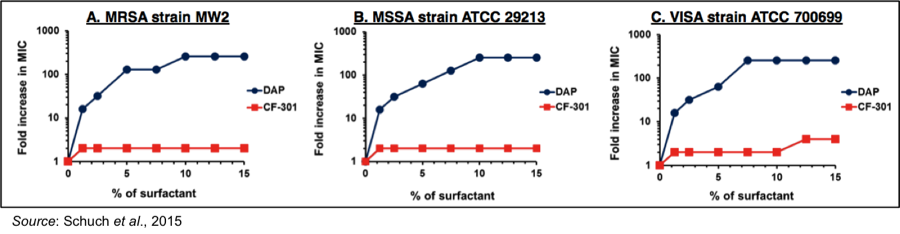
ContraFect scientists first showed that daptomycin is in fact inactivated by surfactant and that CF-301 retains its activity. This was shown by an analysis of the minimum inhibitory concentration (MIC) for each compound. The MIC is the lowest concentration of an antimicrobial agent that will visibly inhibit the growth of a microorganism. As shown in the following figure, the MIC for CF-301 increased very little as the percentage of surfactant used in the assay increased, while the MIC for DAP increased over 100 fold as the percentage of surfactant increased over 5%. The results are shown against three different strains of S. aureus; a MRSA strain, a methicillin-sensitive strain (MSSA), and a vancomycin-intermediate strain (VISA). VISA refers to a strain of S. aureus that requires a large dose to kill.
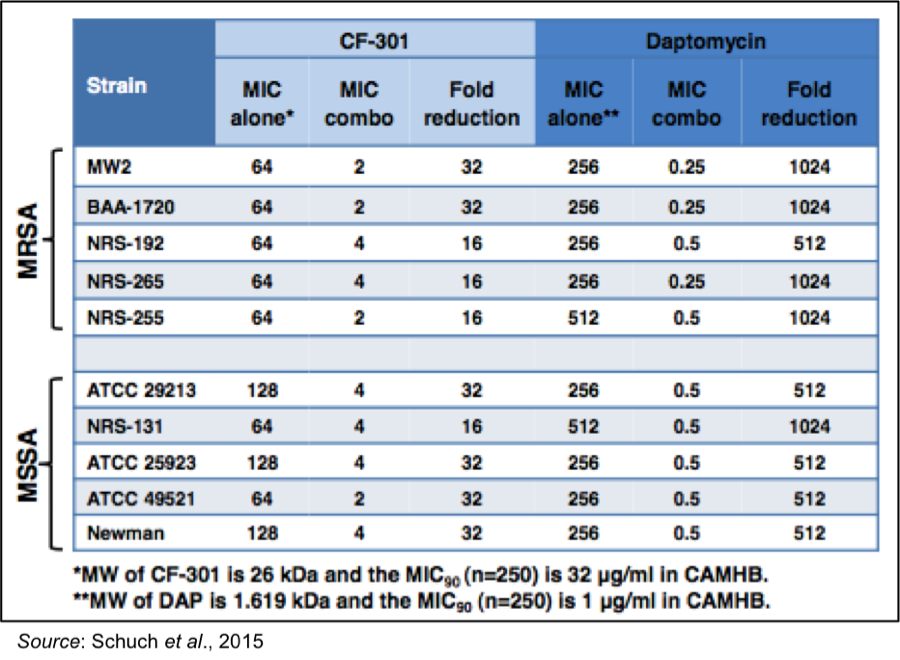
The following tables show how CF-301 synergizes with DAP to lower the MIC of each compound when they are tested together. Each compound was tested alone and in combination against multiple strains of S. aureus (both MRSA and MSSA) in 7.5% surfactant. When tested alone with no surfactant present, the MIC for CF-301 and DAP are 32 and 1 μg/mL, respectively. Thus, there is a substantial decrease in the MIC for each compound when they are used in combination in 7.5% surfactant.
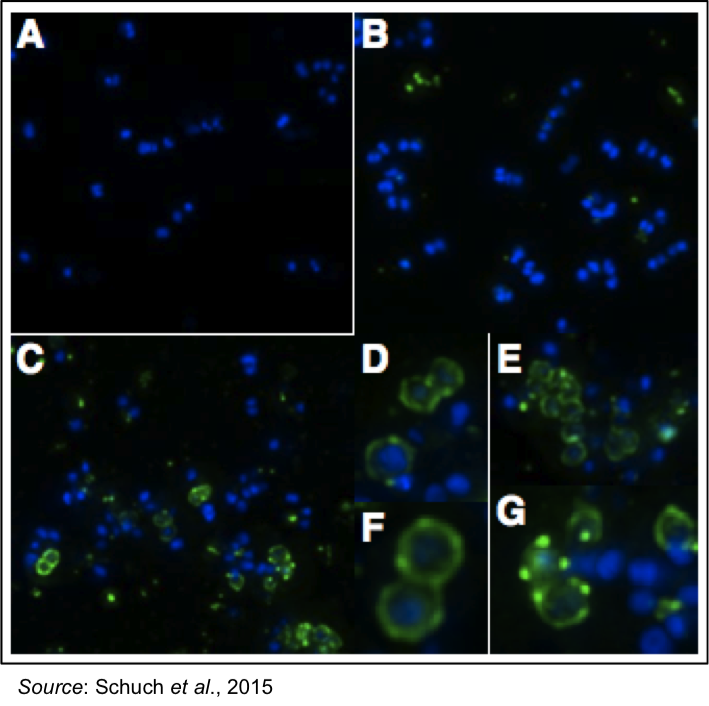
The synergy between the two compounds is exemplified in the following figure that shows fluorescently labeled DAP (DAPBD) binding to S. aureus cells (VISA strain) in 7.5% surfactant, but only in the presence of CF-301. Panel A shows S. aureus cells in the presence of buffer, panel B is S. aureus cells in the presence of 4 ug/mL DAPBD (1/64th MIC), while panels C-G are S. aureus cells in the presence of 4 ug/mL DAPBD and 4 ug/mL CF-301 (1/128th MIC) at different magnifications. The green ring surrounding the blue circle represents DAP binding to S. aureus. DAPI stain (blue) is used to indicate the nucleus of the cells.
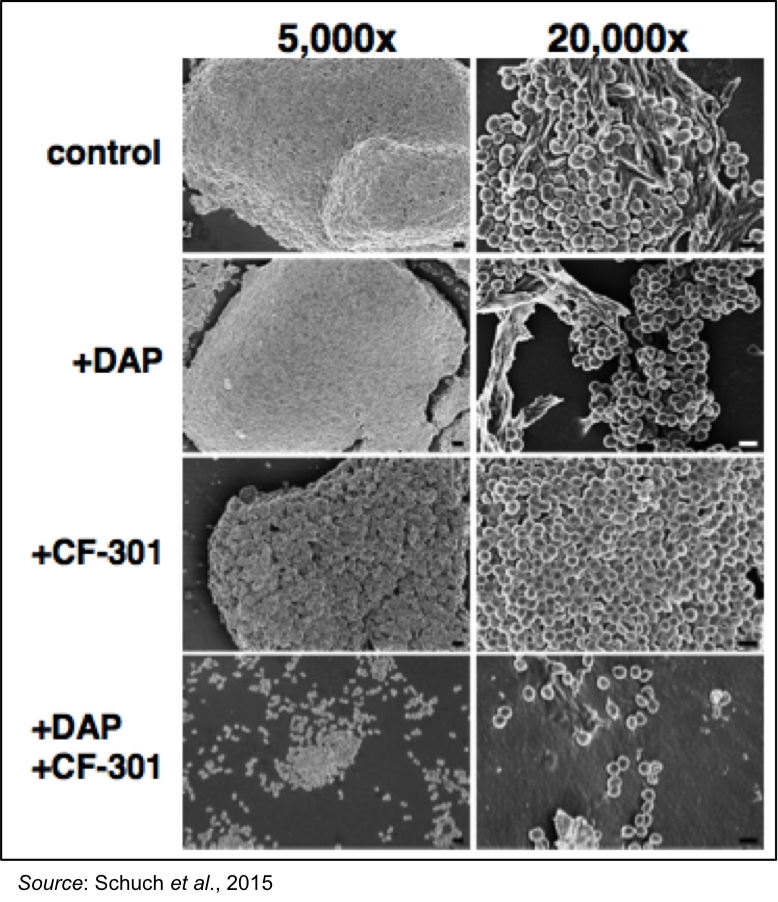
This binding to S. aureus resulted in killing of the cells and a large reduction in biofilm-like structures, as shown in the following figure. These results were shown with the same conentrations of DAP and CF-301 as in the previous figure.
Lastly, the DAP/CF-301 combination therapy was tested in a mouse model of lethal S. aureus pneumonia. Mice (n=10 per group) were infected intranasally with 5 x 10⁸ CFUs of a S. aureus MRSA strain and then treated once daily with either DAP, CF-301, or both beginning four hours after infection. Results show that the combination therapy of CF-301 and DAP is superior to monotherapy with CF-301 alone and is in agreement with previous studies showing CF-301 is synergistic with other antibiotics in treating S. aureus bacteremia (Schuch et al., 2014).
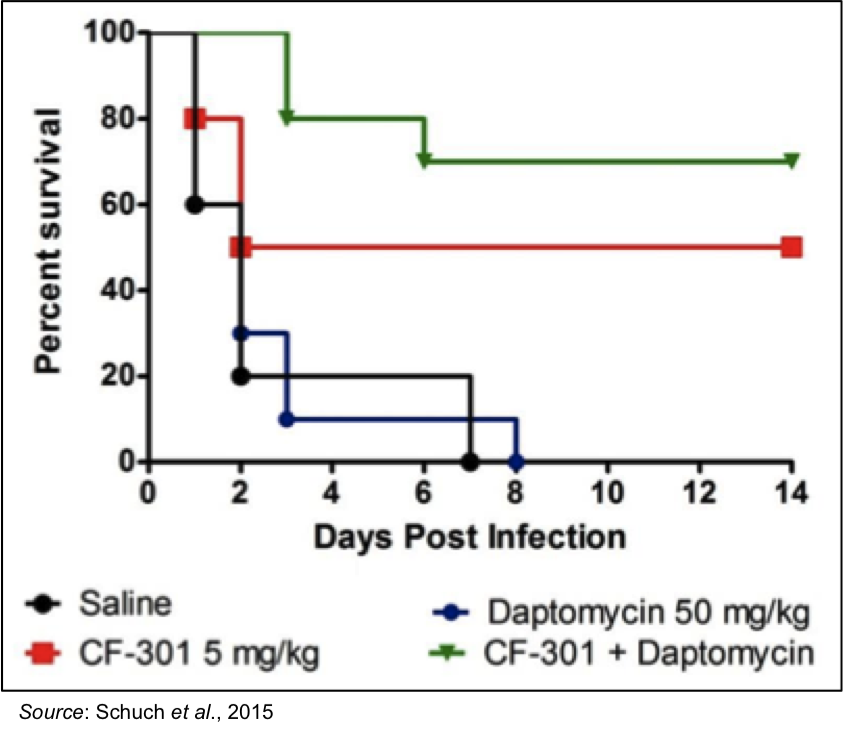
The most important conclusions from the aforementioned studies are as follows:
1) DAP is not active in pulmonary surfactant, however CF-301 is.
2) When used in combination in surfactant, sub-MIC concentrations of CF-301 and DAP show activity against a wide range of MRSA and MSSA S. aureus strains, thus somehow CF-301 is able to “activate” DAP in the presence of surfactant (the exact mechanism of action for this phenomenon is still being investigated).
3) DAP and CF-301 work synergistically to increase survival in a mouse model of lethal S. aureus pneumonia.
Conclusion
Earlier in the year, ContraFect initiated dosing of healthy volunteers with CF-301 in a randomized, double blind, placebo controlled, dose ranging Phase 1 study in order to evaluate the safety, tolerability, and pharmacokinetics of CF-301 when administered alone. CF-301 is the first lysin to be tested in humans. The company provided the first update on the trial on August 11, 2015, with the announcement that the independent Data Safety Monitoring Board (DSMB) recommended the continuation of the Phase 1 trial. At the time of the announcement, two of the four planned dosing levels had been successfully administered to healthy volunteers. The DSMB is reviewing the data after each dosing level is complete before the study can advance to the next level. We anticipate the Phase 1 study will be complete by the end of 2015 and, if no adverse events are detected, that the company can initiate a Phase 2 study of CF-301 in conjunction with standard of care antibiotics in patients with S. aureus bacteremia in 2016.
The results presented above indicate that CF-301 could be utilized for infection types caused by S. aureus outside of bacteremia. Given the specificity of lysins, we view the above data as important for generating additional market opportunities for CF-301, particularly since the specificity of lysins already limits treatment to certain species of bacteria. While the company has not yet disclosed what other infection types it plans to target, it is encouraging to see efficacy of CF-301 outside of bacteremia models.
We currently forecast peak sales of CF-301 in the $900 million range, and that is just for bacteremia. If the company can successfully target the drug for additional indications that number could rise by quite a bit, however we can’t specifically model anything at this point until the company provides more guidance on the future of the clinical program and what additional indications may be pursued.
In addition to CF-301, the company continues preclinical development of CF-404, which is a mixture of monoclonal antibodies that target different strains of the influenza virus. The distinguishing characteristic of CF-404 is that the antibodies target conserved regions of the virus that are not prone to high rates of mutation. ContraFect will be positioning CF-404 as a therapeutic option for the approximately 200,000 individuals who are hospitalized each year due to influenza, and we believe that is a potential $500 million opportunity.
Based on our current model, we believe the shares are worth $10 and we continue to rate the stock a ‘Buy’, noting that there is considerable upside potential based on expanding the clinical application of CF-301.
READ THE LATEST FULL RESEARCH REPORT HERE
SUBSCRIBE TO ZACKS SMALL CAP RESEARCH to receive our articles and reports emailed directly to you each morning. Please visit our website for additional information on Zacks SCR and to view our disclaimer.