By David Bautz, PhD
NASDAQ:CFRX
On December 15, 2015, ContraFect Corp. (NASDAQ:CFRX) announced the completion of the Phase 1 clinical trial of CF-301, a bacteriophage lysin targeted for the treatment of bacteremia (bloodstream infection) caused by Staphylococcus aureus, including all drug-resistant phenotypes. The trial was a safety study in healthy volunteers to determine if there were any adverse effects seen with single administrations of CF-301 at various doses, as well as to determine the pharmacokinetic parameters of the molecule. Below we provide a brief overview of CF-301, the Phase 1 clinical trial, and next steps for the development of the compound.
Background on CF-301
CF-301 is a lysin, a natural anti-bacterial hydrolytic enzyme that is produced by bacteriophages, virus’ that infect and kill bacteria. Lysins are highly evolved enzymes that are able to target one of the five bonds in peptidoglycan (murein), the main component of bacterial cell walls. A typical lysin, such as CF-301, comprises two domains separated by a short linker region. The N-terminal domain catalyzes the hydrolysis of peptidoglycan whereas the C-terminal domain binds to the cell wall substrate, often a carbohydrate, which confers a great specificity and decreases the chance for bacterial resistance. Due to this, the use of lysins as antibacterial agents is designed to combat drug resistance to currently used antibiotics.
CF301 will initially be targeted for the treatment of bacteremia, or infections of the bloodstream. Most studies estimate the incidence of S. aureus bacteremia (SAB) ranging from 20-50 cases/100,000 population (Klevens et al., 2007; Benfield et al., 2006; El Atrouni et al., 2009). Prior to the advent of antibiotics, the mortality rate from SAB was close to 80% (Mendell, 1939). The introduction of antibiotics, coupled with greater standards of care, has reduced the mortality rate, which appears to have stabilized at approximately 20% (Turnidge et al., 2009). SAB can frequently lead to infective endocarditis (IE), an infection of the endocardial surface of the heart (Fowler et al., 2005). The prevalence of IE is estimated to be anywhere from 11 to 50% of patients with SAB. Development of IE leads to an increased risk of embolic event and death (Miro et al., 2005).
The treatment of choice for S. aureus infections is penicillin, however in most countries penicillin resistance is extremely common. Resistance to penicillin is due to the activity of the enzyme penicillinase, which cleaves the β-lactam ring of the penicillin molecule. Penicillinase-resistant β-lactam antibiotics include methicillin, oxacillin, and flucoxacillin. S. aureus strains that have acquired resistance to methicillin have an altered penicillin-binding protein (PBP2a) that has lower affinity for binding β-lactam antibiotics, thus rendering them ineffective. Strains that have acquired this resistance are referred to as methicillin-resistant S. aureus (MRSA). The current gold standard for treatment of MRSA is vancomycin. However, vancomycin is far from ideal due to poor tissue penetration, slow bactericidal activity, and a number of side effects (Gould, 2008). Additional antibiotics utilized include teicoplanin, tegecyline, linezolid, daptomycin, and televancin. Each of those medications has their own shortcomings, including the development of resistance, thus there exists a significant unmet medical need for newer therapies, particularly those that are not susceptible to the development of resistance.
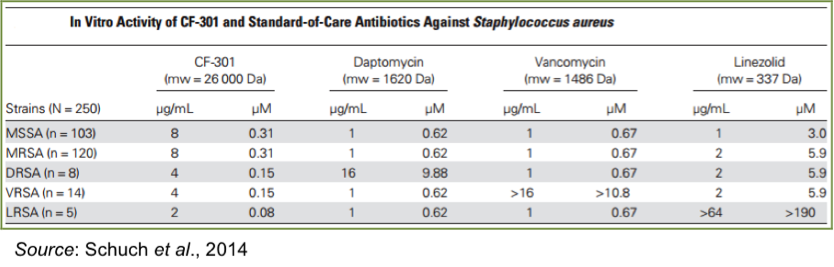
Prior in vitro studies have shown that CF-301 has potent inhibitor activity against 250 S. aureus strains, including 103 MSSA and 120 MRSA strains (Table below). CF-301 inhibited growth of MRSA strains additionally resistant to daptomycin, vancomycin, or linezolid. On a molar basis, CF-301 was 2- to 40-fold more potent than the standard of care antibiotics.
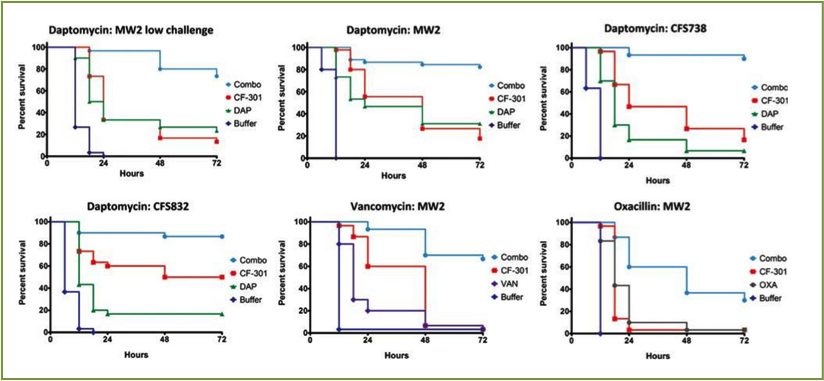
These promising in vitro results also translated to compelling animal studies in which mice were subjected to various S. aureus strains with CF-301 alone or in combination with various antibiotics currently in the clinic today. In all cases, the combination of CF-301 and antibiotic therapy resulted in increased survival when compared to single drug treatment regiments.
Phase 1 Study is Complete
On May 21, 2015, ContraFect initiated dosing of healthy volunteers with CF-301 in a randomized, double blind, placebo controlled, dose ranging Phase 1 study in order to evaluate the safety, tolerability, and pharmacokinetics of CF-301 when administered alone (NCT02439359). The company provided the first update on the trial on August 11, 2015, with the announcement that the independent Data Safety Monitoring Board (DSMB) recommended the continuation of the Phase 1 trial. At the time of the announcement, two of the four planned dosing levels had been successfully administered to healthy volunteers.
On December 15, 2015, the company announced the completion of the Phase 1 study. The DSMB reviewed safety, tolerability, and pharmacokinetic data from healthy volunteers in all the planned cohorts and found no clinical adverse safety signals associated with CF-301. This is very encouraging news, as CF-301 is the first lysin to be tested in a clinical trial and thus showing that the drug can be safely administered to humans is an important first step in its development.
Next Steps in Development of CF-301
At this point, the data from the Phase 1 study is still locked, thus the company has not had a chance to review all the various data points that were captured, including the pharmacokinetic (PK) data. It will be necessary to review the data to determine whether the next clinical trial will be dose ranging or involve a single dose. The company is hoping to meet with regulatory officials in the next few months to discuss the regulatory path forward for CF-301 as well as the next clinical study, which we anticipate will involve patients with SAB, including those with IE. The next clinical trial is likely to be initiated in the second half of 2016.
Conclusion
The successful completion of the Phase 1 study of CF-301 is an important milestone for ContraFect as it shows that the drug can be safely administered to humans with no adverse effects (i.e., allergic reactions). Investors greeted the news enthusiastically as the company’s stock price rose approximately 26% from where it closed on Dec. 14 after the news was released. We share investor’s enthusiasm about the data, and believe that the stock price could continue to climb as more people become aware of the significance of the Phase 1 data. For modeling purposes, we believe CF-301 could have peak revenues of $900 million and based on the successful Phase 1 data we have increased the probability of approval from 25% to 33%. As a result, we are increasing our target price from $10 to $12 and are re-iterating a ‘Buy’ rating.
READ THE LATEST FULL RESEARCH REPORT HERE
SUBSCRIBE TO ZACKS SMALL CAP RESEARCH to receive our articles and reports emailed directly to you each morning. Please visit our website for additional information on Zacks SCR and to view our disclaimer.