By David Bautz, PhD
NASDAQ:CFRX
Financial Update
On November 12, 2015, ContraFect Corp. (NASDAQ:CFRX) announced financial results for the third quarter of 2015. As expected, the company reported no revenues. Net loss was $5.6 million, or $0.22 per share, and was comprised of $3.4 million in R&D and $2.4 million in G&A expenses. Cash burn for the quarter was $2.9 million. The company exited the third quarter of 2015 with approximately $29.5 million in cash and cash equivalents. Subsequent to the end of the quarter, the company raised gross proceeds of approximately $9.6 million through the exercise of approximately 4.8 million Class B Warrants, which represents close to 70% of the total amount of Class B Warrants that were issued as part of the company’s IPO. The Class B Warrants that were not exercised have since expired.
As of November 9, 2015 the company had approximately 27.5 million shares outstanding. In addition, there are approximately 4.1 million stock options and 13.5 million warrants for a fully diluted share count of approximately 45.1 million shares. While the Class B Warrants have expired, the company still has Class A Warrants outstanding that trade on the NASDAQ under the ticker CFRXW. The 6.9 million Class A Warrants are exercisable at $4.80 per share, expire on January 31, 2017, and are callable if the stock trades at $9.60 per share or more for a period of 20 trading days.
CF-301 Update
ContraFect’s lead candidate is CF-301, a bacteriophage lysin targeted for the treatment of bacteremia (bloodstream infection) caused by Staphylococcus aureus, including all drug-resistant phenotypes. The company has commenced a Phase 1 clinical trial of CF-301 in healthy volunteers (NCT02439359). This is a randomized, double blind, placebo controlled, dose ranging trial that is taking place in the U.S. and is designed to test the safety, tolerability, and pharmacokinetics of a single intravenous dose of CF-301. CF-301 is the first lysin allowed by the U.S. FDA to enter human clinical trials.
S. Aureus Bacteremia
Infections of the bloodstream, particularly those caused by S. aureus, represent a significant medical challenge. While difficult to ascertain an exact figure, most studies estimate the incidence of S. aureus bacteremia (SAB) ranging from 20-50 cases/100,000 population (Klevens et al., 2007; Benfield et al., 2006; El Atrouni et al., 2009). Prior to the advent of antibiotics, the mortality rate from SAB was close to 80% (Mendell, 1939). The introduction of antibiotics, coupled with greater standards of care, has reduced the mortality rate, which appears to have stabilized at approximately 20% (Turnidge et al., 2009). SAB can frequently lead to infective endocarditis (IE), an infection of the endocardial surface of the heart (Fowler et al., 2005). The prevalence of IE is estimated to be anywhere from 11 to 50% of patients with SAB. Development of IE leads to an increased risk of embolic event and death (Miro et al., 2005).
The treatment of choice for S. aureus infections is penicillin, however in most countries penicillin resistance is extremely common. Thus, first-line treatment for most S. aureus infections is a penicillinase-resistant β-lactam antibiotic such as oxacillin. Antibiotic resistance in S. aureus was uncommon when penicillin was first introduced; in fact the petri dish that Sir Alexander Fleming first observed the antibacterial activity of the Penicillium fungus was growing a culture of S. aureus. However, by 1950, 40% of S. aureus isolates were penicillin resistant and by 1960 the rate had grown to 80% (Chambers, 2001).
Resistance to penicillin is due to the activity of the enzyme penicillinase, which cleaves the β-lactam ring of the penicillin molecule. Penicillinase-resistant β-lactam antibiotics include methicillin, oxacillin, and flucoxacillin. S. aureus strains that have acquired resistance to methicillin have an altered penicillin-binding protein (PBP2a) that has lower affinity for binding β-lactam antibiotics, thus rendering them ineffective. Strains that have acquired this resistance are referred to as methicillin-resistant S. aureus (MRSA). S. aureus strains that are sensitive to the penicillinase-resistant β-lactam antibiotics are said to be methicillin-sensitive (MSSA). It is currently estimated that more than 40% of SAB are caused by MRSA (Styers et al., 2006).
The current gold standard for treatment of MRSA is vancomycin. However, vancomycin is far from ideal due to poor tissue penetration, slow bactericidal activity, and a number of side effects (Gould, 2008). Additional antibiotics utilized include teicoplanin, tegecyline, linezolid, daptomycin, and televancin. Each of those medications has their own shortcomings, including the development of resistance, thus there exists a significant unmet medical need for newer therapies, particularly those that are not susceptible to the development of resistance.
Preclinical Studies Support the Use of CF-301
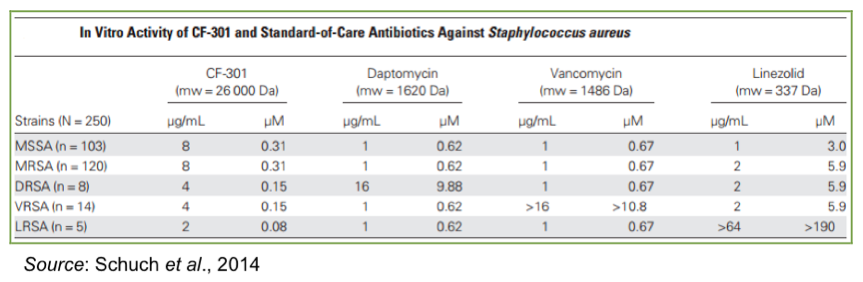
In an in vitro study published in the Journal of Infectious Diseases (Schuch et al., 2014), CF-301 demonstrated potent inhibitory activity on 250 S. aureus strains, including 103 MSSA and 120 MRSA strains (Table below). CF-301 inhibited growth of MRSA strains additionally resistant to daptomycin, vancomycin, or linezolid. On a molar basis, CF-301 was 2- to 40-fold more potent than the standard of care antibiotics.
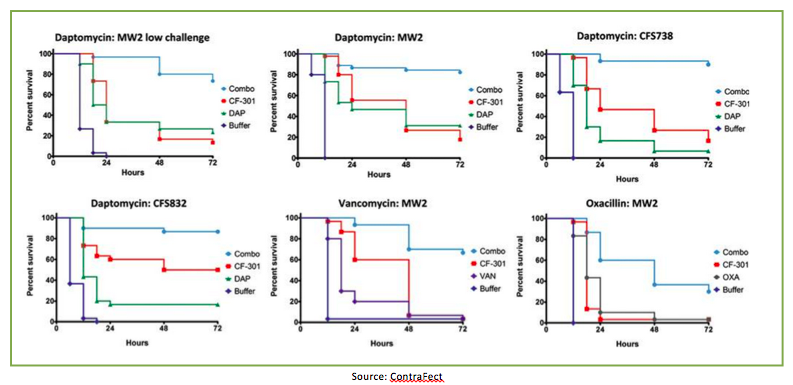
These promising in vitro results also translated to compelling animal studies in which mice were subjected to various S. aureus strains with CF-301 alone or in combination with various antibiotics currently in the clinic today. In all cases, the combination of CF-301 and antibiotic therapy resulted in increased survival when compared to single drug treatment regiments.
Biofilm Mechanism Key
Biofilms are thin and slimy films containing bacteria that adhere to human tissues such as heart valves and bone as well as implanted devices such as catheters, prosthetic joints, and medical devices. These biofilms have been known to be 1000-fold more resistant to antibiotics and have plagued the implant and medical device industry for decades. Biofilms are the root cause for implant failure, often resulting in surgery or even death with no viable treatments. Thus, biofilms cost the healthcare system billions of dollars which creates a high unmet need for therapies to alleviate them.
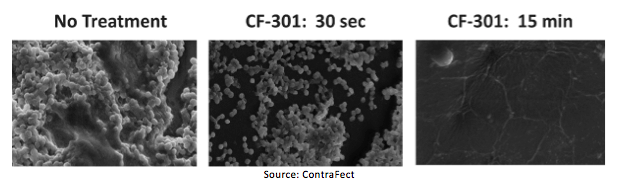
In vitro experiments using CF-301 against cellular cultures of biofilms showed it was a million-fold more potent than antibiotics at destroying biofilms. To further assess CF-301, ContraFect treated catheters inoculated with biofilms with CF-301 and showed it completely neutralized the biofilm on the catheter within 15 minutes of treatment (see below). As a result of this data, the company is pursuing further development of its lysin technology to potentially eradicate biofilms.
Update on Phase 1 Study
On May 21, 2015, ContraFect initiated dosing of healthy volunteers with CF-301 in a randomized, double blind, placebo controlled, dose ranging Phase 1 study in order to evaluate the safety, tolerability, and pharmacokinetics of CF-301 when administered alone. The company provided the first update on the trial on August 11, 2015, with the announcement that the independent Data Safety Monitoring Board (DSMB) recommended the continuation of the Phase 1 trial. At the time of the announcement, two of the four planned dosing levels had been successfully administered to healthy volunteers. The DSMB is reviewing the data after each dosing level is complete before the study can advance to the next level. We anticipate the Phase 1 study to finish enrollment by the end of 2015 with data available in the first half of 2016. If no adverse events are detected, the company should be able to initiate a Phase 2 study of CF-301 in conjunction with standard of care antibiotics in patients with SAB in 2016.
CF-301 Intellectual Property and Fast Track Designation
On July 17, 2015, ContraFect announced the issuance of U.S. Patent No. 9,034,322 titled “Streptococcus bacteriophage lysins for detection and treatment of gram positive bacteria”. The patent, which contains composition claims for CF-301 sequences and variants having at least 80% similarity, was assigned to Rockefeller University and ContraFect is the exclusive licensee. The expiration date for the patent is April 20, 2032, thus providing intellectual property protection for CF-301 for the next 16.5 years.
On August 17, 2015, ContraFect announced that the FDA has granted Fast Track designation to CF-301. The Fast Track program was put into place under the FDA Modernization Act of 1997 and is a process designed to facilitate the development, and expedite the review of drugs to treat serious conditions and fill an unmet medical need. A company that receives Fast Track designation for a drug is eligible for the following:
- More frequent meetings with the FDA to discuss the drug’s development plan and ensure that the appropriate data is being collected to support drug approval.
- More frequent written communication from the FDA about things such as clinical trial design.
- Eligibility for accelerated approval and priority review, including the submission of a New Drug Application (NDA) or a Biologics License application (BLA) on a rolling basis. What this means is that a company can submit completed sections of an NDA or BLA as they are completed and have them reviewed by the FDA, rather than waiting until every section of the application is completed before the entire application can be reviewed.
Resistance to standard of care antibiotics is a danger that necessitates the development of novel anti-bacterial therapies. Since CF-301 is the first lysin to enter clinical testing, the Fast Track designation will be very helpful to ContraFect as it will allow frequent communication between the FDA and the company to ensure that the clinical trials are being performed properly and the necessary data are being obtained that the FDA believes will be important for gaining approval.
CF-404 Offers Additional Upside
CF-404 is a mixture of monoclonal antibodies that target different strains of the influenza virus. The distinguishing characteristic of CF-404 is that the antibodies target conserved regions of the virus that are not prone to high rates of mutation. A new influenza vaccine is necessary each year due as the different strains of the influenza virus are constantly changing. By targeting the portions of the virus that are not prone to mutation, the company is able to develop one therapeutic that will not need to be continually reformulated.
ContraFect will be positioning CF-404 as a therapeutic option for the approximately 200,000 individuals who are hospitalized each year due to influenza. Preclinical data shows that CF-404 is effective in a mouse model of the H1N1 virus even when dosed up to 96 hours post-infection. This is in stark contrast to Tamiflu® (oseltamivir), an antiviral medication that must be administered within 24 hours of infection in the same model.
The company is planning on conducting additional manufacturing and pre-clinical studies to support filing an investigational new drug (IND) application in 2016, with initiation of Phase 1 clinical trials shortly thereafter.
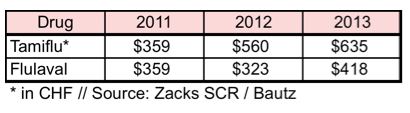
Given that CF-404 is currently still in pre-clinical development, it is difficult to forecast potential sales figures, although this does not mean that we assign it no value. An analysis of currently available influenza treatments shows that CF-404 likely has the potential to be a $500 million drug.
Key Management Additions
ContraFect has recently made a number of important additions to the company’s management team:
- In September 2015, the company announced the appointment of Josh Muntner as Senior Vice President of Business Development and Paul Boni as Head of Investor Development and Strategy. Most recently, Mr. Muntner was a Managing Director and Co-Head of Healthcare Investment Banking at Janney Montgomery Scott, where he was responsible for originating and executing equity financing and M&A transactions for the firm's life science clients. Mr. Muntner received his MBA from the UCLA Anderson School of Management and a Bachelor of Fine Arts from Carnegie Mellon University. Mr. Boni has over 14 years of experience as an investor, analyst, and executive in the biotechnology industry. Prior to joining ContraFect, Mr. Boni was the Global Head of Research at Integreon, where he was in charge of the firm's strategic research business and carried out special project work for its key life science and financial services clients. Previously, Mr. Boni worked as an analyst/portfolio manager at PAW Partners where he covered healthcare investments. Before moving to the buy-side, Mr. Boni also served as Vice President of Equity Research at Punk, Ziegel and Company (later acquired by Ladenburg Thalmann Financial Services) and also covered biotechnology stocks at Mehta and Isaly (later split into Orbimed Advisors and Mehta Partners). Mr. Boni received his BS from Harvard College with honors in Biology.
- In October 2015, the company announced the appointment of Cara Cassino, MD as Chief Medical Officer. Most recently, Dr. Cassino held the position of Senior Vice President, Global Clinical Development at Forest Laboratories, Inc (Forest) and served on its R&D Executive Leadership team. Dr Cassino led Forest's clinical development organization that was responsible for a portfolio of over 35 compounds, (including 7 drugs in the anti-infective space) and was also instrumental in the clinical due diligence process for Forest's $2.9 billion acquisition of Aptalis Pharma and $1.1 billion acquisition of Furiex Pharmaceuticals. Prior to joining Forest, Dr. Cassino held a number of senior executive positions at Pfizer, including Global Medical Team Leader of Pfizer's antibacterial franchise, which included Zyvox (linezolid) and Medicines Development Group VP for Pulmonary Vascular Disease and Rare Disease. Dr. Cassino graduated summa cum laude and Phi Beta Kappa from NYU with a BA in Chemistry and Fine Arts and received her medical degree from NYU. Dr. Cassino completed her internship and residency in Internal Medicine at NYU/Bellevue Hospital, followed by fellowship in Pulmonary/Critical Care Medicine at NYU and Mount Sinai Medical Center in New York City.
Valuation Methodology for ContraFect
For CF-301, we forecast the drug will be approved in 2019 and given that the compound is in Phase 1 testing we assign a 25% probability of eventual approval. We estimate peak sales of $900 million in 2024 and apply a 20% discount rate and approximately 65% operating margins. This leads to a net present value for CF-301 of approximately $207 million. For CF-404, we forecast that the drug could potentially reach peak sales of $500 million five years after approval in 2020. Since CF-404 is still in pre-clinical testing we assign a 15% probability of eventual approval. We estimate 65% operating margins and apply a 20% discount rate that results in a net present value of approximately $56 million.
Based on our current model, we believe the shares are worth $10 and we continue to rate the stock a ‘Buy’, noting that there is considerable upside potential based on expanding the clinical application of CF-301 and in the development of other lysins, which are currently still in the research phase.
READ THE LATEST FULL RESEARCH REPORT HERE
SUBSCRIBE TO ZACKS SMALL CAP RESEARCH to receive our articles and reports emailed directly to you each morning. Please visit our website for additional information on Zacks SCR and to view our disclaimer.