By Grant Zeng, CFA
NASDAQ:CPXX
On Dec. 8, 2015, Celator (NASDAQ:CPXX) announced positive data for VYXEOS™ (CPX-351) in two presentations at the 57th American Society of Hematology (ASH) Annual Meeting and Exposition in Orlando, December 5-8, 2015.
Abstract 1: CPX-351 ((Cytarabine:Daunorubicin) Liposome Injection, (Vyxeos)) Does Not Prolong QTcF Intervals, Requires No Dose Adjustment for Impaired Renal Function and Induces High Rates of Complete Remission in Acute Myeloid Leukemia
This open-label, single arm, Phase II PK/PD study measured the effects of VYXEOS on cardiac repolarization during the first induction cycle and correlated electrophysiologic changes, as measured by the QT/QTc interval, with a detailed pharmacokinetic assessment of cytarabine and daunorubicin and their metabolites using exposure response modeling methodology.
This study, in adult patients with acute hematologic malignancies, was conducted to support the NDA filing in the US.
The study completed enrollment in June 2015. Each patient received a first induction of VYXEOS on days 1, 3 and 5 and, if necessary, a second induction for patients with reduced leukemia burden not yet achieving a disease-free state. Responding patients were eligible for up to four consolidation courses.
Twenty-six patients with acute myeloid leukemia (AML) or acute lymphoblastic leukemia (ALL) were enrolled and 21 were evaluable for QT interval change from baseline. VYXEOS did not prolong the QT/QTc interval, a positive safety outcome. The largest absolute and mean change from time-matched baseline was 12.56 and 8.03 ms, respectively (Day 1, hour 4). Mean QTcF change on Day 5 was unchanged from baseline. QTcF intervals >480 ms were never observed and no consistent QTcF intervals >450 ms were noted. Absolute QTcF increases between 30 and 60 ms were present in 4 of 25 patients and no changes >60 ms were observed. CPX-351 plasma concentration vs. time curves for day 1 and 5 exhibited a volume of distribution approximately equal to the plasma volume with prolonged single-exponential elimination half-lives for cytarabine and daunorubicin of ≥24 hours.
The study included patients with newly diagnosed AML, relapsed/refractory AML and relapsed/refractory ALL. Thirteen of the 26 patients responded. Responses were seen in each of the three acute leukemia patient populations. The high response rates corroborate the high level of efficacy observed in earlier studies with CPX-351.
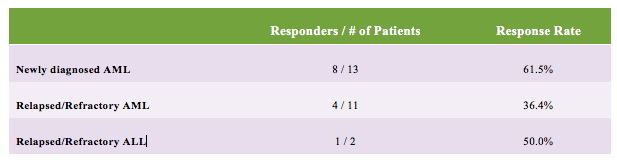
In addition, CPX-351 exposure was independent of renal function, indicating no need for dose adjustment when renal function is impaired.
Adverse events were similar in frequency and severity to those described in earlier studies.
Abstract 2: CPX-351 Enables Administration of Consolidation Treatment in the Outpatient Setting and Increases the Time Spent out of the Hospital after Completion of AML Treatment Compared with 7+3
In this presentation, health resource utilization (HRU) was assessed using data from a previously published randomized Phase II study (study 204) comparing first-line treatment with VYXEOS vs. the current standard of care, known as the 7+3 regimen, in newly diagnosed older patients (age 60-75) with AML (Lancet, et al. Blood 2014;123(21):3239-3246).
85 patients were randomized to VYXEOS (CPX-351) and 41 to the 7+3 control arm. The two study arms were balanced for age, sex, race, AML type (de novo vs. secondary AML), performance status, and cytogenetic risk.
The two treatment arms were compared for number of hospitalizations, total hospital days, patients responding following a single induction, responding patients receiving consolidation therapy in the outpatient setting, event-free survival (EFS), and the ratio of EFS per inpatient days.
Analysis of the Phase II study data indicated that HRU outcomes were favorable for VYXEOS compared to 7+3. VYXEOS-treated patients required fewer inductions to respond and were more likely to be given consolidation treatment in an outpatient setting (47% vs. 19%).
VYXEOS treatment was associated with a substantial increase in EFS days (median:197 days vs. 60 days), with a slight increase in hospital days (median:38 days vs. 35 days) resulting in a substantial improvement in the ratio of median EFS days to median hospital days (5.2 vs. 1.7) in favor of VYXEOS.
In conclusion, CPX-351 was associated with better clinical outcomes, including, lower early death rates, higher response rates, and improved overall survival in specific patient subsets. This report provided the first evidence that number of hospitalizations per patient, a key driver of hospital costs, is significantly less for CPX-351 and that overall days in hospital is similar for CPX-351 and 7+3 among responding patients, with many CPX-351 patients receiving consolidation as outpatients. In addition, CPX-351 improved the duration and proportion of time spent as an outpatient following completion of AML treatment.
A more robust analysis of HRU is planned for the Phase III trial.
SUBSCRIBE TO ZACKS SMALL CAP RESEARCH to receive our articles and reports emailed directly to you each morning. Please visit our website for additional information on Zacks SCR and to view our disclaimer.