By David Bautz, PhD
NASDAQ:CTRV
Financial Update
On November 12, 2015, ContraVir Pharmaceuticals, Inc. (NASDAQ:CTRV) filed SEC form 10-Q with financial results for the first quarter of fiscal year 2016 that ended September 30, 2015. The company did not report any revenues during the most recent quarter. Net loss for the quarter was $4.8 million, or $0.22 per share, which was comprised of $3.8 million in R&D expenses and $1.1 million in G&A expenses.
ContraVir exited the most recent quarter with $1.8 million in cash and cash equivalents. Cash burn for the first quarter of FY2016 was $2.8 million. Subsequent to the end of the quarter, the company raised gross proceeds of $15 million through the sale of five million shares of common stock at $3.00 per share. We believe this will be sufficient to fund operations for the next 12 months. As a reminder, on March 9, 2015, ContraVir entered into an “At-the-market” sales agreement with Cantor Fitzgerald & Co. through which the company may sell up to $50 million worth of common stock. Thus far, the company has not sold any shares under this agreement.
The company reported 27.3 million shares outstanding as of November 9, 2015, and when adding in the 0.9 million currently exercisable stock options and the shares upon conversion of the Series A and B Preferred Shares gives a fully diluted share count of 55.4 million. This gives the company a current fully diluted market cap of approximately $89 million.
CMX157 More Potent Than Viread® Against Hepatitis B
On October 5, 2015, ContraVir announced in vitro data showing that CMX157 is 60-fold more potent against the hepatitis B virus (HBV) than tenofovir (Viread®). Below is an overview of hepatitis B, tenofovir, and the clinical development plan for CMX157.
Overview of Hepatitis B
The hepatitis B virus (HBV) is a member of the hepadnavirus family that causes both acute and chronic liver infections. It is estimated that approximately 350-400 million people worldwide have a chronic, lifelong infection. HBV can be classified into 10 genotypes (A to J) based upon an inter-group divergence of more than 8% or more in the complete nucleotide sequence (Stuyver et al., 2000; Arauz-Ruiz et al., 2002; Olinger et al., 2008; Tatematsu et al., 2009). Recent evidence suggests clinical outcome and response to antiviral therapy may be impacted by HBV genotype.
Acute infection with the hepatitis B virus typically results in a loss of appetite, nausea, vomiting, body aches, mild fever, and jaundice. More than 90% of people infected with the hepatitis B virus will recover and be completely free of the virus within six months. According to the World Health Organization, the likelihood of developing a chronic hepatitis B infection is highly dependent upon the age when the infection occurs (WHO fact sheet N°204):
- 80-90% of infants infected during the first year of life develop chronic infections;
- 30-50% of children infected before the age of six develop chronic infections;
- Less than 5% of otherwise healthy adults will develop chronic infection;
- 15-25% of adults who develop chronic infection during childhood will die from hepatitis B associated liver cirrhosis or cancer
Chronic HBV infection can be divided into five different phases (EASL, 2012), which are not necessarily sequential, with each phase necessitating a different treatment protocol. The goal of treating chronic HBV infection is to prevent progression of the disease to cirrhosis, end-stage liver disease, liver cancer (hepatocellular carcinoma or HCC), and death. This can usually be achieved by suppressing HBV replication is a sustained manner. However, chronic HBV infection can never be completely eradicated due to the presence of HBV DNA in the nucleus of hepatocytes (Bréchot et al., 1981) as well integration of the HBV genome into the host genome (Bréchot, 2004).
Two different types of drugs are utilized in the treatment of chronic HBV infection: conventional or pegylated interferon alpha (INF or PEG-INF) and nucleoside/nucleotide analogs (NAs). NAs available for the treatment of chronic HBV infection include:
- Nucleoside analogs: lamivudine, telbivudine, emtricitabine, entecavir
- Nucleotide analogs: adefovir and tenofovir
NAs are quite effective at inhibiting HBV replication; however, these treatments are not curative and require life-long dosing with a high risk of developing drug resistance and toxicity (Scaglione et al., 2012).
Overview of Tenofovir
Tenofovir is an NA inhibitor of reverse transcriptase, an enzyme involved in a number of diverse roles during different stages of HBV replication (Jones et al., 2013). Tenofovir was originally synthesized in the mid 1980’s and was initially shown to have anti-HIV activity. However, due to its very limited bioavailability the compound did not have the potential for widespread use. Tenofovir disoproxil fumarate (TDF) is a prodrug of tenofovir that was developed to allow for oral administration of the drug. TDF was approved by the FDA for the treatment of HIV in 2001 and for the treatment of chronic HBV infection in 2008. The drug is marketed under the name Viread® by Gilead Sciences.
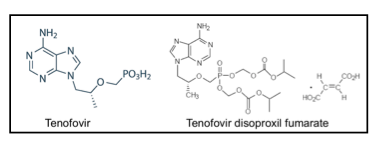
Gilead has developed tenofovir alafenamide fumarate (TAF) as a follow-on compound to TDF. TAF is reported to have greater antiviral activity than TDF along with better penetration into lymphoid tissues (Eisenberg et al., 2001). In addition, TAF exhibits similar efficacy to TDF but at much lower concentrations, as shown in a Phase 1 study where a TAF dose 10 times less than TDF offered superior antiviral activity (Ruane et al., 2013). Lastly, the higher intracellular concentration of tenofovir following metabolism of TAF supports the notion that kidney toxicity will be reduced compared to treatment with TDF. Gilead is currently testing TAF in two clinical trials for chronic HBV.
CMX157
CMX157 is a prodrug of tenofovir (Viread®) that utilizes a proprietary lipid technology developed by Chimerix, Inc. The proprietary technology is utilized to covalently modify a drug molecule with a lipid side-chain that mimics a naturally occurring phospholipid component of cell membranes. The lipid-conjugated molecule can then utilize natural uptake pathways to achieve oral bioavailability, enhance uptake into cells, avoid many toxicities, and yield higher intracellular concentrations of drug.
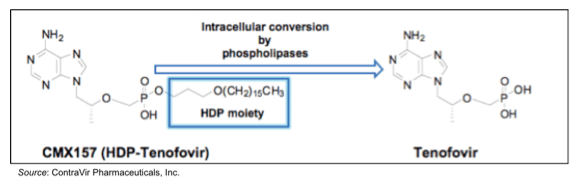
Chimerix tested CMX157 in a Phase 1 trial in 2010. It was a randomized, double blind, placebo controlled, single dose escalation study conducted in healthy volunteers. The purpose of the study was to evaluate the safety, tolerability, and pharmacokinetics of CMX157. Along with CMX157, subjects were also dosed with Viread® to permit comparison of active tenofovir inside patient cells.
Data from the Phase 1 study showed that CMX157 was both safe and well tolerated. The data generated from the study support the notion that CMX157 may have a better safety profile than Viread® as the novel structure of CMX157 resulted in a high intracellular concentration of the active antiviral agent tenofovir diphosphate and decreased levels of circulating tenofovir, which means there is decreased potential for renal side effects associated with Viread®.
ContraVir did not release many details associated with the data showing that CMX157 is 60-fold more potent than tenofovir against hepatitis B in in vitro studies, however the company is planning to present the data on this and other preclinical studies in detail at HepDART in early December 2015. At that time investors should be able to get a more detailed look at the data on CMX157 and we will be presenting a thorough analysis on the data shortly thereafter.
The company will be able to use the Phase 1 safety data for CMX157 (referenced above) along with the various preclinical data compiled thus far in the IND filing, which the company hopes to have completed by the end of 2015. We anticipate a Phase 2 study of CMX157 being initiated in 2016 in HBV patients. Thanks to a recently issued composition of matter patent for CMX157, the compound has intellectual property protection to at least 2031.
FV-100 Update
On August 3, 2015, ContraVir announced the first patient was enrolled in the pivotal Phase 3 study of FV-100 for the treatment of shingles and shingles-associated pain. Below is a brief background on shingles, FV-100, and the Phase 3 clinical trial design.
Background on Shingles
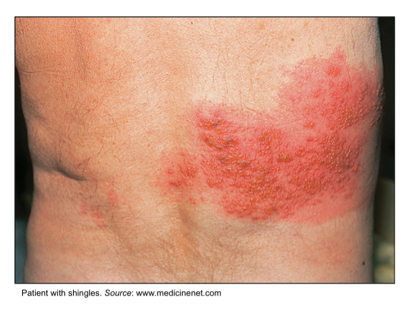
Herpes zoster (shingles) is caused by the varicella-zoster virus (VZV), which is a human alphaherpesvirus that also causes varicella (chickenpox). Before the advent of a vaccine, chickenpox was a common childhood illness associated with fever and a generalized pruritic vesicular rash. As is common with all alphaherpesviruses, which includes herpes simplex virus types 1 and 2 (HSV-1 and HSV-2), VZV is capable of establishing lifelong latent infection in the cells of the peripheral nervous system after the initial infection (Weller, 2011). For reasons that are not yet fully understood, some individuals with a previous primary VZV infection will go on to develop shingles. Patients with shingles typically have a unilateral radicular pain (a type of pain that radiates into the lower extremities directly along the course of a spinal nerve root) and a vesicular rash that is usually limited to a single dermatome (an area of the skin that is supplied by a single spinal nerve).
There are currently three antiviral therapies approved by the FDA for the treatment of shingles: famciclovir, acyclovir, and valacyclovir. Each of the antiviral therapies is available as a generic. Based upon data collected by ContraVir, there were approximately 17 million prescriptions for famciclovir, acyclovir, and valacyclovir in 2009, with approximately 15-30% of those written for the treatment of shingles. Glaxo sold roughly $1.75 billion in Valtrex® sales at its peak in 2009. The majority of Valtrex® sales in 2009 were in HSV, but the aforementioned estimate of 15-30% in shingles equates to sales in the $260 to $520 million range.
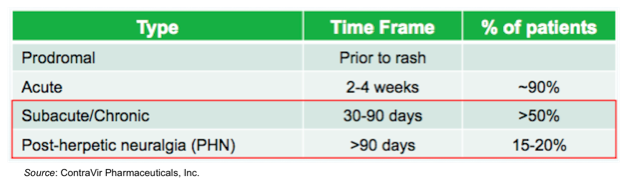
The pain associated with shingles is typically reported to be a deep aching or burning along with altered sensitivity to touch, exaggerated response to stimuli, or electric shock-like pains. Most patients will experience some form of pain for a few weeks. A majority of patients will experience further pain that lasts anywhere from one to three months. For approximately 15-20% of patients the pain is persistent for more than three months, at which point it is referred to as post-herpetic neuralgia (PHN).
Post-Herpetic Neuralgia
PHN is one of a number of types of neuropathic pain (NP), which is a chronic pain caused by tissue damage or disease that affects the somatosensory system, which is the part of the sensory system associated with the conscious perception of touch, pressure, pain, temperature, position, movement, and vibration. The pain associated with PHN can be severe and debilitating and in many patients it has a negative impact on the quality of life by affecting mood, sleep, and overall well-being (Magrinelli et al., 2013; Johnson et al., 2010).
In some patients, pain and temperature detection systems are hypersensitive to light mechanical stimulation (allodynia). Other patients may have severe and spontaneous pain with no allodynia. Since pain is unique to each individual, the words that describe PHN vary considerably and include pricking, tingling, burning, stabbing, or aching. While the exact mechanism is unclear, the pain appears to result from injury of the peripheral nerves brought about by the virus and the associated inflammatory response.
The type of pain along with the variability of its duration makes PHN a very difficult condition to properly treat, and suggests that multiple pathophysiological mechanisms are likely to be involved in its manifestation. Numerous medications have been evaluated in clinical trials to treat PHN, including gabapentin (Neurontin®, Gralise®), pregabalin (Lyrica®), topical lidocaine, topical capsaicin, and gabapentin enacarbil (Horizant®), each of which has received FDA approval for the PHN indication. In addition, the American Academy of Neurology also recommends tricyclic antidepressants and opioids as first-line treatments for PHN.
Pain associated with PHN is often refractory to treatment and many patients require more than one agent to achieve significant pain relief. Also, approximately 40-50% of patients with PHN do not respond to any treatment, with other patients experiencing limited efficacy. Thus, given the difficulty in treating PHN, the ability to prevent or limit the onset of PHN would offer a unique treatment option for shingles patients.
Drawbacks to Currently Approved Antivirals
Clinical trials of the aforementioned antiviral therapies have shown them to be successful in lessening the dermatological symptoms of shingles patients when treatment begins within 72 hours of the first appearance of a shingles-related rash or lesion. However, there are a number of drawbacks with the currently available antivirals, such as:
- None are approved for the reduction of shingles-associated pain or prevention of PHN. While past clinical trials have shown that antiviral therapy reduces the duration of pain, none of the antivirals is approved for the reduction of shingles associated pain or the prevention of PHN.
- Inconvenient dosing. Each of the approved shingles medications must be taken multiple times per day: Famciclovir – three times per day; Acyclovir – five times per day; Valacyclovir – three times per day. There are multiple studies that have examined the relationship between dosing frequency and patient compliance, as medication non-adherence can lead to suboptimal health outcomes. Claxton et al. showed a statistically significant difference in compliance between once-daily (QD) and three-times-daily (TID) medications (79% vs. 65%, P = 0.008).
- Current antiviral dosages must be adjusted for patients with renal insufficiency. Although the currently available antiviral medications are generally safe and well tolerated, dosing must be adjusted for patients who have renal insufficiency to avoid potential adverse events.
Background on FV-100
FV-100 is an orally available, small-molecule nucleoside analog of CF-1743 that is under development for the treatment of shingles and the prevention of PHN. Both compounds belong to a group of molecules known as bicyclic nucleoside analogues (BCNAs), and are differentiated from the acyclic purine nucleoside acyclovir and the related compound famciclovir based on their specificity, as acyclovir and famciclovir are significantly more active against HSV than VZV, thus the reason for the higher clinical dosing of acyclovir/famciclovir/valacyclovir for treating shingles.
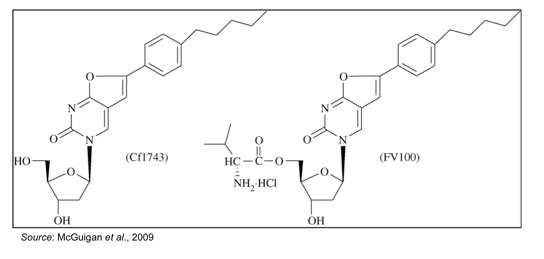
Initial research into BCNAs resulted in compound CF-1743 emerging as the prototype BCNA compound, with early in vitro testing showing inhibitor activity against VZV at or below 1 nM, thus being approximately 1,000 times more potent than acyclovir (McGuigan et al., 2000). As with acyclovir/famciclovir, CF-1743 has an absolute requirement for VZV thymidine kinase mediated phosphorylation for antiviral activity; however, unlike acyclovir/famciclovir CF-1743 has virtually no reactivity to HSV thymidine kinase (Sienaert et al., 2002). One limitation to CF-1743 was a lack of water solubility, which limits oral bioavailability, thus a number of pro-drug formulations were tested to enhance the pharmacokinetic profile of the drug. Just as valcyclovir is the valyl ester form of acyclovir, the valyl ester form of CF-1743 (designated as FV100) was selected for further development based on high solubility, stability, and a favorable pharmacokinetic profile (McGuigan et al., 2007).
FV-100 Phase 3 Clinical Trial
ContraVir has initiated a global, multi-center, randomized, double-blind, parallel group, comparative Phase 3 clinical trial of FV-100 and valacyclovir (NCT02412917). The trial will enroll 825 patients evenly split between three groups: 400 mg FV-100 dosed once a day for seven days, 400 mg FV-100 dosed twice a day for seven days, or 1000 mg valacyclovir dosed three times a day for seven days.
The primary endpoint of the study is the difference in incidence of PHN between FV-100 and valacyclovir treated patients and will be evaluated on day 120. Each day, patients will phone into an interactive voice response system (IVRS) to answer three questions on the zoster brief pain inventory (ZBPI), a questionnaire that measures the impact of the pain and discomfort caused by shingles or PHN on the ability to carry out seven general activities: work, sleep, walking, life enjoyment, mood, relations with others, and general activity (Coplan et al., 2004).
The study subjects will be asked daily:
1. Have you had any pain caused by your shingles in the last 24 hours? If they answer “no” they will not be required to answer the next two questions.
2. On a scale of 0 to 10, where 0 represents ‘no pain’ and 10 represents ‘pain as bad as you can imagine’, what best describes your pain at its worst in the last 24 hours?
3. On a scale of 0 to 10, where 0 represents ‘no pain’ and 10 represents ‘pain as bad as you can imagine’, what number best describes your pain on the average in the last 24 hours?
The primary efficacy endpoint is the proportion of subjects with PHN at Day 120, and will be determined by Item 3 of the ZBPI, Worst Pain in the Last 24 Hours. PHN will be defined as the average of the ZBPI Worst Pain in the Past 24 Hours scores collected between Days 114 and 120 that is ≥ 3.
A key secondary endpoint will be time to loss of acute pain, defined as the first occurrence where ZBPI Item 3 (Worst Pain in the Last 24 Hours) as collected daily from the IVRS is equal to 0 and remains at 0 until all the lesions are healed. Additional secondary endpoints include: time to resolution of clinically significant pain (defined as start of the first seven day period where the average of ZBPI Item 3 is < 3; time to resolution of pain using ZBPI Item 3; time to resolution of pain after complete lesion healing; time to cessation of new lesion formation; time to complete lesion healing; and changes in pain intensity.
For statistical analysis, it is assumed that no more than 11% of twice-daily FV-100 treated patients and no fewer than 20% of valacyclovir treated patients will experience PHN at Day 120. With 825 total subjects (275 in each group), the trial is 80% powered to detect the aforementioned difference in incidence of PHN vs. the control, assuming a two-sided 5% significance level.
Shingles Market Analysis
There are an estimated one million cases of shingles in the U.S. each year (source: NIAID), with approximately 50% of all cases occurring in individuals over the age the age of 60 and approximately 80% occurring in individuals over the age of 50. The aging population of many Westernized nations means the incidence is expected to continue to increase.
As mentioned previously, none of the antiviral therapies approved for the treatment of shingles are approved for the prevention of PHN. All three antivirals (valacyclovir, acyclovir, famciclovir) are available as generics, with valacyclovir the market leader. In 2012, there were approximately 20 million prescriptions written for valacyclovir (57%), acyclovir (39%), and famciclovir (4%). We estimate that approximately 15% (3 million) of the prescriptions were for shingles patients. According to GoodRx.com, 50 tablets of generic 800 mg acyclovir cost approximately $75, 21 tablets of generic 1000 mg valacyclovir cost approximately $225, and 21 tablets of 800 mg famcicovir cost approximately $50. We estimate Valtrex® sales for shingles in 2009, the year before the patent expiration, totaled roughly $300 million.
Since all currently available shingles medications are available as generics, in order for ContraVir to justify pricing FV-100 at a premium the results of the Phase 3 study must clearly show a reduction in the risk of developing PHN. We believe a 50% reduction in incidence would be considered clinically meaningful by physicians. The degree of risk reduction will dictate potential pricing and peak revenue opportunity. With 50% risk reduction being the minimum, we estimate peak sales for FV-100 could range anywhere between $250 and $700 million.
Conclusion
The news that CMX157 is much more potent against HBV than Viread® was well received by investors, with the stock up well over 150% at one point on the day the news was released! This could be partly explained by the size of the HBV market and how much successful therapies generate in revenues, as shown in the following figure.
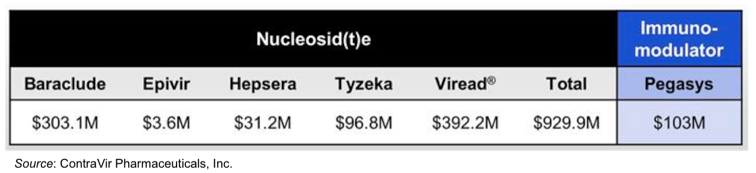
What those numbers do not represent is the possibility of not just managing HBV, but of curing the disease. Up until a couple of years ago, hepatitis C was similar to hepatitis B in that it was a disease that could only be managed. However, with the recent approval of a number of treatments such as Sovaldi®, Harvoni®, and Veikira Pak®, hepatitis C is being cured in greater than 95% of patients that are treated. This is reflected in the revenues for Sovaldi® and Harvoni®, which were $2.3 and $7.2 billion, respectively, in just the first half of 2015 (EvaluatePharma)! While CMX157 is most likely not going to represent a cure for HBV on its own, ContraVir is very open to forming combination partnerships to determine the possibility of using CMX157 in a potentially curative combination therapy. While very difficult to forecast at this point, based on the efficacy of tenofovir coupled with its much-improved safety and toxicology profile, CMX157 could go on to become a blockbuster medication as part of a multi-component treatment regimen.
For our model, we estimate that a Phase 2 trial of CMX157 gets underway in 2016, a Phase 3 trial in 2017, with an NDA filing and approval in 2019 and 2020. For modeling, we estimate that CMX157 will be as efficacious as TAF, thus we forecast that the drug would cost $12,000 per year in 2015 (the approximate current cost of Viread®), with inflationary increases for the ensuing years. At this point we are very conservatively modeling for peak revenues of $200 million. However, based on the discussions above, we want investors to be aware that the revenue potential for CMX157 could be much higher. With the notion of the drug being used in a combination therapy only theoretical at this point, we choose to remain very conservative for our future revenue forecasts, noting that those numbers could be adjusted upward significantly based upon future preclinical and clinical data.
Right now, the majority of the intrinsic value of ContraVir continues to come from FV-100, due to the fact that the compound is in a Phase 3 clinical trial for the treatment of herpes zoster and PHN, which we believe is a potential $700 million opportunity. We estimate that the FV-100 Phase 3 trial will conclude in 2016 with successful results leading to an NDA filing in 2017, and approval by the FDA in 2018. For valuation purposes, we performed a weighted average discounted cash flow analysis that takes into account the likelihood of different outcomes for the trial and the pricing/peak market share for each outcome:
- Best = 25% probability, 32% peak market share, $350 / Rx
- Base = 50% probability, 25% peak market share, $290 / Rx
- Lowest = 15% probability, 19% peak market share, $210 / Rx
- Failure = 10% probability, not approved
We have recently lowered the discount rate that we utilize in our model due to the fact that the company now has a compound in an active Phase 3 trial, which resulted in an increase to the fair value to $8. We continue to rate the stock a ‘Buy’ and believe that the recent pullback in the stock price represents a good opportunity to initiate or add to a position in the stock.
READ THE LATEST FULL RESEARCH REPORT HERE
SUBSCRIBE TO ZACKS SMALL CAP RESEARCH to receive our articles and reports emailed directly to you each morning. Please visit our website for additional information on Zacks SCR and to view our disclaimer.