By Grant Zeng, CFA
NASDAQ:DEPO
The Deal
Recently in Nov, 2015, Depomed (NASDAQ:DEPO) entered into a definitive agreement to acquire the U.S. and Canadian rights to cebranopadol and its related follow-on compound from Grünenthal GmbH.
Pursuant to the agreement, Depomed has entered into a settlement agreement with Endo Pharmaceuticals to resolve Depomed's ongoing patent litigation against Endo for alleged infringement of three of Depomed's patents by Endo's OPANA® ER product. As the formulator of OPANA® ER, Grünenthal indemnified Endo for certain intellectual property matters, including Depomed's ongoing patent infringement lawsuit against Endo. The settlement agreement grants Endo a non-exclusive patent license in the United States, and a covenant not to sue outside the United States, for the currently marketed form of OPANA® ER. In addition, Depomed is providing Grünenthal with a limited covenant not to sue under certain Depomed Acuform® drug delivery patents with specific drug substances.
In connection with the acquisition, Depomed will pay Grünenthal $25 million in cash. Depomed will also pay Grünenthal royalties on net sales and one-time net sales milestones. There are no clinical, regulatory or approval milestone payments. The deal is expected to close in the fourth quarter of 2015. The settlement agreement with Endo becomes effective upon the closing under the license agreement.
Cebranopadol
Cebranopadol is a novel, first-in-class analgesic in development for the treatment of moderate to severe chronic nociceptive and neuropathic pain.
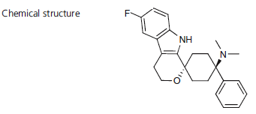
Cebranopadol is a differentiated molecule with a novel dual mechanism-of-action, functioning as a high-potency agonist of both the mu-opioid (MOP) and the nociceptin receptors (NOP). Cebranopadol's pharmacology is likely to confer analgesic efficacy equivalent to that of traditional opioids in peripherally-mediated, nociceptive pain conditions, while potentially conferring great efficacy in neuropathic pain and other pain states characterized by more centralized pain. Moreover, the product does not appear to impact respiratory function to the degree that traditional mu-opioid receptor agonists do, and the nociceptin receptor pharmacology also appears to substantially mitigate the abuse potential of cebranopadol.
The in vitro Binding Assay
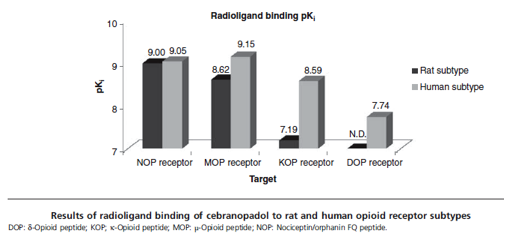
In in vitro radioligand binding testing, Cebranopadol showed the highest receptor affinities at NOP and MOP, both rat and human receptors, while the affinity at KOP receptors was ~ 3-fold weaker, and ~ 20-fold weaker for DOP receptors for human receptors. The affinity at the rat KOP and DOP receptor was even lower (Linz K,et al: J Pharmacol Exp Ther 2014;349(3):535-48).
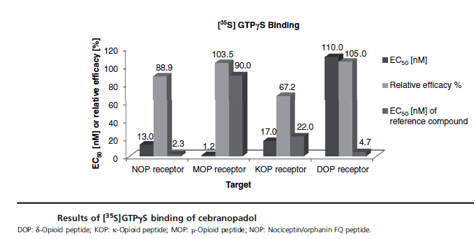
The agonistic activity of cebranopadol at human opioid receptors was determined in [35S] guanosine-5′-[Ƴ-thio] triphosphate binding assays. These data showed that cebranopadol was a full agonist of human MOP and DOP receptors, almost a full agonist of human NOP receptors, and a partial agonist of human KOP receptors (Linz K,et al: J Pharmacol Exp Ther 2014;349(3):535-48).
Preclinical Animal Studies
In preclinical animal studies, Cebranopadol demonstrated excellent anti pain efficacy in both acute and chronic animal models. In one acute rat model, Cebranopadol was antinociceptive after intravenous and oral administration, and its activity lasted longer (7 h) than that of equianalgesic doses of morphine (3 h) and fentanyl (30 min). Intravenous cebranopadol was also effective in chronic pain models: complete Freund’s adjuvant (CFA)-induced arthritis (a model of nociceptive/inflammatory pain), bone cancer pain (nociceptive and neuropathic pain), painful diabetic neuropathy and the spinal nerve ligation model (neuropathic pain models). In these experimental models, intravenous cebranopadol was 2 -- 3 orders of magnitude more potent than the reference drug -- morphine, and the obtained ED50 values for cebranopadol ranged from 0.5 μg/kg in streptozotocin-induced painful diabetic neuropathy, to 5.5 and 5.6 μg/kg in CFA-induced arthritic pain and the tail-flick model, respectively (Br J Anaesth 2015;114(3):364-6).
Clinical Studies and Development Plan
To date, cebranopadol has been studied in sixteen Phase I, four Phase IIa and three Phase IIb trials in painful diabetic peripheral neuropathy (PDPN), osteoarthritis (OA) and chronic lower back pain as well as a human abuse potential study. In total, cebranopadol has been studied in approximately 2,000 patients worldwide. These studies have confirmed a profile of high potency and efficacy with good tolerability and the potential for a lower abuse profile.
Based on all the data available from both preclinical and clinical studies, Depomed anticipates conducting an End-of-Phase-II meeting with the FDA in 2016 and commencing Phase III development for chronic lower back pain (cLBP) and other pain indications by 2017. Cebranopadol has patent protection through at least 2032 with the potential for patent term extension to 2037.
Our Takeaway
We welcome this deal which adds a highly complementary late stage development candidate with a strong efficacy profile, favorable tolerability and low abuse potential with patent protection into the 2030's to Depomed's broad commercial platform of pain and neurology marketed products.
Based on both the animal data and clinical results, we have a strong feeling that cebranopadol has a high probability of success for approval. Developmentally, Depomed has a well-defined pathway to follow, which further convince us that cebranopadol will be a great addition to the company’s existing portfolio.
We also think the acquisition of cebranopadol fits well with the company’s strategy to expand its leading pain management portfolio. With the addition of cebranopadol, Depomed pain management franchise is greatly enhanced. This will make the company a key player in the chronic pain management market place.
We will further update investors on the clinical data when they are available and on the development plan as the company integrates this acquisition and meets with the FDA.
READ THE LATEST FULL RESEARCH REPORT HERE
SUBSCRIBE TO ZACKS SMALL CAP RESEARCH to receive our articles and reports emailed directly to you each morning. Please visit our website for additional information on Zacks SCR and to view our disclaimer.