By Grant Zeng, CFA
NASDAQ:DEPO
Since we issued our previous report on July 30, 2015, we continue to monitor the growth of Depomed’s (NASDAQ:DEPO) lead drug NUCYNTA in terms of prescription volume and market share.
In this report, we will discuss the prospect of NUCYNTA, the importance of this drug for Depomed and the intrinsic value of the company as a whole.
Background of NUCYNTA
Depomed’s NUCYNTA franchise includes NUCYNTA (tapentadol) and NUCYNTA ER (tapentadol extended release tablet). NUCYNTA® is indicated for the management of moderate to severe acute pain in adults, while NUCYNTA® ER is indicated for the management of:
- pain severe enough to require daily, around-the-clock, long-term opioid treatment and for which alternative treatment options are inadequate, and/or
- neuropathic pain associated with diabetic peripheral neuropathy (DPN) in adults severe enough to require daily, around-the-clock, long-term opioid treatment and for which alternative treatment options are inadequate.
We would like to point out that the drug is the only Schedule II new chemical entity (NCE) opioid approved in the U.S. in the last 30 years.
Tapentadol is a centrally-acting synthetic analgesic with a believed dual mechanism of action. Pre-clinical animal studies have shown that tapentadol is a μ -opioid receptor (MOR) agonist and norepinephrine reuptake inhibitor (NRI). Clinical data suggests a statistically significant improvement in pain with tapentadol use in as little as 48 hours after starting treatment. Because of the dual mechanism, the drug has utility in both nociceptive and neuropathic pain. It has a low abuse profile and mild side effect rate when compared to other opioid products.
NUCYNTA® was approved in November 2008. The extended-release version, which was formulated by Depomed, was approved in August 2011. Depomed was previously receiving a low single-digit royalty on sales of NUCYNTA® ER at J&J. Trailing twelve-month sales ending December 31, 2014 (unaudited) totaled $172 million, with approximately $44 million of that in the fourth quarter 2014. Management notes that the ER formulation has around one-third of the overall franchise. We suspect that overall prescription growth is flat due to minimal promotional effort being put forth by J&J in 2014. Despite this modest effort, there were still over 800,000 prescriptions written for the drug last year. NUCYNTA® has less than 1% market share in the short-acting opioid market. The ER formulation fairs slightly better, with around 1.5% market share of the long-active opioid market based on 2014 data. Based on the 44% price increase Depomed instituted in early April 2015, NUCYNTA® ER at $18.44 per day is now priced comparable to OxyContin® CR at $18.40 per day and Opana® ER at $20.40 per day.
Depomed acquired the U.S. rights to the NUCYNTA franchise from Janssen Pharmaceuticals for $1.05 billion in April 2015, and re-launched NUCYNTA in June 2015. NUCYNTA is now the flagship asset in Depomed's growing portfolio of pain and neurology specialty pharmaceuticals.
Why NUCYNTA Makes Sense for Depomed
The NUCYNTA® franchise acquisition meets all of the company’s criteria for a deal, and includes:
Scale & Size: Depomed has said that any acquisition needs to increase the scale and accelerate growth of the overall company. With $172 million in 2014 revenue, NUCYNTA® / ER is expected to increase Depomed’s annual product revenue by 2.5x.
Synergies: Depomed has been squarely focused on the pain and neurology market since the launch of Gralise® (gabapentin extended release) in late 2011. The acquisitions of Zipsor® (diclofenac potassium liquid capsules) in the pain market and Cambia® (diclofenac potassium oral solution) in the neurology market have added nicely to the synergistic co-promotion of Depomed’s brands. According to management, the prescriber overlap in pain, neurology, and primary care is roughly 70% with NUCYNTA® / ER and Gralise®, Cambia®, and Zipsor®. The NUCYNTA® market was being promoted by approximately 80-90 contract representatives at J&J. Depomed expanded that to >270 reps today. This is three-times the size of J&J’s effort that delivered $172 million in revenues in 2014. We suspect that this increased promotion will have a meaningful impact on NUCYNTA® / ER prescriptions by the end of 2015.
To pain specialists, Depomed’s new 275 sales reps will have an attractive bag of products including NUCYNTA®, Gralise®, and Zipsor®. Although Zipsor® moves to the third position, it still remains handsomely cash flow positive for the company at roughly $28-30 million in annualized revenue. To neurologists, Depomed can now promote two powerful and differentiated neuropathic pain products with NUCYNTA® ER and Gralise®, along with Cambia® to headache specialists. Gralise® is indicated for post-herpetic neuralgia (PHN) and used off-label for diabetic peripheral neuropathy (DPN) and fibromyalgia. With NUCYNTA® ER, Depomed can actively promote the DPN label – something J&J had yet to embark upon – giving neurologists a full suite of neuropathic pain options for their patients. DPN is an enormous opportunity. Approximately 20% of the adult population has diabetes, and up to 50% of these individuals will experience DPN at some point in their lifetime (Tesfaye, S. et. al, 2012). A Nature Review article from 2012 lists both Gralise® and NUCYNTA® ER as two of the more interesting neuropathic pain products to hit the market, predicting that NUCYNTA® ER will become the market leader by 2020. From a synergistic standpoint, the deal is a perfect fit for Depomed.
Protection: The tapentadol composition of matter patent goes until August 2022, with potential pediatric extension taking exclusivity into 2023. Depomed plans to explore filing additional patents that could extend exclusivity of the product.
Initial Strong Sales Convinces us that NUCYNTA Franchise Has Blockbuster Potential
NUCYNTA acquisition completed earlier than expected on April 2, enabling Depomed to record full second quarter NUCYNTA net sales of $56.7 million, an increase of 29% compared to sales of $44 million in 4Q14 generated by JNJ.
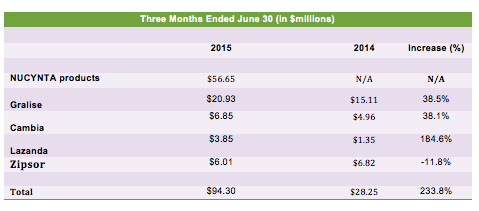
Product franchise was officially re-launched in mid-June with expanded sales force of 275 plus full marketing and medical support. The sales force of 275 reps more than tripled compared to sales force of 80-90 reps for JNJ.
We believe the effect of the re-launch strategy and the tripled sales force is expected to impact NUCYNTA prescription growth beginning later this year.
Per management, product positioning will be focused on NUCYNTA’s dual mechanism of action designed to target both nociceptive and neuropathic pain. The company plans to capture market share in large and growing markets including chronic pain and chronic lower back pain (CLBP). Over 100 million US patients suffer from chronic pain, while 31 million US patients suffer from chronic lower back pain. DepoMed will specifically targeting the CLBP patient population. The company also launched NUCYNTA for moderate to severe painful diabetic peripheral neuropathy (DPN), which affects another 1-2 million patients.
All these commercial strategies mentioned above combined with strong initial sales make us believe that NUCYNTA has blockbuster potential and will become the company’s flagship brand.
Prescription and Market Share of NUCYNTA ER Continue to Grow
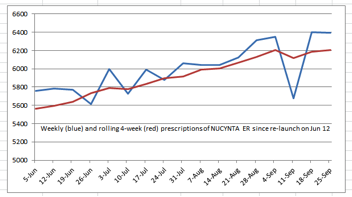
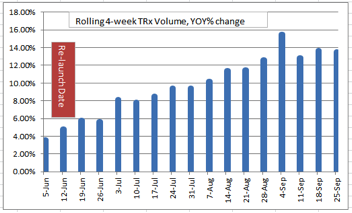
Since Depomed re-launched NUCYNTA on June 12, 2015, prescription volume and market share continue to grow. We summarize the weekly prescription data for NUCYNTA ER from the beginning of 2Q15, when the company closed the acquisition. But remember that Depomed re-launched NUCYNTA on June 12, 2015.

Our takeaways from the weekly prescription data:
- since the re-launch of NUCYNTA ER in mid-June 2015, weekly and monthly prescription volume are indicating an upward trend;
- Year-over-year change% of rolling 4-week prescription volume of NUCYNTA ER also indicating an upward trend.
- market share of NUCYNTA has been climbing from 1.53% in the June 5 week (prior to launch) to 1.79% in the Sept 25 week, an nice increase of 17%;
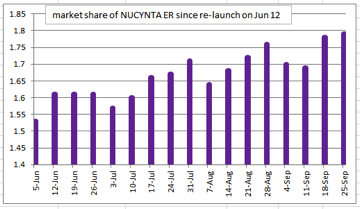
- Since re-launch of NUCYNTA ER on Jun 12, 2015, most of the time, sequential change of weekly prescription volume (current vs. prior week) is positive, only two negative sequential changes have been recorded (July 10 and Sept 11week).
Current Market Price Undervalues Depomed
We maintain our Buy rating on Depomed shares and reiterate our 12-month price target of $36 per share.
We continue remain positive on the Depomed story, especially as it pertains to the NUCYNTA® franchise, as we believe the transaction to acquire NUCYNTA® / ER is transformational for the company. The strategic fit is excellent and past execution has been outstanding. There is clearly a lot of future execution that still must take place for this to benefit shareholders but the plan is in place, and in our opinion, looks solid. We view the name as a good core-holding in the specialty pharmaceutical industry with significant upside should the NUCYNTA® / ER product take off.
In 2Q15, Depomed generated $56.7 million in NUCYNTA sales, an increase of 29% over the $44 million in 4Q14 under JNJ control. The initial sales of NUCYNTA products were also much better than our estimate of $45 million. Although Depomed acquired NUCYNTA products from JNJ in early April, the company only relaunched NUCYNTA products in mid-June. Based on the initial sales and the prescription data so far, we have reasons to believe that NUCYNTA sales are poised to take off in 2H15 and beyond.
Actually, as a result of the strong initial sales of NUCYNTA in 2Q15, DepoMed has raised its 2015 financial guidance for total product sales, adjusted earnings and adjusted EBITDA.

We model NUCYNTA sales of $197 million for 2015. Sales will reach $400 million in 2017.
In terms of valuation, we think Depomed shares are undervalued at current market price. Currently share price of Depomed is trading at about $20, valuing the company at $1.2 billion in terms of market cap. We think this deeply undervalues Depomed.
Based on our long term financial model, revenue will reach $352 million in 2015 with non-GAAP earnings per share (EPS) of $1.00. We continue to expect that the NUCYNTA® / ER deal will be strongly accretive, and that Depomed will generate $400 million in sales from NUCYNTA franchise in 2017. Non-GAAP EPS will grow from $1.00 in 2015 to $2.30 in 2017 based on total revenue of $624 million.
We think DepoMed shares should be valued using a 25x P/E multiples, which is close to the biotech industry’s average P/E ratio of 22.6. Using this P/E ratio, multiplied by our estimated EPS of $2.30 for 2017, discounted at 25% for two years, we come up with our fair value of DepoMed at $36 per share.
We consider Hillary Clinton’s comments on drug price control more as politics rather than policy. Any proposal with respect to drug price control is unlikely to become a law in a short period of time in our view. Therefore, the recent decline in share price of Depomed due to the industry correction should be considered great buying opportunity.
We also noticed Horizon’s recent offer. According to our calculation, Horizon’s share exchange offer values Depomed shares at approximately $28/share, which is lower than our fair price target of $36 per share.
READ THE LATEST FULL RESEARCH REPORT HERE
SUBSCRIBE TO ZACKS SMALL CAP RESEARCH to receive our articles and reports emailed directly to you each morning. Please visit our website for additional information on Zacks SCR and to view our disclaimer.