By Grant Zeng, CFA
OTC:DMPI
Cash Burn is Conservative and In line with Our Estimate
DelMar (OTC:DMPI) held $3 million in cash as of March 31, 2015, as compared to $4.0 million in cash as of December 31, 2014.
The cash burn rate is in line with our estimate of less than $1 million/quarter, which is very conservative in our view. Current cash will be sufficient to fund current operations through the end of calendar 2015.
For the fiscal third quarter ended March 31, 2015, R&D expenses were $0.6 million as compared to $0.6 million for the fiscal 3Q14.
G&A expenses for fiscal 3Q15 were $0.5 million as compared to $0.6 million for fiscal 3Q14.
Operating loss for fiscal 3Q15 was $1.1 million as compared to $1.6 million for fiscal 3Q14.
GAAP net loss for fiscal 3Q15 was $1.6 million ($0.04 per share) as compared to $3.2 million ($0.10 per share).
Non-GAAP net loss for fiscal 3Q15 was $1.1 million ($0.03 per share) as compared to non-GAAP net loss of $1.6 million ($0.05 per share) for fiscal 3Q14.
DMPI Ready to Move VAL-083 to Pivotal Trial for GBM
DMPI recently presented updated clinical data on the ongoing Phase I/II clinical trial of its lead candidate VAL-083 at the 2015 AACR held April 18-22, 2015, in Philadelphia, Pennsylvania.
Background of the Phase I/II clinical trial
DelMar initiated the Phase I/II clinical trial of VAL-083 for the treatment of refractory glioblastoma multiforme (GBM) or progressive secondary brain tumor in October 2011. The Phase I/II study is an open-label, single arm dose-escalation study designed to evaluate the safety, tolerability, pharmacokinetics and anti-tumor activity of VAL-083 in patients with histologically confirmed initial diagnosis of primary WHO Grade IV malignant glioma (GBM), now recurrent. Patients with prior low-grade glioma or anaplastic glioma are eligible if histologic assessment demonstrates transformation to GBM. Patients must have been previously treated for GBM with surgery, and/or radiation, if appropriate, and must have failed both Bevacizumab (Avastin) and temozolomide (Temodar), unless either or both are contra-indicated. Patients with brain tumors that have developed due to CNS metastases were eligible for the DelMar clinical trial at early doses.
The primary outcome measures in the dose-modernization portion of the clinical trial will be the determination of maximum tolerated dose (MTD). Secondary outcome measures include tumor response in patients and pharmacokinetics.
An initial phase of the study will involve dose escalation cohorts until a maximum tolerated dose (MTD) is established in the context of modern care. Once the modernized dosing regimen has been established, additional patients will be enrolled at the MTD in a registration directed Phase II clinical trial. Approximately 30 patients have been enrolled in the Phase I portion of the study.
The study was designed for patients to receive VAL-083 on days 1, 2, and 3 of a 21-day cycle. Tumor response is assessed according to RANO criteria prior to every other 21-day treatment cycle, and patients exhibiting stable disease or tumor regression remained on VAL-083. Determination of MTD is based on 3+3 design. Currently, 37 patients have been enrolled across 8 dose cohorts ranging from 1.5 to 50mg/m2/d.
Update on the Clinical Data
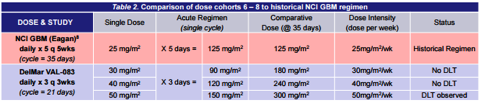
Historical studies sponsored by the NCI achieved promising results in newly diagnosed and recurrent GBM using a dosing regimen of 25 mg/m2/day for 5 days every five weeks. Historically, dose limiting hematologic toxic effects were noted on white blood cell (WBC) and platelet counts.
The DelMar dosing regimen uses a cycle of treatment on the first three days of every three weeks. The hypothesis is that this regimen along with improvement in management of myelosuppression in the modern era would allow for more aggressive dosing and potentially improved patient outcomes.
Data to date have demonstrated that VAL-083 is safe and well tolerated at doses up to 40mg/m2. No drug-related serious adverse events or dose limiting toxicities (DLTs) have been detected and a maximum tolerated dose (MTD) has not been reached at doses up to 40 mg/m2.
In accordance with the protocol, six patients have been enrolled at dose level 8 (50mg/m2/d). In this cohort, one DLT consisting of Grade 4 thrombocytopenia has been observed at dose level 8 to date and three additional patients in the cohort experienced Grade 3 thrombocytopenia. The DLT-related symptoms resolved rapidly and spontaneously without concomitant treatment. Prior to this cohort, other treatment related toxicities have been mild to moderate.
Pharmacokinetic analyses show dose-dependent linear systemic exposure with a short plasma 1-2h terminal half-life; Cmax ranged from 739–1130 ng/mL (5.1–7.7µM) at 40mg/m2/d.
One important point of this clinical trial is that compared to historical trials of VAL083, the present regimen delivers substantively more drug as measured by single dose and overall exposure. A higher dose and dose intensity is achieved by DelMar's dosing regimen in the current trial.
Further, we are very pleased to see that in the dose-escalation portion of the current clinical trial, three GBM patients were observed to have a response (stable disease or partial response) with improved clinical signs (maximum response of 84 weeks).
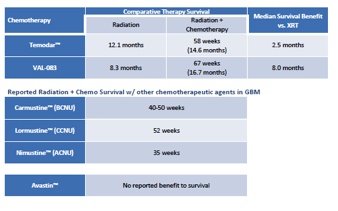
Multiple historical NCI-sponsored clinical studies of VAL-083 demonstrated that, in general, tumor regression in brain cancer was achieved following therapy in greater than 40% of patients treated and stabilization was achieved in an additional 20% to 30%. In published clinical studies VAL-083 has previously been shown to have a statistically significant impact on median survival in high grade glioma brain tumors when combined with radiation versus radiation alone with results similar or superior to other chemotherapies approved for use in GBM.
DelMar plans to present additional data on VAL-083 as a potential new treatment for temozolomide-resistant GBM at the American Association for Cancer Research (AACR) Advances in Brain Cancer Research Conference being held May 27-30, 2015, in Washington, DC and at the 2015 ASCO Annual Meeting, being held May 29-June 2, 2015, in Chicago, Illinois.
A Registration Directed Phase II Trial and a Phase II/III to Begin in 2015
Based on the positive interim data, DelMar plans to initiate a registration directed Phase II trial in refractory GBM in 2H2015. Based on historical development of other products in GBM, it’s possible that DelMar may be able to obtain FDA approval to commercialize VAL-083 to treat patients who have failed other therapies from an open-label Phase II registration-directed clinical trial, which will save significant costs of a large Phase III clinical trial. It’s also possible that the FDA may grant fast-track, accelerated approval and/or priority review status to VAL-083, which will enable DelMar to begin filing for commercial approval during the clinical trial process.
Based on historical precedent with the FDA, the Phase II registration directed trial are expected to mirror the Avastin approval study in that indication. Under this scenario, the Phase II trial would be:
- Single-arm; open label design;
- Primary endpoints: overall survival, radiographic response;
- Secondary endpoints: quality of life, safety and tolerability;
- N = 80-100 patients;
- Minimum response rate = 20%;
- Enrollment: Patients with recurrent GBM who have failed or are ineligible for both Temodar® and Avastin® (i.e. the same population as in the current trial);
The recent failure of Avastin in the front line treatment of GBM has highlighted the need for new therapies in newly diagnosed patients, particularly those with unmethylated MGMT promoter regions who do not respond to standard of care with temozolomide.
DelMar would plan to advance modernized dosing regimen into a Phase II/III trial in newly diagnosed patients with unmethylated MGMT promoter in parallel with the refractory GBM registration trial (i.e. in 2015). The Company has begun designing this trial with KOLs.
-Randomized groups: Temodar vs. VAL-083;
- Primary endpoints: overall survival;
- Secondary endpoints: PFS6 & radiographic response;
- N = 500 – 600 patients (with interim endpoint at ~10% enrollment);
We estimate data from the registration trial in refractory GBM will be available in mid-2016 and an NDA will be filed in late 2016 or early 2017. The FDA approval will occur in late 2017 or early 2018.
Preclinical Data Support VAL-083's Potential to Treat TMZ-Resistant GBM
Also at the AACR meeting, DelMar presented promising preclinical data on the potential of VAL-083 for the treatment of TMZ-resistant GBM.
Data from the in vitro portion of the study demonstrate that:
- VAL-083 is highly efficacious against both stem and non-stem GBM cell cultures, including those resistant to temozolomide;
- VAL-083 maintains anti-tumor activity independent of DNA repair enzyme 0-6-methylguanine DNA methyltransferase (MGMT) resistance mechanism; and
- VAL-083 showed an additive effect when combined with radiation in all cultures tested, suggesting that VAL-083 might act as a radiosensitizer in GBM.
The study's in vivo results demonstrate that VAL-083 is effective against GBM in significantly extending survival time in intracranial xenograft GBM models in a dose dependent manner, including in GBM xenografts that are traditionally resistant to temozolomide.
These preclinical data further validate the benefits of VAL-083 in the treatment of GBM and support the company’s ongoing Phase I/II clinical study with VAL-083 as a treatment for refractory GBM in patients with recurrent disease. Therefore, VAL-083 demonstrates the potential to become a new standard of care for newly diagnosed GBM patients whose tumors are known to highly express a repair MGMT.
Pipeline Will be Expanded to NSCLC
Recently, DMPI presented promising preclinical data supporting VAL-083 activity in non-small cell lung cancer at the AACR's New Horizons in Cancer Research Meeting and at the AACR Annual Meeting.
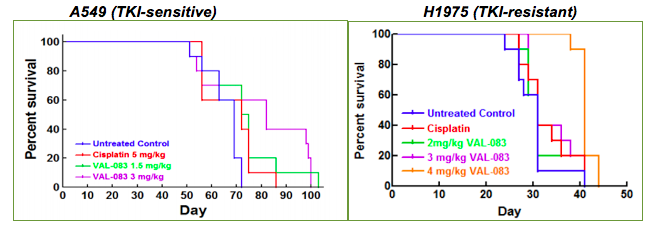
The data presented at the AACR New Horizons meeting showed that VAL-083 is superior to cisplatin in both in vivo tumor models that are sensitive and resistant to tyrosine kinase inhibitors (TKI) and has synergistic effect in combination with cisplatin. The data suggests important clinical and market potential of VAL-083 in NSCLC.
The data presented at the AACR annual meeting demonstrated that VAL-083's mechanism is distinct from platinum-based chemotherapy, the current standard of care for NSCLC. VAL-083 retains its high level of anti-cancer activity in p53 mutated NSCLC cell lines compared to cisplatin or oxaliplatin.
In addition, the combination of VAL-083 with either cisplatin or oxaliplatin demonstrated superadditivity/synergy against NSCLC cell lines, including those resistant to tyrosine kinase inhibitors. These results support the potential benefit of a VAL-083/platinum combination therapy in newly diagnosed NSCLC patients.
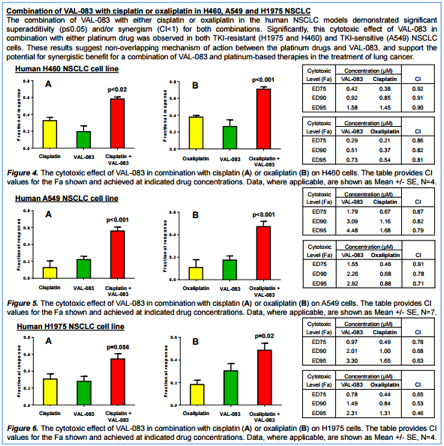
These data provide support for the potential of VAL-083 as a viable treatment option for NSCLC patients failing platinum-based therapy.
VAL-083 is already approved in China for NSCLC. New clinical data will support sales growth in China and achieve royalty revenue through sales partnership. The company is positioning VAL-083 for global development in lung cancer.
Valuation Very Attractive
We maintain our Outperform rating on DelMar shares and reiterate our 12-month price target of $4.50 per share. Our call is based on recent clinical progress the company has made and attractive valuation of the company shares.
DMPI is a clinical and commercial stage biopharmaceutical company focused on the development and commercialization of oncology drugs. The Company’s lead drug candidate VAL-083 is currently in a Phase I/II trial for the treatment of recurring GBM.
Previous multiple clinical studies conducted by NCI have demonstrated that VAL-083 is safe and efficacious for the treatment of GBM. Interim data from the Company’s Phase I/II trial confirmed the efficacy and safety profile of VAL-083 in GBM patients. Based on the data currently available, DMPI intends to initiate a registration directed Phase II/III trial of VAL-083 for recurring GBM in 2H15. This will be a significant milestone for the Company which will position the Company in a late stage development.
DelMar also plans to expand its pipeline by initiating clinical trials of VAL-083 for lung cancer in the short run.
VAL-083 has been approved in China for leukemia and lung cancer and DMPI has acquired its commercial rights in China market. Delmar is seeking to enter into a marketing partnership that could generate upfront fees, milestones and royalty revenue for DMPI, which is a de-risking event for the Company.
VAL-083 is a first-in-class alkylating agent with a different mechanism of action from that of Temodar, current market leader for GBM. The unique MOA of VAL-083 overcomes the resistance problem for Temodar.
Currently, DMPI shares are trading at around $0.70 per share, which values the Company at about $28 million in market cap based on 40 million outstanding shares. This is a deep discount compared to its peers. We noticed that most small biotech companies of development stage are valued from $50 million to $1 billion depending on how advanced the pipeline is and which indications the company is targeting. DMPI’s lead drug candidate VAL-083 is in a Phase I/II clinical trial and will enter a registration directed Phase II trial in 2H 2015.
We estimate VAL-083 could be approved by the FDA in calendar 2017 for recurring GBM. The broad application of VAL-083, including first line, second line and third line treatment of GBM, and other cancers, means a great market potential for VAL-083, which could be a blockbuster for DelMar. We estimate DMPI will be profitable in fiscal 2019 with an EPS of $0.06 based on product sales of $35 million. EPS will grow to $0.35 in fiscal 2020 based on total product sales of $70 million.
Based on our financial model and the Company’s fundamentals, we have a price target of $4.50 per share for DMPI. We think a P/E ratio of 38x is appropriate for DMPI considering its growth in the next few years. Based on this P/E multiple, we come up with our price target of $4.50 per share using 25% discount for 5 years. Our price target values DMPI at $180 million in market cap, which we think is still conservative compared to its peers.
But risk is high at this point for DMPI. Although VAL-083 has been approved in China for marketing, its indications are leukemia and lung cancer, different from the current indication of GBM under development in the US. The bar on both clinical and regulatory hurdle in the US is higher. We remind investors that risks associated with drug development are high.
READ THE LATEST FULL RESEARCH REPORT HERE
SUBSCRIBE TO ZACKS SMALL CAP RESEARCH to receive our articles and reports emailed directly to you each morning. Please visit our website for additional information on Zacks SCR and to view our disclaimer.