By Grant Zeng, CFA
OTC:DMPI
DMPI (OTC:DMPI) recently presented updated clinical data on the ongoing Phase I/II clinical trial of its lead candidate VAL-083 at the 2015 ASCO in Chicago and at the 2015 AACR held April 18-22, 2015, in Philadelphia, Pennsylvania.
We updated the AACR presentation two weeks ago. Here is the update on the ASCO presentation.
From previous AACR presentation, we are very pleased to see that in the dose-escalation portion of the current clinical trial, three GBM patients were observed to have a response (stable disease or partial response) with improved clinical signs (maximum response of 84 weeks).
At this year’s ASCO presentation, DelMar presented very encouraging preliminary efficacy data from the Phase I trial.
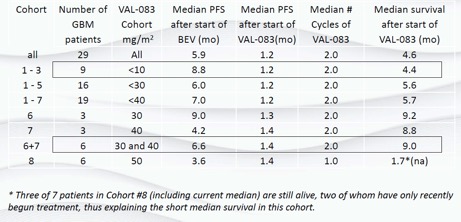
· Patients receiving a dose >30mg/m2 daily x 3 every 21 days had a median survival of 9.0 months vs. 4.4 months at doses 2 daily x 3 every 21 days, demonstrating a dose-response trend.
· Median Progression Free Survival (PFS) was short (1.2 – 1.4 months).
· Adverse events were typically mild to moderate; no treatment-related serious adverse events at doses up to 40 mg/m2 daily x 3 every 21 days were observed.
· Dose limiting toxicity (DLT) was observed in two of six (33%) of patients at 50 mg/m2 daily x 3 every 21 days.
· Pharmacokinetic analysis suggests that a dose of 40mg/m2 achieves concentrations of VAL-083 in the CNS at or above the IC50 observed for multiple GBM cell lines in vitro.
· At the time of the analysis, 75% of patients treated with VAL-083 had survived longer than 2 months (reported by Iwamoto 2009) following failure of bevacizumab therapy with supportive care and 48% of patients treated with VAL-083 survived longer than 5.2 months (reported by Iwamoto 2009) following failure of bevacizumab and subsequent treatment with a range of salvage therapies.
The median OS from the start of bevacizumab reported by Sakruti et al. (2014) was 12.2 months (95% CI, 10.0, 14.3) with no significant difference in OS whether bevacizumab therapy was initiated following first, second or later GBM recurrence.
· At the time of the analysis, 59% of patients treated with VAL-083 survived longer than 12.2 months following initiation of bevacizumab therapy.
· At the time of the analysis, 6 month OS following initiation of VAL-083 treatment across all dose cohorts was 41.4%, with two additional patients from later cohorts still alive, but not yet reaching 6 month OS.
· 12 month OS following initiation of VAL-083 treatment across all dose cohorts was 17.2%, with four additional patients from later cohorts still alive, but not yet reaching 12 month OS.
A Phase II expansion cohort of up to 14 patients has been initiated at the dose of 40 mg/m2/d. A small additional (3 patient) cohort at an interim 45mg/m2/d dose will also be studied in parallel with the expansion cohort, and the expansion cohort may be continued at this higher dose if safety data warrants.
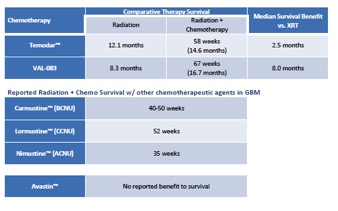
Multiple historical NCI-sponsored clinical studies of VAL-083 demonstrated that, in general, tumor regression in brain cancer was achieved following therapy in greater than 40% of patients treated and stabilization was achieved in an additional 20% to 30%. In published clinical studies VAL-083 has previously been shown to have a statistically significant impact on median survival in high grade glioma brain tumors when combined with radiation versus radiation alone with results similar or superior to other chemotherapies approved for use in GBM.
READ THE LATEST FULL RESEARCH REPORT HERE
SUBSCRIBE TO ZACKS SMALL CAP RESEARCH to receive our articles and reports emailed directly to you each morning. Please visit our website for additional information on Zacks SCR and to view our disclaimer.