By Grant Zeng, CFA
OTC:DMPI
There was no revenue reported for the first fiscal quarter.
R&D expenses for fiscal 1Q16 were $0.6 million, as compared to $0.6 million for the same period last year.
G&A expenses for fiscal 1Q16 were $0.5 million, as compared to $0.5 million in the same period last year.
For the three months ended September 30, 2015 the Company reported a net loss of $1.6 million ($0.04 per share), compared to a net loss of $1.3 million ($0.04 per share) for the three months ended September 30, 2014.
Non-GAAP net loss for fiscal 1Q16 was $1.1 million ($0.03 per share), as compared to non-GAAP net loss of $1.3 million ($0.04 per share).
As of September 30, 2015, DelMar (OTC:DMPI) held $2.8 million in cash.
In August, DelMar closed a registered direct placement with $2.6 million received from the offering.
The Company sold to institutional and accredited investors an aggregate of 4.3 million shares of common stock and 4.3 million common stock purchase warrants at a price of $0.60 per share. Each common stock purchase warrant entitles the holder to purchase an additional share of the Company's common stock at a price of $0.75 per share for a period of five years.
Also in August, DelMar received an increase in funding of up to CDN$287,000 from the National Research Council of Canada Industrial Research Assistance Program (NRC-IRAP) to support an ongoing research project. With the increase, NRC-IRAP's total non-refundable financial contributions to DelMar total CDN$420,000 to date.
According to our financial model, current cash balance can fund the company’s operations into the third quarter of 2016.
Update on VAL-083 Phase I/II Clinical Trial
DelMar commenced enrollment in the 14-patient expansion cohort for the trial in GBM near the end of the second quarter of 2015. The purpose of the expansion cohort is to gain additional information about the safety and efficacy of VAL-083 at a 40mg/m2 dose prior to advancement into registration-directed Phase II/III clinical trials.
On October 21, 2015, DelMar announced the full enrollment of the Phase II expansion cohort.
To further explore the therapeutic window of VAL-083, DelMar also enrolled three (3) patients an interim dose of 45mg/m2.
The 14 patients have now received at least one course of treatment in the Phase II expansion of this study. Patients enrolled in this clinical trial have failed both front-line therapy with temozolomide and second-line Avastin and, in most cases, one or more salvage therapies.
Data from the expansion cohort will be presented at the 20th Annual Scientific Meeting and Education Day of the Society for Neuro-Oncology being held November 19 - 22, 2015, in San Antonio, Texas.
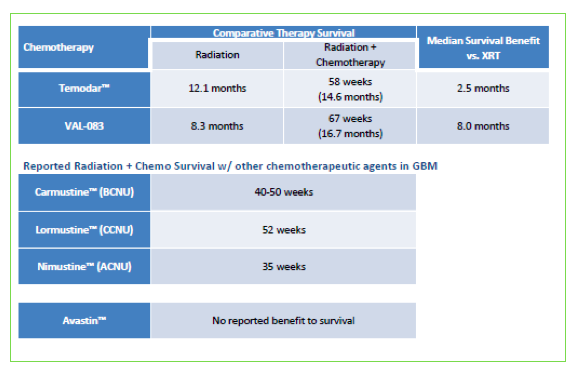
Multiple historical NCI-sponsored clinical studies of VAL-083 demonstrated that, in general, tumor regression in brain cancer was achieved following therapy in greater than 40% of patients treated and stabilization was achieved in an additional 20% to 30%. In published clinical studies VAL-083 has previously been shown to have a statistically significant impact on median survival in high grade glioma brain tumors when combined with radiation versus radiation alone with results similar or superior to other chemotherapies approved for use in GBM.
A Registration Directed Phase II Trial and a Phase II/III to Begin in 2016
Based on the positive interim data, DelMar plans to initiate a registration directed Phase II trial in refractory GBM in 1H2016. Based on historical development of other products in GBM, it’s possible that DelMar may be able to obtain FDA approval to commercialize VAL-083 to treat patients who have failed other therapies from an open-label Phase II registration-directed clinical trial, which will save significant costs of a large Phase III clinical trial. It’s also possible that the FDA may grant fast-track, accelerated approval and/or priority review status to VAL-083, which will enable DelMar to begin filing for commercial approval during the clinical trial process.
Based on historical precedent with the FDA, the Phase II registration directed trial are expected to mirror the Avastin approval study in that indication. Under this scenario, the Phase II trial would be:
- Single-arm; open label design; 1:1 randomization;
- Primary endpoints: overall survival, radiographic response;
- Secondary endpoints: quality of life, safety and tolerability;
- N = approximately 100 patients;
- Minimum response rate = 20%;
- Enrollment: Patients with recurrent GBM who have failed or are ineligible for both Temodar® and Avastin® (i.e. the same population as in the current trial);
The recent failure of Avastin in the front line treatment of GBM has highlighted the need for new therapies in newly diagnosed patients, particularly those with unmethylated MGMT promoter regions who do not respond to standard of care with temozolomide.
DelMar would plan to advance modernized dosing regimen into a Phase II/III trial in newly diagnosed patients with unmethylated MGMT promoter in parallel with the refractory GBM registration trial (i.e. in 2015). The Company has begun designing this trial with KOLs.
- Randomized groups: Temodar vs. VAL-083;
- Primary endpoints: overall survival;
- Secondary endpoints: PFS6 & radiographic response;
- N = 500 – 600 patients (with interim endpoint at ~10% enrollment);
We estimate data from the registration trial in refractory GBM will be available in 2H17 and an NDA will be filed in 2018. The FDA approval will occur in 2019.
DelMar also plans to develop VAL-083 as the treatment of pediatric brain tumor.
READ THE LATEST FULL RESEARCH REPORT HERE
SUBSCRIBE TO ZACKS SMALL CAP RESEARCH to receive our articles and reports emailed directly to you each morning. Please visit our website for additional information on Zacks SCR and to view our disclaimer.