By Grant Zeng, CFA
NASDAQ:DRRX
Total revenues for 2Q15 were $4.4 million, as compared to $4.6 million for 2Q14.
Total revenues included revenues from collaborative research and development projects and revenues from product sales.
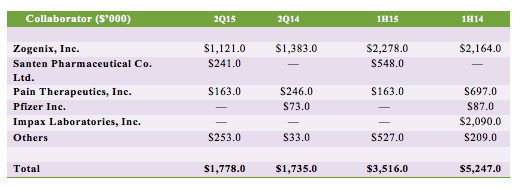
Revenue from collaborators was $1.8 million for 2Q15, as compared to $1.7 million for 2Q14. The collaborative research and development and other revenues associated with the Company’s (NASDAQ:DRRX) major third-party collaborators are as follows:
Product sales were $2.7 million in 2Q15, as compared to $2.8 million in 2Q14. Durect currently generates product revenue from the sale of three product line:
- ALZET ® osmotic pumps for animal research use;
- LACTEL ® biodegradable polymers which are used by our customers as raw materials in their pharmaceutical and medical products; and
- Certain key excipients that are included in REMOXY and one excipient that is included in a currently marketed animal health product.
Since Durect’s core business is to develop and commercialize pharmaceutical products, the company does not intend to significantly increase its investments in or efforts to sell or market any of the existing product lines. However, the company is going to continue to make efforts to increase its revenue related to collaborative research and development by entering into additional research and development agreements with third-party collaborators to develop product candidates based on the company’s drug delivery technologies.
Cost of goods sold was $1.0 million in 2Q15, compared to $1.1 million in 2Q14.
R&D costs were $5.6 million in 2Q15, compared to $6.1 million in 2Q14.
SG&A expenses were $2.7 million in 2Q15, as compared to $2.9 million for 2Q14.
Durect recorded a net loss of $5.5 million ($0.05 per share) for the three months ended June 30, 2015, as compared to a net loss of $5.4 million ($0.05) for the three months ended June 30, 2014.
At June 30, 2015, the company had cash and investments of $37.8 million with $19.8 million in long term debt.
New Phase III of POSIDUR Will be Initiated in the Fall
The new Phase III study will be conducted in patients undergoing laparoscopic cholecystectomy (gallbladder removal). Target enrollment is 300 patients, randomized one-to-one between POSIDUR and placebo (saline) as a one-time intra-incisional instillation at the close of surgery. The objective of the study will be to evaluate the safety and efficacy of Posidur for the management of postoperative pain. The primary efficacy endpoint will be pain intensity on movement over 0-72 hours after surgery. We believe this is a very manageable study for Durect.
Management has already engaged with contract research organizations and started identifying clinical investigators to participate in the study. We anticipate the trial being conducted at 15-20 centers in the U.S., and that enrollment will take roughly twelve months to complete. Management has guided to requiring another six months to analyze and prepare the data, and then re-file the package to the FDA. Once back under review, we expect the FDA to designate a Class-2 review time of six months. External costs for the new Phase III study should be roughly $10 million. We estimate top line data will be available in 1Q17 and the FDA approval will take place in late 2017 or early 2018.
Update on Remoxy
Based on DURECT's ORADUR®technology, REMOXY (oxycodone extended-release capsules) is a unique oral, long-acting formulation of oxycodone designed to discourage common methods of tampering associated with opioid misuse and abuse.
In May 2015, Pain Therapeutics stated that the transition of the program back from Pfizer was substantially complete. The company recently reported positive top-line data from an abuse potential study in May 2015, and has plans to file the NDA to the U.S. FDA during the first quarter of 2016. After the resubmission is accepted by the FDA, it will take about 6 months for the FDA to review the NDA and make a decision on the approval. This means that Remoxy could be approved in late 2016.
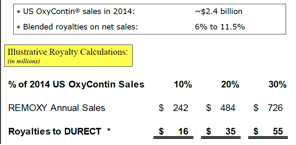
The extended release oxycodone market is ~$2.4 billion in the U.S. alone. We believe that REMOXY represents a $500-750 million drug, of which Durect is entitled to 6-11.5% royalties on commercial sales once launched.
DUR-928 Holds Great Potential for Multiple Indications
The Background
DUR-928 came from DURECT's Epigenomic Regulator Program, which is a collaborative effort between DURECT and the Department of Internal Medicine at Virginia Commonwealth University (VCU), the VCU Medical Center, and the McGuire VA Medical Center. During the course of this program, a number of compounds that may have therapeutic utility have been identified, including the lead molecule DUR-928. DURECT holds the exclusive worldwide right to develop and commercialize DUR-928 and related molecules discovered in the program.
DUR-928 is an endogenous (produced naturally by the body), orally bioavailable small molecule that modulates the activity of several nuclear receptors that play an important regulatory role in lipid homeostasis, inflammation and cell survival. Studies have showed that DUR-928 modulates the activity of more than 240 genes, including ACC, FAS, HMGR, Cyp7A1, LXR, PPARγ, NFκB/IκB, TNFα, IL-1α, IL-6, COX-2, PCSK9, and others.
The broad biologic activities indicate that DUR-925 may have a broad range of clinical applications including acute organ injury, ischemia or reperfusion injury, and chronic liver disease such as non-alcoholic fatty liver disease (NAFLD) and non-alcoholic steatohepatitis (NASH).
Compelling Animal Data
Durect has completed multiple animal studies with compelling efficacy and safety data. These studies involved 7 different animal models involving three animal species.
Four of these models represent acute organ injury, which include:
- liver toxicity mouse;
- endotoxin induced septic shock mouse;
- renal ischemia/reperfusion rat; and
- brain ischemia/stroke rat;
Three represent chronic disorder animal models. They are:
- high fat diet mouse;
- high fat diet hamster; and
- nonalcoholic fatty liver disease (NAFLD) and nonalcoholic steatohepatitis (NASH) mouse.
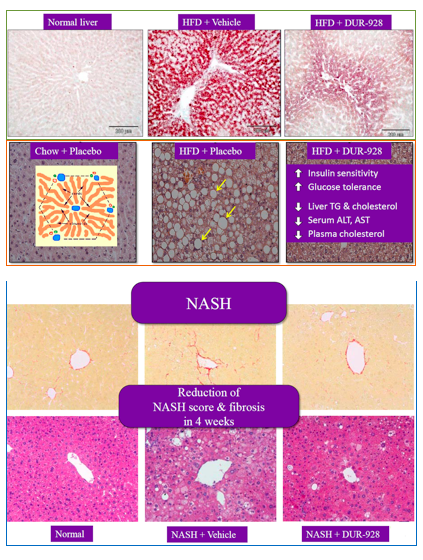
In the three chronic disorder animal models, DUR-928 treatment led to significant improvement in liver morphology and improvement in NAFLD/NASH score and fibrosis.
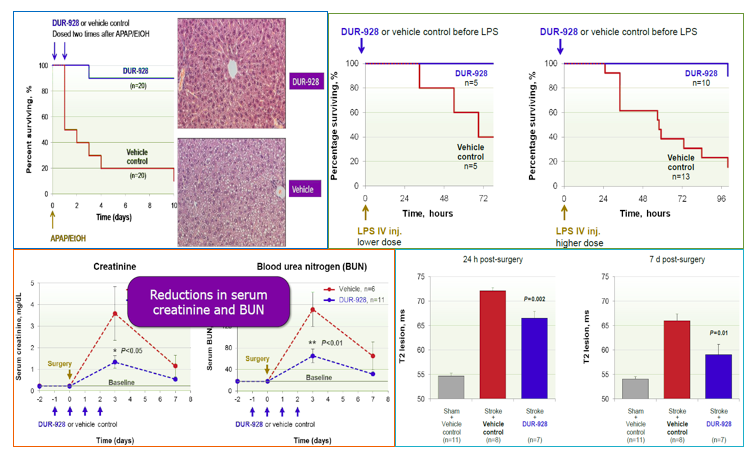
In all four chronic organ injury models, DUR-928 treatment led significant increase in survival.
- In a chemical induced mouse liver toxicity model (upper left panel), 90% mice lived in the DUR-928 group while 90% mice died on the vehicle group.
- In an endotoxin-induced septic shock mouse model (upper right panel), 90-100% mice survived on the DUR-928 group, while only 15-40% mice lived on the vehicle group.
- In an acute kidney injury rat model (lower left panel), DUR-928 significantly reduced creatinine and blood urea nitrogen (BUN) in serum, indicating the organ protection by DUR-928.
- In a brain injury rat model (lower right panel), DUR-928 significantly reduced the T2 lesion (measure of cell viability).
Animal pharmacokinetics and toxicity studies have shown DUR-928 to be orally bioavailable and safe at all doses tested to date.
An injectable formulation, envisioned for use in acute conditions, is currently undergoing animal testing. The company plans to use the oral version of DUR-928 for chronic use and the injectable DUR-928 for acute use.
Positive Phase I Data Reported
DURECT recently has completed and reported positive results from two Phase I clinical trials with an oral formulation of DUR-928.
The initial Phase I trial of DUR-928 was a single-site, randomized, double-blinded, placebo-controlled, single-ascending-dose study that evaluated the safety, tolerability and pharmacokinetics of DUR-928 when orally administered in 30 subjects. After the completion of the initial single-dose trial, the company subsequently conducted a Phase I multiple-ascending-dose, oral administration trial in 20 healthy subjects, evaluating DUR-928 in two consecutive 10-subject cohorts, the first receiving DUR-928 at a lower dose and the second at a higher dose.
In both Phase I clinical trials, DUR-928 was well-tolerated at all dose levels, with no clinically significant changes in vital signs, laboratory values or ECG parameters, no severe or serious drug-related adverse events reported and no subjects withdrawing from the study. Peak plasma concentrations achieved were at least 100-fold higher than endogenous levels, no accumulation in plasma concentrations were observed with repeat dosing, and dose related increases in plasma concentrations were observed with peak plasma concentration at approximately 2 – 6 hours after dosing.
What’s next for DUR-928?
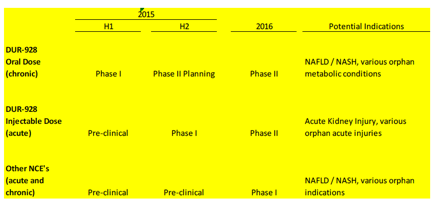
Based on the compelling animal data and Phase I results, Durect plans to initiate additional Phase I studies later in 2015, and move into Phase II in 2016 for both oral DUR-928 and injectable DUR-928.
The company is currently evaluating potential indications for DUR-928 in order to prioritize the development program. Long term opportunities fall into four broad categories:
- orphan acute indications;
- broader acute indications;
- orphan chronic indications, and
- broader chronic indications.
DURECT’s initial Phase II studies will be designed to show an efficacy signal in patients suffering from one orphan acute condition such as acute kidney injury and one broad chronic indication such as NAFLD/NASH. We will provide update when the company provides more detail on the Phase II studies later this year.
Large Market Opportunity for DUR-928
Although DUR-928 may have broad applications in many indications, we believe the initial focus will be in NAFLD/NASH and acute kidney injury.
Non-alcoholic fatty liver disease (NAFLD) is the build-up of extra fat in liver cells that is not caused by alcohol. It is normal for the liver to contain some fat. However, if more than 5% - 10% percent of the liver’s weight is fat, then it is called a fatty liver (steatosis). The more severe form of NAFLD is called non-alcoholic steatohepatitis (NASH). NASH causes the liver to swell and become damaged.
NAFLD affects about 30% of adults and 10% of children in the US, among which 10-30% will develop NASH. 25-40% NASH patients will develop progressive liver fibrosis, while 20-30% NASH patients with advanced fibrosis will develop cirrhosis, which could lead to liver cancer.
Currently there are no FDA approved medicines for the treatment of NAFLD/NASH.
Acute kidney injury (AKI) is defined as an abrupt or rapid decline in renal filtration function. This condition is usually marked by a rise in serum creatinine concentration or by azotemia (a rise in blood urea nitrogen [BUN] concentration).
According to Medscape, in the United States, approximately 1% of patients admitted to hospitals have AKI at the time of admission. The estimated incidence rate of AKI during hospitalization is 2-5%. AKI develops within 30 days postoperatively in approximately 1% of general surgery cases and arises in up to 67% of intensive care unit (ICU) patients. Approximately 95% of consultations with nephrologists are related to AKI. The appropriate nephrologist referral rate is approximately 70 cases per million populations.
The current treatment for AKI is mainly supportive in nature. No therapeutic modalities to date have shown efficacy in treating the condition. Therapeutic agents (eg, dopamine, nesiritide, fenoldopam, mannitol) are not indicated in the management of AKI and may be harmful for the patient.
Certainly there are highly unmet medical needs in the NAFLD/NASH and acute kidney injury fields. The unique mechanism of action and the compelling animal and human data so far make DUR-928 a highly promising candidate for the management of NAFLD/NASH and kidney injury.
Valuation and Recommendation
We continue to be optimistic about Durect and maintain our Buy rating for its shares. We increase our price target to $6.00 per share from previous $3.00 per share based on the progress the company has made in advancing its candidates.
Durect is a late development stage biotech company. Its two Phase III candidates are Posidur and Remoxy. The company and its partner Pain Therapeutics plans to submit a NAD for Remoxy in the 1Q16 and we expect the drug to be approved by the end of 2016.
The company plans to conduct a new Phase III trial with its clinical candidate Posidur in the fall. We estimate top line data will be available in 1Q17 and the FDA approval will take place in late 2017 or early 2018.
Based on our financial model, we expect the company will become profitable in 2018 with an EPS of $0.11 based on total revenue of $70 million, which include royalty revenue from Posidur and Remoxy, existing product sales and collaborative revenue. EPS will increase to $0.19 in 2020 based on total revenue of $96 million. Based on this model, we come up with a fair value of the company at $3.00 per share, which values the company at $360 million in market cap.
Remember this valuation only considers the company’s existing products and the two late stage candidates of Remoxy and Posidur. However, as we discussed above, we are especially optimistic about the company’s epigenomic regulator program DUR-928, which holds great potential for multiple indications, such as NASH and acute kidney injury. Based on probability adjusted NPV analysis, we have a fair value of $3 for DUR-928.
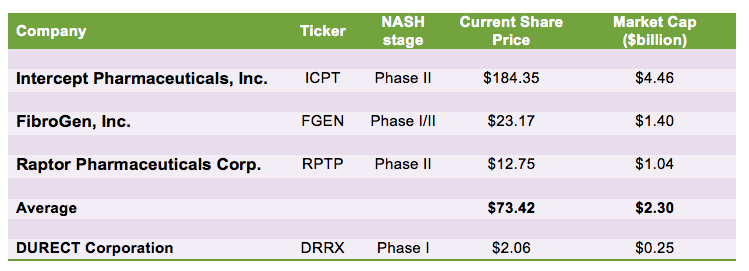
We believe even with the only NAFLD/NASH indication, the market is big enough for DUR-928 to support the company’s long term growth and valuation. If we look at the valuation of similar companies, we will have some sense how DUR-928 will impact Durect’s valuation. We notice that three companies have similar NASH programs. ICPT and RPTP’s NASH programs are in Phase II and FGEN’s is in Phase I. Our $3.00 per share value Durect’s NASH program at $360 million in market cap based on 120 million outstanding shares, which is still conservative compared to its peers in our view.
Together our fair value for Durect is $6.00 per share, which values the company at $720 million in market cap. If the company can show positive DUR-928 data for NASH and/or acute kidney injury in the planned Phase II trials, share price can easily double.
READ THE LATEST FULL RESEARCH REPORT HERE
SUBSCRIBE TO ZACKS SMALL CAP RESEARCH to receive our articles and reports emailed directly to you each morning. Please visit our website for additional information on Zacks SCR and to view our disclaimer.