By Anita Dushyanth, PhD
TSX:EDT.TO
OTC:EDTXF
Spectral is developing the Toraymyxin column for the treatment of severe sepsis. The Toraymyxin column is a polymyxin B loaded absorption column designed to reduce blood endotoxin levels in sepsis patients. Polymyxin B is an antibiotic with very high affinity for endotoxin, a component of the outer membrane of Gram-negative bacteria that is the most potent initiator of the septic response. The Toraymyxin column is approved in both Japan and Europe and has been used to safely treat over 100,000 patients.
The company trades on the Toronto stock exchange (TSX) under the ticker symbol (TSX:EDT.TO), and on the U.S. OTC market under (OTC:EDTXF). We initiated coverage of Spectral Medical in January 2015 (see FULL REPORT) with a Hold rating and a $0.75 price target. We have since revised that target to $1.20 per share based on a favorable update from an independent Data Safety and Monitoring Board (DSMB) on the ongoing Phase 3 EUPHRATES clinical trial.
…Progress on Phase III EUPHRATES Trial…
Spectral initiated the EUPHRATES Phase 3 clinical trial in June 2010 and had 15 sites up and running by the end of 2012. There are currently 50 hospitals eligible to enroll patients in the study throughout Canada and the U.S., thus it could be argued that the trial is taking a very long time to fully enroll. That being said, investors should keep in mind that it is quite difficult to identify septic patients who fit all the inclusion/exclusion criteria. The EUPHRATES trial is screening approximately 125 patients per week, with most patients not qualifying due to not meeting the vasopressor requirements, not having a MODS score > 9, or not having an elevated EAA score. For comparison’s sake, the PROWESS-SHOCK trial that evaluated Eli Lilly’s Xigris® was performed from 2008-2011 in 208 hospitals and screened 27,816 patients in order to enroll 1,697 (6.1% enroll-to-screen rate).
The primary outcome of the EUPHRATES trial is now 28-day all-cause mortality in patients that are in severe septic shock with EAA > 0.6 and a MODS score of > 9. As before, patients must also have at least one organ dysfunction. Since the implementation of the new exclusion criteria (MODS score ≤ 9), the composite mortality rate of the enrolled patients has increased significantly, indicative of the fact that those patients most likely to benefit from treatment with the Toraymyxin column are being properly identified and randomized into the trial.
Spectral released some very good news earlier in March 2015 when an independent DSMB recommended the Phase 3 EUPHRATES clinical trial continue on as planned. The DSMB also agreed that an interim analysis be performed on the patients randomized since the last protocol amendment to include EAA > 0.6 and a MODS score of > 9.
The following references lend some support to a higher mortality rate for patients with a MODS score > 9:
Marshall et al., 1995: This paper originally described the MODS score and found the following correlations with intensive care unit (ICU) and hospital mortality.
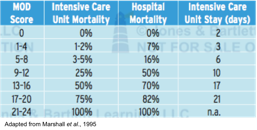
Hebert et al., 1993: This study examined organ failure on day 1 of admittance to the ICU for 154 consecutive patients with sepsis syndrome. The results showed 30-day mortality of 20% in patients with less than 3 organ system failures and 70% in patients with 3 or more organ system failures.
Marshall, 2001: The number of failing organ systems is correlated to mortality for patients in the ICU as follows:
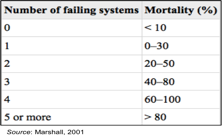
Averaging the mortality rates together for patients with MODS scores from 9-20 (we have decided to exclude patients with a MODS score >20 as they are unlikely to have mean arterial pressure of >65mm Hg, which is an exclusion criteria for the trial) for both the ICU and hospital gives a composite mortality of 59%. We also estimate that patients entering the trial would average three failing organ systems, which gives an average mortality rate of 60%.
…DSMB gives the green signal to continue Phase III trial…
The composite mortality rate at the time of the planned interim analysis, conducted in January 2014, was approximately 30 percent. It would take an enormous absolute risk reduction in order to show significance (> 20% difference in mortality between the Toraymyxin treated and control groups). However, since the implementation of the exclusion criteria (MODS<=9) , which enrolled those sick patients who are most likely to benefit from treatment with the Toraymyxin column, the composite mortality rate had increased significantly to roughly 50 percent.
Based on our power analysis back in March 2015, we felt that the trial was not properly powered. The graph below shows the statistical power assumptions for the following variables: placebo = 60%, column = 40%, p<0.005.
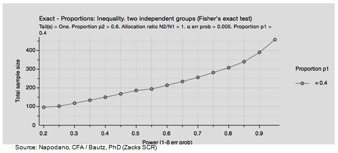
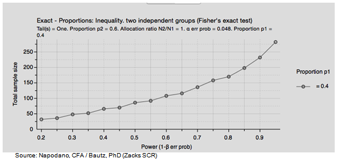
As investors can see, with around 116 patients, the trial is only 30% powered to succeed. However, when we adjust the assumptions to assume enrollment of 175 patients (which should take place mid 2016) and a p<0.048, we see that the statistical power is now ~ 80%.
During the early part of the third quarter, management consulted with their regulatory advisors, independent statisticians, and the trial’s Steering Committee about the total number of subjects that needed to be enrolled into the study. Using the last three years of mortality data of the treated patients which was available from a validated patient registry, management performed statistical analysis on the actual composite mortality rate of patients randomized into this trial as well as on similar patients who were treated with the PMX medical device in Europe using the same protocol as the EUPHRATES trial. Management then decided to revise the sample size for its EUPHRATES trial to a total of 446 evaluable patients (previously 650), of which 176 patients will be randomized into the study. These patients will be considered for determining the primary end-point of 28-day mortality, as recommended by the FDA. The trial remains powered at 80 percent and the alpha remains at < 0.05. The methodology used in the recalculation the sample size was presented to the DSMB as well as to the FDA at its quarterly meeting early in September 2015. On September 14, 2015 management was pleased to announce that the DSMB had given a green signal to continue the ongoing clinical trial without the need for an interim analysis, as had been previously contemplated.
When we initiated coverage on Spectral back in January 2015, we had performed a thorough analysis on the pace of patient enrollment. This turned out to be approximately one patient every 4.2 days which translates to about seven subjects per month. The company is now looking to recruit the last 75 of the required 446 trial patients. Management stated on the recent news that thus far, an average of eight new patients have been enrolled per month in 2015. The enrollment rate has turned out to be in-line with our forecast. Approximately 85% of required patients have now been enrolled. The trial is being conducted at a total of 42 hospitals (32 in the U.S. and 10 in Canada).
…Upcoming Milestones…
2H 2015 – Continue enrollment of the 75 patients for Phase III trial
End Q2/ early Q3 2016 – Complete patient enrollment in Phase III trial and expect data from primary end-point
Q4 2016 – Submit clinical data as the last module in the PMA filing towards anticipated FDA approval.
…Regulatory Process…
Based on progress made to date, the most effective and fastest pathway for Spectral to obtain market approval is by continuing to move forward with the EUPHRATES trial and implementing the rolling Pre Market Approval (PMA) submission plan (consists of four separate modules) that has already been accepted by the FDA in April, 2015. This process allows for the timely review of the various modules and has the potential to significantly reduce the time to commercialization. The first three modules include physical, chemical and safety testing data, as well as requisite manufacturing information. The fourth and final module provides clinical data. The company has completed the first three modules. The first module was submitted in June 2015. Management has submitted the second module in the beginning of September 2015 and the third module is expected to be filed early in the fourth quarter of 2015. Management expects to enroll the last patient by June/July 2016, after which they need to wait 28 days for recording the primary end-point. The final module, consisting of clinical data, is expected to be submitted in the fourth quarter of 2016 as a final step towards anticipated FDA approval.
…Commercialization…
The company has taken a number of other operational and strategic measures to prepare itself for commercialization.
The company has developed a working prototype of its proprietary hemoperfusion/RRT (renal replacement therapies) pump. It is specifically designed to simplify the treatment for patients with septic shock and is intended for use in the intensive care unit under the direction of the intensive care doctor and nurse. The pump was introduced to a select group of critical care clinicians and nephrologists at the CRRT conference held in San Diego in February 2015. Approval of this instrument by Health Canada is anticipated during the fourth quarter of 2015, with 510K approval in the U.S. targeted for the first quarter of 2016.
Other commercialization initiatives include new packaging for the EAA™(Endotoxin Activity Assay) diagnostic to simplify usage and reduce lab technician time in hospitals. For assays to remain stable and have a long shelf life, they must be sealed using moisture barriers and protected from ambient humidity. Test assays are individually sealed in a foil package as a single-test pouch instead of multi-test packets (5 tests in a single pouch) to improve the shelf life. A longer shelf life for diagnostic assays reduces wastage as well as the expense associated with laboratory downtime when having to produce new batch of assays due to expiration.
The company is also working towards the automation and scale up of the manufacturing process at their plant in Toronto, Canada to increase production capacity. Management anticipates forming a sales and distribution infrastructure capable of servicing a large potential market pending FDA approval.
…Spectral’s Sources of Revenues…
For all intents and purposes, an investment in Spectral Medical, Inc. is predicated on successful commercialization of the Toraymaxin column. However, Spectral does derive some revenue from the sale of proprietary reagents (monoclonal antibodies, recombinant proteins, and calibrators). These materials are sold for use in research and development as well as in products manufactured by other diagnostic companies through non-exclusive license and supply agreements. In the last two years, Spectral’s revenue from royalties alone has been in the $1.5-2 million range.
Spectral is aiming for the pairing of a diagnostic tool with a therapeutic device. Thus far, the treatment for patients presenting symptoms of septic shock include the use of third party tools such as dialysis pumps and an assembly of nephrologists to diagnose and administer treatment. Since such patients suffer from acute conditions and do not have the privilege of extra time for trial-and-error on treatment methodologies, diagnosis and treatment are crucial to improve the survival rate.
While EAA serves as a diagnostic tool for detecting endotoxin levels, currently treatment options for sepsis are only palliative, with no FDA approved treatments available. Spectral’s theranostic product has the potential to address a large unmet medical need, Toraymyxin use, guided by the EAA, allows physicians to target patients who are most likely to benefit from the treatment. Although EAA has received regulatory approval for some time now, the revenue generation has been slow as treatment has not been approved yet. We believe if and when the PMX cartridge is launched in the market, the need for diagnosis will rise, and EAA will be used widely to guide treatment.
At this time, we are not including the potential revenue from the RRT pump as regulatory approvals in the different global regions are pending and anticipated only by the first quarter of 2016. However, Spectral should experience an increase in revenues over the next few years from RRT pump sales, EAA/PMX sales in the U.S. as well as EAA sales in other global markets since we expect testing to be on the rise as therapy comes into play.
…Long-Term We Like the Concept…
We believe the company has the right strategy with EUPHRATES given the amended protocol and previous clinical data supporting safety and efficacy of the Toraymyxin column. We are more confident in the outcome of a fully enrolled trial, which we estimate would be approximately 175 patients with estimated mortality rates of 60% and 40% for control and treated groups, respectively. From our analysis, we had estimated these numbers quite accurately in our March 2015 report. Under this scenario, we believe the trial would be fully enrolled in mid-2016 with data expected in late 2016. We feel that there will be ample opportunity for investors to take a position in Spectral during the year as more information is gathered in regards to the EUPHRATES trial. We recommend that investors get familiar with the Spectral story, and follow the updates. Being familiar with the Spectral story will allow investors to invest astutely on the results of the EUPHRATES trial. If the results turn out positive in favor of the Toraymyxin column, we believe the shares are headed for a major revaluation – potentially in the order of ten-fold, and investors should immediately buy the news in anticipation of a significant run in the shares.
…Valuing Spectral Medical…
Historically, prior studies indicate a clear evidence of improvement in clinical parameters in sepsis patients receiving PMX therapy. For the EUPHRATES trial, the study is double-blinded, the sample size is increased to 446 patients (total), and the subjects are pre-screened for an elevated EAA (high risk). We think that all of the aforementioned factors make the study sufficiently powered. More importantly, the DSMB and the FDA have recommended the ongoing study to continue without any further modifications. In our report in March 2015, we had taken a conservative approach and modeled for the EUPHRATES trial to conclude in mid-2016 and the Toraymyxin column to be approved as early as the first half of 2017.
Although management’s initial guidance was that they had expected the PMX column to obtain regulatory approval by first half of 2016, they are now in agreement with our forecast after the recent meeting with the FDA. Despite utilizing the modular PMA pathway, the approval timelines have been pushed back from management's initial expectations as a result of additional time spent on determining the sample size for the trial. We model the product to be launched in 2018.
Of the one million cases of sepsis in the U.S., about 35% experience severe sepsis and septic shock and 50% of those are found to have high levels of endotoxin. We forecast that each treatment will cost $21,000 ($10,000/column x 2 columns per patient + $200/EAA test x 5 EAA tests per patient). As of now, we are projecting peak market share of 25% in a target population of 175,000 septic patients per year to occur in 2024, with corresponding peak revenues of $1.2 billion. Given the limited treatment options available for sepsis patients and the lack of many viable treatments during the late stage of the disease, we feel that this is a fully realizable potential.
Spectral’s risk profile had been high in the past due to the impending interim analysis that required the company to re-visit the sample size after every meeting with DSMB. This left a cloud of uncertainty hanging over the timeline required for Phase III trial to conclude. After meeting with DSMB and FDA, Spectral has made progress in moving their clinical trial forward, which we feel has helped to de-risk from a clinical and regulatory perspective. As a result, we have reduced our discount rate to 22% from 25% (used on our prior valuation). Nonetheless, the company may still be subjected to unpredictable outcome of the EUPHRATES clinical trial, and/or the risks associated with regulatory delays.
We forecast free cash flow to be 60% of gross revenues, and we assign a 50% probability of the EUPHRATES trial being successful. This gives us a net present value for the company of approximately $240 million. Spectral currently has a fully diluted share count of 191 million shares, which leads to a fair value of approximately $1.20 per share. We maintain our Hold rating. We believe that the recent news about the FDA giving consent to progress on Phase III trial is a noteworthy event for the company. We continue to believe that a positive outcome to the EUPHRATES trial would cause a significant revaluation of the shares, as there are no FDA approved treatment options for sepsis and the sepsis market in the U.S. is a greater than $3 billion opportunity.
READ THE LATEST FULL RESEARCH REPORT HERE
SUBSCRIBE TO ZACKS SMALL CAP RESEARCH to receive our articles and reports emailed directly to you each morning. Please visit our website for additional information on Zacks SCR and to view our disclaimer.