By Grant Zeng, CFA
OBB:ENUM
Recently, Enumeral Biomedical Holdings, Inc. (OBB:ENUM) announced important progress in its anti-PD-1 antibody program. The company also provided an update on the progress of additional programs in the Company’s R&D pipeline, including its TIM-3 and LAG-3 antibody programs.
Update on the PD-1 Program
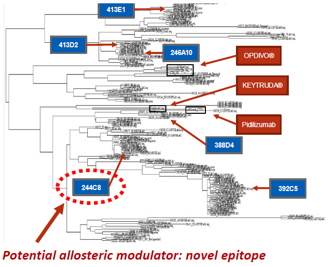
Earlier this year, Enumeral announced the identification of antibodies that appear to bind to the PD-1 inhibitory checkpoint protein in a manner different from that of currently marketed anti-PD-1 antibodies, while retaining activity in cell-based assays. This time, Enumeral reported that these novel antibodies do not appear to compete with currently marketed antibodies for binding to PD-1, nor do they appear to compete with PD-L1, providing further evidence of a differentiated mechanism of action. Enumeral presented these and related findings during the recent CRI-CIMT-EATI-AACR Inaugural International Cancer Immunotherapy Conference and the Biopharm America Conference.
Enumeral has advanced six lead clones into pre-clinical characterization, four of which are undergoing humanization. The humanization of 388D4 and 244C8 has been completed. The Company anticipates that the humanization process will be completed before the end of 2015, which will enable initiation of cell line development for IND-enabling studies.
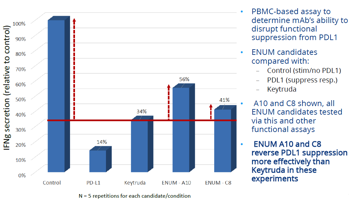
Enumeral’s PD-1 antibodies have superior function than Keytruda. In the PBMC-based assays, ENUM A10 and C8 reverse PDL1 suppression more effectively than Merck’s Keytruda.
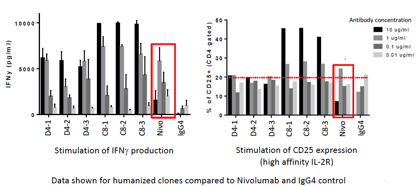
Enumeral has humanized two lead antibodies (C8 and D4) and tested them in cell-based assays. As reported at the recent immunotherapy meeting, C8 and D4 showed enhanced activation of T cells in mixed lymphocyte reaction (MLR) and other assays than associated with currently-marketed antibodies, including:
- Increased dose-dependent stimulation of IFNɣ production;
- Dose-dependent increases in T cell CD25 expression.
The stimulation of CD25 expression by Enumeral antibodies may be partially responsible for the elevated production of interferon gamma, perhaps through an autocrine IL-2 signaling mechanism, in contrast to other types of antibodies, which do not appear to have an effect on CD25 expression.
The Implications
From these initial results, we believe Enumeral’s PD-1 antibodies are differentiated, which might elicit desirable cellular immune responses among subsets of tumor infiltrating lymphocytes (TILs) that differ from those observed with competitor antibodies against the same target.
We already knew that Anti-PD-1/PD-L1 non-responders constitute the majority of patients even in “immune therapy” tractable tumors like melanoma and RCC. Recent melanoma studies have reported response rates in the range of 20-40% using anti-PD-1 or anti-PDL-1.
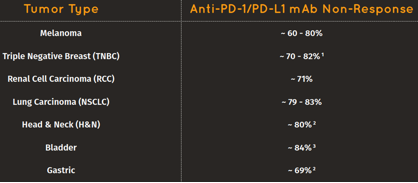
Since Enumeral antibodies do not compete with PD-L1, yet still display activity in relieving the immunosuppressive effects of PD-L1, they may prove useful in treating patients who have failed prior PD-1 therapy. Further, this potentially distinct class might be synergistic when combined with other PD-1 pathway-directed therapies, including anti-PD-L1 therapy.
Enumeral is further investigating the mechanism of action of these differentiated antibodies, and has initiated testing in immuno-humanized mouse models of cancer, which enable testing of PD-1 modulatory therapies. The Company expects data from these studies to be available in December 2015.
We look forward to the completion of humanization process of these antibodies and the initiation of the IND-enabling studies by the end of this year. Positive data from the combination study may further strengthen the company’s negotiation power with potential partners.
Update on TIM-3 Program and LAG-3 Program
The T-cell inhibitory receptor Tim-3 (T-cell immunoglobulin and mucin-domain containing-3) is one of the check point proteins, which exhibits several unique features that make it an intriguing candidate for the next wave of therapies that target immune checkpoints in cancer. Tim-3 is currently receiving much attention due to its demonstrated success in multiple preclinical cancer models.
In Enumeral’s TIM-3 program, the Company has isolated 124 TIM-3 binding antibodies to date. The screening efforts are ongoing. Enumeral’s bioinformatics analysis indicates desirable diversity, with the antibodies falling into 42 distinct clades that bind to TIM-3. Enumeral plans to apply its unique approach to cellular immune response profiling to further understand the utility of these different antibodies for modulation of different tumor infiltrating lymphocytes.
We believe Enumeral’s TIM-3 antibodies may have the potential to promote anti-cancer immune responses, either as a monotherapy or in combination with other therapies, including other immune checkpoint-targeted drugs. The company currently anticipates nominating lead clones in 4Q15, and beginning the humanization process by the end of this year.
In Enumeral’s LAG-3 program, the Company has isolated 102 LAG-3 binding antibodies that fall into 40 distinct clades that bind to LAG-3. The Company is currently in the process of selecting antibody clones for further characterization.
SUBSCRIBE TO ZACKS SMALL CAP RESEARCH to receive our articles and reports emailed directly to you each morning. Please visit our website for additional information on Zacks SCR and to view our disclaimer.