By David Bautz, PhD
NASDAQ:EPRS
Financial Update
On November 16, 2015, Epirus Biopharmaceuticals, Inc. (NASDAQ:EPRS) announced financial results for the third quarter of 2015 and provided a business update. The company reported revenues of $0.2 million for the quarter which consisted of $131,000 in development services provided by the company’s newly acquired subsidiary, Epirus Netherlands, collaboration revenue under the agreement with PolPharma of $50,000, royalties of $31,000 from the sale of Infimab™, and amortization of deferred revenue of $9,000 from the company’s agreement with Sun Pharmaceutical Industries.
Net loss for the quarter was $14.0 million, or $0.59 per share, and was comprised of $9.2 million in R&D and $5.1 million in G&A expenses. This compares to $5.4 million in R&D and $8.5 million in G&A expenses for the third quarter of 2014. The increase in R&D expenses was primarily due to increased development costs for BOW050 and BOW070. The decrease in G&A expenses was related to decreased professional fees due to the merger that occurred in July 2014. Total cash burn for the quarter was $13.9 million and Epirus exited the third quarter of 2015 with approximately $44.4 million in cash and cash equivalents. We believe the company has sufficient cash to fund operations through mid-2016.
Business Update
BOW015 Global Registration Trial To Begin in the First Quarter of 2016
On November 16, 2015, Epirus provided a clinical program update on BOW015 (Remicade® biosimilar). The company announced the completion of the manufacturing process lock and readiness to begin the Phase 3 global registration study in patients with active rheumatoid arthritis (RA) in the first quarter of 2016. Completion of the process lock means that the company is able to consistently produce commercial-scale quantities of high quality product that can be utilized in a clinical trial.
BOW015 targets tumor necrosis factor alpha (TNF-α), and can potentially be utilized to treat not just RA, but a number of other inflammatory conditions including Crohn’s disease, ulcerative colitis, and psoriasis. BOW015 has previously been tested in a Phase 1 bioequivalence study and a randomized, double blind, active comparator Phase 3 clinical trial.
- Phase 1 trial: A Phase 1 bioequivalence study was conducted in the United Kingdom in 2012 with the primary objective of the study being a comparison of the pharmacokinetics of Remicade® and BOW015 administered by intravenous infusion. The pre-defined pharmacokinetic values for the maximum serum concentration as well as the pattern of elimination were similar between BOW015 and Remicade®. In addition, no differences were seen in immunogenicity test results between the two treatment groups nor were there any differences in safety or tolerability between the two groups.
- Phase 3 trial: This study, conducted in India, tested the efficacy and safety of BOW015 in severe, active RA patients on stable doses of methotrexate. The study subjects were randomized 2:1 to receive either BOW015 (n = 126) or Remicade® (n = 63) during the first 16 weeks of the study. The 16-week data shows that 89.8% of BOW015 treated patients achieved ACR20 compared to an 86.4% ACR20 response rate in those patients treated with Remicade®. The outcome met the pre-specified statistical endpoint and was within the 15% equivalence margin at a 95% confidence interval. There were no differences in safety, immunogenicity, or the secondary endpoints between the two treatment groups. In addition, an open-label study was conducted with those that had received Remicade® during the initial 16-week portion of the trial were switched to BOW015. Importantly, 58-week data shows that the durability of the response was seen with BOW015 alone and after switching from Remicade®.
The upcoming registration study will be quite similar to the Phase 3 study conducted in India with a couple of notable differences. The upcoming Phase 3 study will likely have between 450-500 patients, thus it will be much larger than the previous Phase 3 study, and there will not be a switching component, which means patients will be on either BOW015 or Remicade® for the entirety of the study. We believe there is very little clinical risk associated with BOW015, as there is already positive Phase 3 data for the drug, and we see a very high probability of success for the upcoming Phase 3 study.
Epirus Acquires Bioceros Holdings B.V
On September 9, 2015, Epirus Biopharmaceuticals, Inc. (EPRS) announced the acquisition of Bioceros Holdings B.V., a privately held, Netherlands-based biopharmaceuticals R&D company that is focused on the development of monoclonal antibodies and the generation of cGMP cell lines.
Under the terms of the agreement, Epirus acquired Bioceros for a total of $14.1 million in cash and stock payable in installments over a one-year period. The deal is broken down as follows:
- Total cash payments of $5.1 million payable as i) $3.4 million at closing, and ii) $1.7 million on the first anniversary of closing.
- Common stock worth $9.0 million payable as i) $4.0 million in common stock at closing, based on the average closing price over the ten trading days immediately prior to closing, and ii) $5.0 million in common stock to be issued six months following closing, based on the average closing price over the ten trading days immediately prior to that date.
On September 9, 2015, Epirus issued 788,960 shares of common stock in connection with the acquisition. A second tranche of stock will be issued on March 9, 2016 based on the terms disclosed above.
Expanded Pipeline
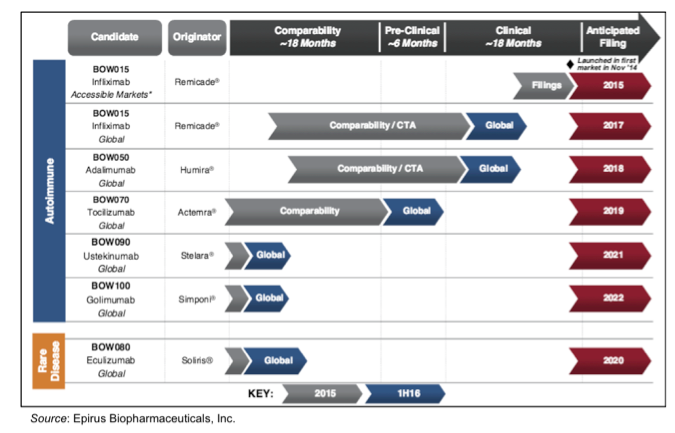
As part of the acquisition, Epirus has expanded its pipeline with three additional biosimilar candidates: BOW080, a biosimilar to eculizumab (Soliris®); BOW090, a biosimilar to ustekinumab (STELARA®); and BOW100, a biosimilar to golimumab (SIMPONI®). According to EvaluatePharma, the three reference drugs are projected to have sales of approximately $12 billion in 2020.
STELARA® (ustekinumab): This is a fully human IgG1 monoclonal antibody that targets the p40 subunit found on both interleukin (IL)-12 and IL-23, thereby blocking the interaction between those cytokines and the receptor and inhibiting signaling, differentiation, and cytokine production found in a number of inflammatory diseases. The drug is currently approved for the treatment of plaque psoriasis and psoriatic arthritis. STELARA® is marketed by Johnson and Johnson (JNJ) and in 2014 had sales of approximately $2 billion worldwide with projected sales of $3.5 billion in 2020. The patents for ustekinumab expire in 2023 and 2024 in the U.S. and Europe, respectively.
SIMPONI® (golimumab): This is a fully human IgG1 monoclonal antibody that targets tumor necrosis factor-alpha (TNF-α), which is the same mechanism of action shared by the top selling rheumatoid arthritis (RA) drugs (Humira®, Enbrel®, and Remicade®). SIMPONI® is currently approved for the treatment of RA, psoriatic arthritis, ankylosing spondylitis, and ulcerative colitis. The drug is marketed by JNJ and Merck and in 2014 had sales of approximately $1.9 billion worldwide with projected sales of $3.4 billion in 2020. The patents for golimumab expire in 2024.
Soliris® (eculizumab): This is a humanized IgG2/4 monoclonal antibody that targets the terminal portion of the complement cascade, specifically by inhibiting the cleavage of complement protein C5 to C5a and C5b. This prevents the formation of the terminal complement complex C5b-9, which causes the complement mediated events seen in paroxysmal nocturnal hemoglobinuria (PHN) and atypical hemolytic uremic syndrome (aHUS), the two conditions for which Soliris® is approved. The drug is marketed by Alexion Pharmaceuticals (ALXN) and had sales of approximately $2.2 billion in 2014 with projected sales of $5.4 billion in 2020. The patents for eculizumab expire in 2020 and 2021 in Europe and the U.S., respectively.
The addition of ustekinumab and golimumab biosimilars adds to the company’s focus on autoimmune-mediated diseases, while the eculizumab biosimilar may indicate the company is interested in expanding into the rare disease space. The updated pipeline is shown below:
Strategic Rationale for Acquisition
In addition to expanding the company’s pipeline, the acquisition of Bioceros will bring with it a host of other product development capabilities that will aid Epirus as it works to build a sustainable biosimilar business, including:
- A 6000 ft2 development laboratory
- A proprietary chinese hamster ovary (CHO) cell line for expressing monoclonal antibodies
- A small scale bioreactor to allow for rapid iterations when optimizing product characteristics
- An experienced development team of approximately 20 scientists (30% w/ advanced degrees)
In the end, the acquisition of Bioceros should lead to accelerated product development timelines as the company has the capability to perform more of the necessary development activities in-house along with decreasing costs associated with each product candidate.
Key Addition to Management Team
On November 10, 2015, Epirus announced the appointment of Vincent E. Aurentz as Chief Business Officer. Mr. Aurentz has over 25 years of experience in the life science industry, including R&D and business development. Most recently, Mr. Aurentz was President of HemoShear Therapeutics, where he oversaw the scientific and business development efforts including collaborations with global organizations such as Pfizer, Eli Lilly, Janssen R&D, and Children's National Health System. Prior to joining HemoShear Therapeutics, Mr. Aurentz was Executive Vice President and member of the Executive Management Board at Merck KGaA (Merck Serono) where he directed R&D programs, portfolio strategy, and headed all deal activity and venture investments. He is a former Executive Vice President at Quintiles, Co-founder and Managing Director of a venture capital and advisory business and started his career at Andersen Consulting (now Accenture).
Conclusion and Recommendation
We continue to be positive on Epirus’ story as the company continues to execute on its strategy in a consistent manner. This is exemplified by key recent accomplishments including the collaboration with PolPharma Group, the acquisition of Bioceros, and the completion of manufacturing readiness for the upcoming global registration trial for BOW015. The company has announced the plan for a global regulatory filing every year for six years beginning in 2017 for the products currently under development, and since management has successfully hit all previous milestones we are confident that trend will continue. The biosimilar market will only continue to expand, and we believe the company is taking the correct path by first focusing on overseas markets that have a clearly defined regulatory environment, few legal encumbrances, and payers seeking lower cost therapies. We believe the shares are worth $15 and we continue to maintain a ‘Buy’ rating on the stock.
READ THE LATEST FULL RESEARCH REPORT HERE
SUBSCRIBE TO ZACKS SMALL CAP RESEARCH to receive our articles and reports emailed directly to you each morning. Please visit our website for additional information on Zacks SCR and to view our disclaimer.