By Brian Marckx, CFA
NASDAQ:EVAR
Q3 Financial Results: Japan Remains Strong, Other Areas Not So Much, 2015 Guidance Lowered. Prompts Downward Revisions to Our Model and Price Target…
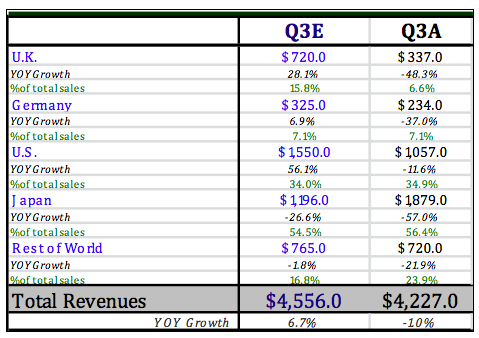
Lombard Medical (NASDAQ:EVAR) announced financial results for the third quarter ending September 30th. Unlike Q2 results, which we characterized as “very good” and which handily beat our estimates on both the top and bottom lines, Q3 results were less than stellar. As was management’s full-year 2015 revenue guidance, which contracted by a range of $3 to $4M, or about 17% to 20%. The sole significant bright spot in Q3 was sales in Japan, which continue to climb – some of which relates to inventory stocking, but procedural volume also remains robust – including ~35% growth from Q2. EVAR notes that they estimate that they now have claimed approximately 5% of the market in Japan. Revenue in Japan of $1.9M was up 15% yoy and up 7% sequentially. It also crushed our $1.2M estimate by over 50%.
Meanwhile U.S. sales, while up in the mid-single digits on a yoy basis, were a double-digit loser compared to Q2 and over 30% lower than what we were looking for. U.K. sales fell 40% yoy, were down sequentially and missed our number by better than 50%. Germany, which earlier this year we had expected to be an area of better-than-average growth given its large size, relatively healthy economy, reliable reimbursement and it being a major medical device market, has been for lack of a better description, a major dud in 2015. Q3 revenue from Germany was off 23% from the same period in 2014, was about flat from Q2 and missed our estimate by 18%.
Not much in the way of background on why the relatively light sales numbers in the U.S. and in Europe on the Q3 call, although management did point to delay of IntelliFlex (new low-profile delivery system) launch – which the company noted they had hoped would be on the U.S. market in Q4 – and therefore lack of prior-period stocking in both the U.S. and elsewhere as a factor. Management also pointed to this being the reason for the downward revision to the full year 2015 revenue guidance. The soft sales in the U.S. and downward revenue guidance is particularly surprising given that Aorfix Plus, which extends the landing zone up to 36mm, launched in late June and was expected to make a meaningful contribution to revenue during 2015.
While we think delays to IntelliFlex commercial introduction may have played a part into the disappointing U.S. and European sales in Q3, we think it’s likely there are other headwinds, particularly given that as of at least the last earnings call it was all but known that U.S. launch would not happen during the current year. We don’t know what the other headwinds are but sales force turnover could potentially be an issue as could just a general slower-than-anticipated adoption of Aorfix domestically and overseas. We have made some meaningful downward revisions to our modeled Aorfix-related revenue for the remainder of the current years as well as our out-years as result of what appears to be more drawn-out-than anticipated uptake of the device in the U.S. and Europe – although we note that we do still model robust double-digit sales growth in most territories, which assumes additional traction is gained with complementary new product launches and a growing and more efficient sales force. The aggregate downward revisions to our model (along with contraction in comp valuations) have resulted in a similar downward revision to our near-term price target ($8.50 to $6.00 per share).
In terms of the sales force – management had guided late last year that the domestic sales force was expected to be increased from about 35 to ~50 by mid-2015. Today it stands at about 30. The company expects to add feet on the ground with the introduction of IntelliFlex but we think this will be very incremental net additions. In the overseas markets where EVAR sells direct (Europe, Germany) there will be some rep additions, particularly with the roll-out of Agili-D, the stent graft acquired with Altura.
In terms of timing for IntelliFlex, management now expects FDA filing in Q4 of this year and hopes to have approval in the U.S. in Q1 and launch domestically in Q2. They expect to have approval and launch in Europe in Q3 2016. These launch timelines might end up being on the somewhat optimistic side but we think launch in both territories are do-able milestones sometime during 2016.
Agili-D is expected to launch in the U.K. and Germany in January 2016, with the company currently targeting about 20 reference centers for the initial introduction. EVAR will bring on additional reps to support the launch - noting on the Q3 call that they will almost double the size of the combined sales force in Germany and the U.K. (which we estimate currently stands at ~10 -12). The European launch will kick off with a live demonstration of the device at the LINC Congress in Leipzig, Germany in January.
In late July when EVAR announced the Altura acquisition the company noted that they expected Agili-D could contribute as much as 20% of total revenue in 2016. We are currently modeling just better than 10% of total revenue ($2.6M) related to Agili-D in 2016 given that we think it may take some time to fully coordinate the roll-out and get reps productive. However, our estimates are highly subject to change. For some reference, Ovation, TriVascular’s ultra-low profile stent graft (which Agili-D will directly compete with), did about $5.4M in sales in its second full-year in Europe.
A significant factor that played into Lombard’s decision to pull the trigger on Altura was that Agili-D gave them the sole position as a provider of products for on-label use in both high neck angles and standard anatomies – the benefit to providers is that EVAR is now a one-stop shop for all anatomies. That benefit could be significant in terms of facilitating uptake of both products. The U.S. and Japanese markets for Agili-D, while likely to be at least six or seven years off and dependent on eventually gaining requisite regulatory approvals, has the potential to significantly steepen the revenue curve for the product.
Q3 Numbers…
Total revenue fell 1% yoy and was down 7% sequentially. As noted, every itemized territory came in soft aside from Japan which is seeing not only strong sales but robust growth in procedural volume – both on a yoy as well as sequential basis. The bulk of the changes to our revenue estimates for 2016 reflect downward revisions to our modeled European sales growth, although we have trimmed our U.S. estimates as well. We think the launch of IntelliFlex as well as a full-year of Aorfix Plus contribution will make a meaningful impact. And, as noted, on the Altura-side, we currently model a $2.6M contribution from Agili-D.
Q3 gross margin at 48.8% was relatively strong – the second best in recent history – which may imply pricing is at least holding up. GM, at least on the Aorfix side, should benefit further from economies of scale from higher manufacturing volumes as well as a higher % of sales from the U.S.
And while there were few highlights to point to in Q3, OpEx was one of them, coming in at $11.4M (compared to our $11.7M estimate), despite about $1.2M in stock-based comp (which, for comparison was about $900k for the entire 1H). We look for OpEx to move higher – in the near-term this relates to the additional headcount being brought on to support Agili-D and in the longer-term, higher R&D expense related to development and sales milestones and U.S. and Japan regulatory activities for that product.
Excluding a $1.2M tax benefit, EPS was ($0.50), compared to our ($0.59) estimate – the difference mostly attributable to higher share count as a result of the Altura acquisition, the purchase price which included 3.75M shares of EVAR common stock.
Altura Acquisition
In late July, just days after reporting solid Q2 financial results, EVAR announced acquisition of Altura Medical, a privately-held Silicon Valley-based medical device company. Altura's Agili-D is an ultra-low profile (14f) AAA stent graft indicated for standard anatomies which received CE Mark in 2015. It is not yet approved in the U.S.
Terms of deal:
> Upfront:
- $15 million of Lombard common stock (3.75M shares @ $4)
- assumption of $5.5 million in bank debt and $2.5 million in liabilities and transaction costs
> Milestones (payable in cash or stock at Lombard's option):
- $15 million on achievement of $10 million in TTM sales
- $12.5 million on achievement of FDA approval of Agili-D
Rationale for the deal:
> Altura's product is one of the lowest profile stent grafts on the market. Only TriVascular's Ovation Prime and Cordis' InCraft have profiles as small as Altura's (14f). Ovation Prime is approved for sale in both Europe and the U.S. (FDA approval in Jan 2013). InCraft is marketed in Europe and Canada and undergoing a PMA study in the U.S.
> While EVAR's flagship device Aorfix is indicated for use in ~85% of AAA anatomies, the simplicity, ease-of-use and physician-familiarity of Altura's device lend it more to the ~70% of AAA patients with standard anatomies. Management indicated that they believe this will fill a sizeable gap in potential sales that they were losing when doctors would choose competitors' grafts instead of Aorfix in standard anatomy procedures
> Lombard will be the only company offering products for on-label use in both high neck angles and standard anatomies. They expect this to facilitate market share gains against competitors
> "Add-to-the-bag" product and leverage existing sales/marketing infrastructure. While EVAR anticipates incremental headcount additions to the direct sales forces in the U.K. and Germany, there should be minimal added OpEx related to detailing the product
> Lombard now has two technologies to choose from for new product development in areas such as fenestrated and thoracic stent grafts
> Will provide almost immediate bolt-on to revenue. Per management (on the acquisition conference call), revenue from Altura's device could account for up to 20% of 2016 sales. We currently (which was updated following Q3 results) model 2016 total revenue of $23M, including $2.6M (or ~11% of total) related to Agili-D
Launch Strategy:
Current activities will surround product branding and building of launch inventory. Initial introduction will happen in January 2016 in Germany and the U.K. EVAR expects to almost double the size of the direct sales force in the UK and Germany (which we estimate currently stands at about 10). Launch into the broader European footprint aimed for 2H 2016. Plan is to increase distribution capability in Spain and the footprint in Italy.
U.S. Study:
EVAR expects to leverage their knowledge and contacts from Aorfix's pivotal PYTHAGORAS U.S. study in designing and executing a successful PMA study in support of FDA approval. Management noted that they expect enrollment of between 150 and 180 patients (for reference TriVascular's Ovation study enrolled 161 patients). Current expected timelines are;
- H2 2015: submit IDE
- 2016: IDE study approval
- 2017: first patient enrolled
- 2018 full enrollment
- 2019: final patient at 12-month follow-up
- 2019: modular submission with clinical follow-up results included in last module
- 2020: FDA approval
- 2020 / 2021: launch in U.S.
Our Take:
The purchase price isn't cheap. The minimum (i.e. - no milestones) purchase price is $23 million. Based on our 2016 estimate (which is mostly a guess at this point) of $2.6M, it is a ~9x purchase price. For reference, in late October ELGX bid for TRIV at a ~6x revenue purchase price. The revenue milestone of $15 million paid on the first $10 million in TTM means EVAR’s purchase price of Altura hits 6x revenue at $6.5M in annualized sales – which we think is achievable in 2017. On the upside, this should be a seamless add-to-the-bag product, affording EVAR leverage of their current sales infrastructure which should (eventually) speed improvement in operating income.
A U.S. PMA study is a significant commitment in time, personnel and money. Management made it clear that they fully intend to pursue this. We think the timelines laid out seem not unreasonable but probably have little to no wiggle room for unforeseen delays. We ballpark cost of the study at somewhere around $50k - $75k per patient or approximately between $8M - $14M. FDA approval triggers the $12.5M milestone. So all-in, cost of U.S. approval could conceivably be near $30M. This is now included in our model.
But FDA approval would significantly expand the opportunity for the device. While Ovation Prime has been in the U.S. since early 2013 (and currently in a PEVAR study) and InCraft is ahead in FDA trials and could launch well ahead of Altura's stent graft, there are reasons to believe Agili-D can be highly competitive. For one, Ovation Prime may be more cumbersome to use as it utilizes polymer sealing rings - delivery and curing of which increases the procedure time. In addition, polymer leakage can be an issue. But, perhaps the most obvious competitive differentiation is one-stop shopping with Lombard reps which will have on label products for high neck angles (Aorfix) and an ultra-low profile, simple to use product for standard anatomies.
Product innovation in the AAA stent graft space has been rapid over the last several years as manufacturers seek to grab more of the ~$1.6B global (~$700M U.S.) EVAR market. This almost certainly was the main reason for ELGX to go after TRIV – combined they will have a formidable product portfolio consisting of Ovation and Nellix (near-term launch expected) and candidates in the late-stage pipeline. And the size of the combined sales forces will now be competitive with the other majors with potentially more accounts. This could be a headwind for not only Medtronic and the larger AAA stent-graft manufacturers but EVAR as well. But, as noted, none will have the benefit of having on-label products that can treat all anatomies like Lombard does.
Slimming down the catheter profile has been a significant area of focus as a lower profile allows for access to smaller vessels and / or percutaneous EVAR (PEVAR), eliminating the need for cutdown of the femoral wall. Studies have shown PEVAR is associated with shorter procedure time and lower risk of complications than traditional EVAR. So with PEVAR gaining more traction, this opens up another potentially receptive part of the AAA market to Lombard (albeit off-label) with the Altura graft.
So, despite the significant cost of PMA study, we think, given the outlined competitive positioning and potentially highly receptive U.S. market, FDA approval would almost certainly open up significant upside for Lombard. And a question the that the ELGX and TRIV acquisition begs is whether the marriage of EVAR (Aorfix) and Altura (Agili-D) makes them a potential take-out target by other competitors such as Medtronic, Cook Medical or WL Gore.
See below for access to our updated report on EVAR.
READ THE LATEST FULL RESEARCH REPORT HERE
SUBSCRIBE TO ZACKS SMALL CAP RESEARCH to receive our articles and reports emailed directly to you each morning. Please visit our website for additional information on Zacks SCR and to view our disclaimer.