By David Bautz, PhD
NASDAQ:CRBP
On August 19, 2015, Corbus Pharmaceuticals (NASDAQ:CRBP) announced that the U.S. Food and Drug Administration has granted Fast Track designation to Resunab™ for the treatment of systemic sclerosis, or scleroderma.
Background on Scleroderma
Scleroderma is a group of rare diseases that involve the hardening and tightening of the skin and connective tissues. Localized scleroderma only affects the skin with limited internal organ damage while systemic sclerosis affects the skin and always involves extensive internal organ damage.
According to the Scleroderma Foundation, approximately 300,000 Americans have scleroderma with one-third of those having the systemic form. The disease typically affects adults (80% of patients are female), with onset usually occurring in midlife.
Systemic scleroderma is a highly complex condition with multiple clinical forms ranging from limited cutaneous systemic sclerosis (mainly confined to the skin) to diffuse cutaneous systemic sclerosis (diffuse skin sclerosis coupled with progressive internal organ development). The limited and diffuse forms of systemic sclerosis each make up approximately 50% of systemic sclerosis cases. Patients with limited scleroderma have skin thickening of the fingers, hands, and face that develops over a number of years. Patients with diffuse scleroderma develop skin thickening more quickly over a broader area of the body with the disease potentially affecting the gastrointestinal tract, lungs, kidneys, heart, and other internal organs.
Survival, which is highly dependent upon the degree of internal organ development, has improved over the past few decades with the 10-year survival rate now 70-80% (Korn, 2003). Diffuse systemic scleroderma has a highly variable but unfavorable survival rate with death typically resulting from progressive pulmonary fibrosis, pulmonary hypertension, severe gastrointestinal involvement, or scleroderma heart disease.
Current treatments for scleroderma are focused on treating the four main features of the disease: inflammation, autoimmunity, vascular disease, and tissue fibrosis. However, there are currently no FDA approved therapies that are proven to reverse the fibrotic and vascular damage in patients with systemic scleroderma.
Preclinical Data Support the Use of Resunab™ in Treating Scleroderma
Resunab™ has been studied in a number of preclinical inflammatory and fibrosis animal models. The following studies give an example of the types of results that have been seen in the study of Resunab™ in treating fibrosis in experimental animal models.
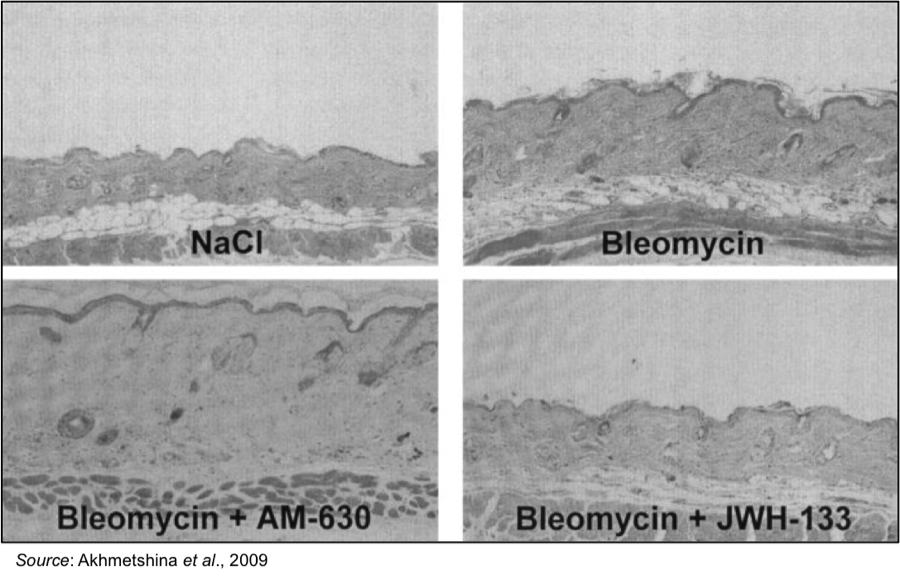
Resunab™ targets the CB2 receptor that is found on a number of cells of the immune system and peripheral tissues. Activation of the CB2 receptor mediates anti-inflammatory and anti-fibrotic effects that limit inflammation and associated tissue injury. This was exhibited by a study involving the use of genetically altered mice that did not express CB2 (CB2 knockout mice; CB2-/-) (Akhmetshina et al., 2009). Fibrosis in the skin was induced by injecting both CB2-/- and wild-type mice with bleomycin. Results showed that CB2-/- mice were more sensitive to bleomycin-induced skin fibrosis and developed increased dermal thickness in comparison to wild-type mice.

These results were then confirmed through the use of a small molecule inhibitor of CB2 (AM-630), which resulted in a similar finding of increased dermal thickness upon induction of fibrosis with bleomycin. In contrast, a CB2 agonist (JWH-133, a compound similar to Resunab™), resulted in a decrease in dermal thickness in comparison to control mice, indicating that activation of CB2 can induce anti-fibrotic effects.
Similar results were seen when Resunab™ (AJA in the following figure) was utilized in a 6-week model of bleomycin-induced fibrosis (Gonzalez et al., 2012). Mice were treated with bleomycin for six weeks and with Resunab™ for the final three weeks of bleomycin treatment. Control mice were treated with bleomycin alone for six weeks, NaCl for six weeks, or bleomycin for three weeks and NaCl for three weeks (to account for spontaneous regression of fibrosis). Results showed that treatment with Resunab™ prevented further fibrosis development in mice that already had fibrotic deposits.

In summary, the previous results show that the CB2 receptor, which is targeted by Resunab™, is involved in fibrotic development and that activation of the CB2 receptor can inhibit the formation of fibrotic deposits or prevent further development of fibrosis in animals that have already developed the condition.
What Fast Track Status Entails
The Fast Track program was put into place under the FDA Modernization Act of 1997 and is a process designed to facilitate the development and expedite the review of drugs to treat serious conditions and fill an unmet medical need. Since there are currently no treatments available for scleroderma, Resunab would obviously fill an unmet medical need. A company with a drug that receives Fast Track designation is eligible for the following:
- More frequent meetings with the FDA to discuss the drug’s development plan and ensure that the appropriate data is being collected to support drug approval.
- More frequent written communication from the FDA about things such as clinical trial design.
- Eligibility for accelerated approval and priority review, including the submission of a New Drug Application (NDA) or a Biologics License application (BLA) on a rolling basis. What this means is that a company can submit completed sections of an NDA or BLA as they are completed and have them reviewed by the FDA, rather than waiting until every section of the application is completed before the entire application can be reviewed.
Conclusion and Recommendation
News that Resunab™ has been granted Fast Track status is the latest in a string of positive news announcements for Corbus recently, including the presentation of positive preclinical data for Resunab™ in a mouse model of cystic fibrosis, the initiation of a clinical trial of Resunab™ in treating dermatomyositis, and a call notice for the exercise of warrants that should bring in approximately $6 million to the company. Additional positive news flow is expected in the second half of 2015, most notably with the initiation of enrollment of patients in Phase 2 clinical trials for Resunab™ in scleroderma and cystic fibrosis (see our last report for details on each of the trials).
If successful, we forecast that Resunab™ could be a major blockbuster, with combined sales from both scleroderma and cystic fibrosis of over $4 billion, indicating the enormous potential of the compound. The news that Resunab™ has been granted Fast Track designation by the FDA was well received by investors, as shares of Corbus traded higher by as much as 100% on the day of the announcement. However, that type of move in the share price is not unwarranted, as our target price is $6.25. Even after the large jump in price, we think the shares are still undervalued and we maintain a ‘Buy’ rating on the stock.
READ THE LATEST FULL RESEARCH REPORT HERE
SUBSCRIBE TO ZACKS SMALL CAP RESEARCH to receive our articles and reports emailed directly to you each morning. Please visit our website for additional information on Zacks SCR and to view our disclaimer.