By Brian Marckx, CFA
OTC:FPMI
2014 10-K Filed
FPMI (OTC:FPMI) filed their 10-K for the quarter and year ending 12/31/2014. Results remain generally in-line with our estimates, although R&D did come in below our number.
Q4 and full year operating expenses were $1.3M and $5.2M, compared to $1.3M and $4.3M in the respective year-earlier periods. We continue to expect OpEx to trend higher with progression of the phase II studies. Q4 and FY 2014 net loss and EPS, excluding non-cash securities and derivative related items, were $1.3M / ($0.05) and $5.3M / ($0.19) compared to $1.3M / ($0.05) and $4.3M / ($0.18) in the year earlier periods.
Excluding changes in working capital, cash used in operating activities in Q4 and for the full year were $1.2M and $4.6M, compared to $900k and $3.5M in the year earlier periods. FPMI exited the year with $292k in cash and equivalents, up from $60k at the end of Q3. Subsequent to year end FPMI issued an additional $200k in promissory notes.
We are maintaining our Buy recommendation. See below for free access to our updated report on FPMI.
CardioPET Phase II Completes, Full Data Forthcoming
FluoroPharma continues to move its clinical programs along which recently included the completion of the Phase II study of CardioPET. As we have reported in our ongoing coverage of the company, preliminary results, including those presented at the Society of Nuclear Medicine and Molecular Imaging (SNMMI) meetings in February and June of last year were highly promising. Preliminary data showed the agent was well tolerated, had rapid clearance and allowed imaging within three minutes of injection and produced excellent images. The full data analysis is now underway and is expected to be presented, in comparison to other SPECT imaging agents and angiography, in the first half of this year. The full data set presentation should provide even greater insight into the performance, utility and competitiveness of CardioPET. Assuming positive, these results could be a significant catalyst to FPMI share price appreciation.
Journal of Nuclear Cardiology Publication Supports CardioPET Utility for CAD
As detailed below, FPMI has had a regular flow of positive data coming from the phase II study of CardioPET in assessment of myocardial perfusion. This interim data from the study was recognized in an article in late October in the online version of the Journal of Nuclear Cardiology, considered the leading peer-reviewed publication in nuclear cardiology.
Authors of the article, titled A New F-18 Labeled PET Tracer For Fatty Acid Imaging, note that initial data from the study has shown CardioPET can better identify differences in fatty acid uptake as compared to the comparator, that is Tc-99m-SPECT, in the evaluation of CAD. Specifically, in a patient with CAD that underwent a stress test, CardioPET identified differences in fatty acid (FA) uptake in areas where Tc-99m-SPECT showed no abnormalities. As fatty acid uptake will decrease with acute or chronic myocardial ischemia, accurately identifying decreased uptake is important in diagnosing the full extent of coronary stenosis (i.e. - narrowing of coronary arteries) and CAD. This is initial data indicates CardioPET may be superior in that regard as compared to the current standard imaging modality and standard imaging agent.
The authors concluded that, "These preliminary findings suggest a promising role of this new F-18 labeled tracer of FA uptake for the identification of functionally significant coronary artery disease."
Clinical Data Flow Continues to Provide Evidence of CardioPET Utility
FPMI made two recent presentations at industry conferences of additional clinical data of CardioPET. Data is from the ongoing Belgian-based phase II open label study which is designed to assess safety and performance of CardioPET compared to SPECT myocardial perfusion imaging (MPI) agents and angiography.
In September data from an abstract titled, Preliminary Evaluation of Safety, Image Quality and Timing of Acquisition for a Novel Free Fatty Acid PET Imaging Agent, 18-F FCPHA (CardioPET), was presented at the 19th Annual Scientific Session of the American Society of Nuclear Cardiology (ASNC). Then in mid-October similar data was presented at the prestigious Annual Congress of the European Association of Nuclear Medicine (EANM) in an abstract titled, FCPHA (CardioPET), a novel F-18 fatty acid analog for myocardial PET imaging: Preliminary results of safety, image quality and optimal timing from a phase II trial.
This new data further builds on earlier results from the phase II trial (which we detail later) which have indicated CardioPET produces very high quality (qualitatively and quantitatively), that the agent has rapid uptake and clearance and has little liver interference.
The EANM abstract was from 21 patients with known or suspected coronary artery disease (CAD). Patients were imaged with PET using CardioPET at rest (n=10), at maximal vasodilatation with Dipyridamole (n=4) and after a stress test (n=7). Static images were taken at intervals of 2-5, 5-10, 15-20, 35-40 and 50-60 minutes after CardioPET injection. Two physicians evaluated the image quality as either "optimal", "suboptimal/diagnostic but interpretable" or "non-interpretable". A subgoup of 12 patients was also evaluated for myocardial/blood pool and myocardial/liver ratios.
Two patients were not evaluable as a result of technical issues. Results showed image quality being optimal in 14 patients and suboptimal/diagnostic but interpretable in 5 patients (with suboptimal due to liver activity) from 5 minutes to 60 minutes. Similar to earlier data, there was rapid clearance with marked blood pool activity present only in the 2 to 5 minute images. In addition, myocardial blood pool and myocardial liver ratios varied significantly over time with myocardial blood pool trending lower over time (i.e. - clearance over time) and myocardial liver ratios becoming more stable over time.
Safety also largely mirrored that of earlier results with no patient experiencing any CardioPET-related adverse events. Safety was assessed using blood and urine, electrocardiography and clinical monitoring.
The compilation of the clinical data continues to reinforce our belief that CardioPET has potential to unseat the current standard imaging agents for coronary artery disease imaging. This Belgian-based CardioPET trial concluded in late 2014, additional data from which we expect will provide even greater insight into the efficacy of the agent.
Quantitative Phase II Data Provides Additional Support of CardioPET Utility
These ASNC and EANM presentations follow earlier data which was presented at the Society of Nuclear Medicine and Molecular Imaging Annual Meeting (SNMMI), held in early June 2014 in St. Louis.
In February 2014, at the SNMMI mid-Winter meeting held in Palm Springs, FPMI presented data on fifteen patients that demonstrated CardioPET has the ability to attain high quality images very shortly after injection (below we provide additional detail on this interim data).
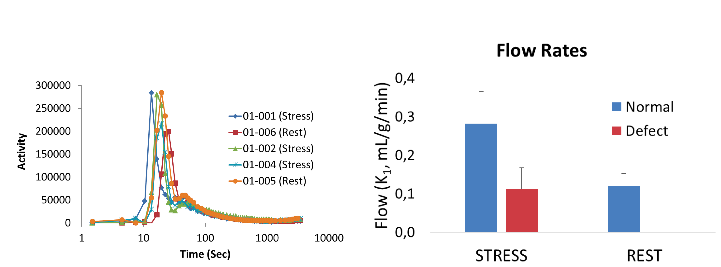
The data presented at SNMMI in St. Louis reinforced the findings of the earlier data and provided quantitative output of results. The quantitative output is presented in graphical form, showing both the rapid uptake and clearance (chart left) of CardioPET as well as how CardioPET can differentiate between normal and damaged tissue (chart right). While the excellent quality of CardioPET images provides a reliable qualitative measure for physicians in diagnosing CAD, this quantitative output demonstrated with the current data provides what is essentially a double-check of the images, offering physicians another tool with CardioPET PET imaging.
Promising Phase II Data Reinforces Our Confidence in CardioPET
Fifteen patients with known or suspected coronary artery disease were included in the analysis. Images were taken in three to five minute durations at intervals of one to ten minutes and at 15, 30, 45 and 55 minutes after injection. Image quality was graded as either optimal, sub-optimal or non-interpretable. Changes in blood pool activity, liver activity and delineation defects over time were recorded.
Relative to safety, there were no adverse events and no other safety issues related to CardioPET (one patient had a panic attack from being in the imaging system). Relative to quality of the images and performance of CardioPET, images at all time points from three minutes following injection were considered excellent. Blood pool activity began to decline in the initial one to three minute timeframe and blood pool clearance was totally completed in all patients at five minutes (image below). Rapid blood pool clearance is beneficial as it allows for imaging shortly following injection and reduces patient exposure to imaging radiation.

CardioPET enters the myocardium similar to the way of fatty acids and remains there long enough to allow for PET imaging. The images also showed that fatty acid uptake decreased over time. In ischemic heart conditions, uptake of fatty acids is reduced, which would be expected in these patients. The interim data, image quality and safety were considered very promising. The ability to attain high quality images very shortly after injection is of particularly benefit and significant.
Product Development Progress
Although development timelines slipped during 2013 as FPMI needed to raise additional capital, the company has made significant progress on moving both CardioPET and BFPET through the development pipeline. Capital infusions since Q3 2013 have allowed the company to dedicate more resources towards the ongoing phase II study of CardioPET and should facilitate enrollment of BFPET studies, slated to begin at Massachusetts General Hospital.
CardioPET data to-date has been consistently very positive and our expectations that follow-on results will be similarly positive. The Belgian-based phase II trial is an open label study designed to assess safety and performance of CardioPET compared to SPECT myocardial perfusion imaging (MPI) agents and angiography. Interim data, presented throughout 2014 (as discussed above), provided the most substantive evidence to-date of the potential performance benefits of CardioPET over current standard imaging agents. The full data set presentation should provide even greater insight into the performance, utility and competitiveness of CardioPET. Assuming positive, these results could be a significant catalyst to FPMI share price appreciation.
Relative to BFPET, in January 2013 FPMI announced that phase II trials will be conducted at Massachusetts General Hospital. The phase II study will evaluate BFPET in assessment of MPI in patients with CAD as compared to standard nuclear MPI agents.
As a reminder, in July and November 2012 FPMI announced image results from a 20-patient investigator-sponsored clinical trial conducted in China where patients with CAD were imaged using BFPET.
Alan Fishman, principal investigator of the BFPET phase I trial (completed in 2008), commented on the initial results of the China-based study released in July 2013, noting that the "initial results are impressive. Image quality obtained using PET is superb. BFPET shows clear diagnostic qualities as well as increased resolution, inherent in PET. The initial images look spectacular and we are confident that when all the patients are imaged, the data will further support clinical development of the agent." His confidence was further bolstered when additional data was available in November 2013, noting "We saw a high level of agreement between the angiography, the SPECT and the BFPET images. These additional images demonstrate that BFPET shows clear diagnostic qualities as well as the increased resolution, inherent in PET."
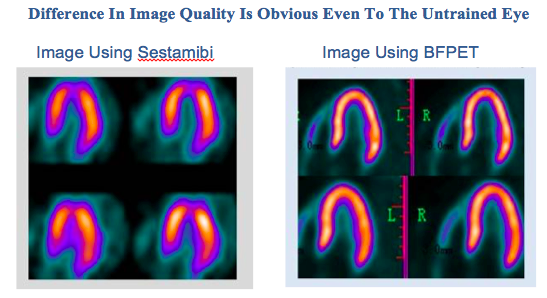
As highlighted in the images below, image quality with BFPET as compared to standard imaging agents appears to be excellent.
While we had expected this phase II BFPET study at Mass General to initiate by year-end 2013, this has been delayed. In May 2014 FPMI entered into an agreement with PPD Development, a clinical research organization to provide clinical research services for the BFPET phase II study. FPMI now expects the study to commence enrollment in the first half of 2015.
READ THE LATEST FULL RESEARCH REPORT HERE
SUBSCRIBE TO ZACKS SMALL CAP RESEARCH to receive our articles and reports emailed directly to you each morning. Please visit our website for additional information on Zacks SCR and to view our disclaimer.