By: Nisha Hirani, MD and David Bautz, PhD
OBB:GLSO
On August 13, 2015, GlassesOff (OBB:GLSO) filed its Form 10-Q disclosing financial results for the second quarter ending June 30, 2015. During the second quarter 2015, the company reported revenues of $0.06 million, slightly below our estimate but still a 23% gain from the first quarter 2015. Revenues are derived solely from the sale of subscription fees for access to the GlassesOff app currently available in the GooglePlay and iOS App Store (iPhone, iPod, and iPad).
Net loss for the quarter was $0.98 million, or $0.17 per share. Net loss was driven by $0.07 million in cost of sales and royalty payments, $0.57 million in R&D, $0.16 million in S&M, and $0.26 million in G&A.
As of June 30, 2015, the company reported cash and equivalents of $0.76 million. Operating cash burn in the quarter was $0.9 million. We believe the existing cash position is insufficient to fund operations through the end of the third quarter 2015, and management will need to raise new cash as soon as possible. We estimate another $1 to $1.5 million is required to fund operations in 2015, and something in the area of $4-5 million should fund operations for the next 4 quarters. As a reminder, in July 2014, GlassesOff secured access to new capital when it announced a committed equity financing facility that would enable the company to sell up to $15 million of its shares of common stock to YA Global Master SPV Ltd. over a period of up to 36 months. The company is not obligated to use the facility and may still initiate other financing transactions.
GlassesOff Business Update
We have been underwhelmed with the level of sales thus far since the launch of the GlassesOff App in December 2013, and believe that at this stage, GlassesOff is primarily devoted to development efforts including raising capital and recruiting and training personnel. This is no doubt due to the lack of significant sales and marketing initiatives by the company, however this has recently changed with a gradual increase in the marketing efforts and the signing of the first celebrity endorser and U.S. Olympic Gold medalist, Summer Sanders. For example, sales in the fourth quarter 2014 were up 2.5x from the third quarter 2014. We believe that GlassesOff should continue partnering with several different athletes in order to receive much needed exposure to increase its customer base and sales. It is clear that a product like the GlassesOff App is going to take significant marketing and promotion to drive sales in the coming quarters.
We believe it is imperative for GlassesOff to continue to invest in building marketing infrastructure, which includes developing public relations networks to raise awareness of the GlassesOff App, preparing marketing materials, and building a network of eye care practitioners to support and promote the GlassesOff platform and current as well as future products.
Ultimately, while we see meaningful potential for the “Read Without Glasses” version of the application, it may be sports-related and gaming apps that drive the top-line at the company. In this regard, the company is in the midst of developing next-generation gaming apps aiming to enhance a user’s sports performance through improved visual abilities and increased brain processing speed. The company plans to target initial markets of baseball and basketball, but we see significant potential in almost all sporting activities, including hockey, football, racing, hunting, soccer, and tennis. After all, we can’t think of a major sporting activity where you do not use your eyes, or increased visual processing would not help in performance.
For example, in baseball, a 0.1 second improvement in processing speed may translate into a hitter’s ability to not only determine if the pitch is a ball or strike, but also pick up spin on the ball to ascertain the type of pitch – fastball, curveball, slider, etc… A baseball throw at 95 mph travels approximately 14 feet in 0.1 seconds. Management at GlassesOff believes they can develop a gaming application that helps athletes, from kids to professionals, that improves visual performance (how fast you see) and image quality (how clearly you see).
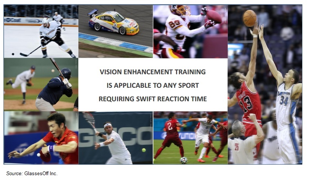
We think a “sports app” has the potential to be a meaningful revenue driver for the company. Games like Candy Crush or Clash of Clains are multi-million dollar products. Glu Mobile (GLUU) generated revenues of $126 million in the first half of 2015 alone, up nearly 50% as compared to the same period in 2014. Glu Mobile has a market capitalization of ~$600 million.
GlassesOff is attempting to marry the company’s strong scientific background with society’s clear interest in fun, addictive mobile games. Only GlassesOff aims to develop games that provide a true physiological benefit to the user, such as improved visual processing or reaction time. The company has been active over the past several months presenting clinical data showing benefits to the technology. For example:
In October 2014, GlassesOff announced the interim results from a study commissioned by the Israeli Air Force (IAF) that showed significant improvements in critical visual functions of IAF pilots after using the GlassesOff mobile app. The data was presented during a poster session at the annual meeting of the American Academy of Ophthalmology. While previous results had shown positive outcomes using the methods employed in the GlassesOff app when applied to the general population, these results show that even those individuals with superior visual functions benefit from the use of the perceptual learning method employed in the GlassesOff mobile application.
The data shows that pilots improved after training in both chart and dynamic visual acuity measurements that included a 35% improvement in chart visual acuity, a 31% improvement in brief visual acuity, and with most of them reaching the level of young controls with no significant difference seen between the two groups after training. The gains in visual acuity are most likely the result of an increase in processing speed as well as contrast sensitivity. In addition, there were significant improvements in reading speed, with the data for each of these parameters shown below.
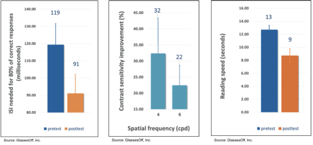
There was a 28 millisecond decrease in the minimum time required between the target and mask stimulus to correctly identify the target between the pre- and post-test results (chart on left). This represented a 24% improvement in processing speed (P = 0.001). Contrast sensitivity also increased significantly for Gabors with both tested spatial frequencies (chart in middle). In addition, there was a 32% improvement in reading speed, represented by a gain of 4 seconds in reading a sentence with the minimal font size (chart on right; P = 0.001). Lastly, self-reported improvements were noted as follows:
- Over 70% of the participants reported a substantial change in their near vision.
- 60% of the participants reported substantial changes in their reaction times.
- 90% of participants that completed the program requested to continue their access to the GlassesOff technology so that they could maintain the acquired gains. In addition, they were interested in getting their peers into future studies.
- Perhaps most importantly, over 90% of the participants did not require the use of optical correction for presbyopia, which successfully resolved the related operational limitations posed by pilots using optical correction.
In November 2014, GlassesOff published data in Natures Scientific Reports demonstrating the potential of the application to improve performance of young professional and amateur athletes in sports requiring swift reaction time, such as tennis, baseball, football, ice hockey and others. Study data showed that prior to using a new app currently being developed by GlassesOff, participants with 20/20 vision, required an average of 204 milliseconds (approximately 0.2 of a second) to process and identify a visual stimulus in order to see it with 20/20 clarity. After using this app for an average of two months, these participants required only 123 milliseconds (approximately 0.1 of a second) for the same task, indicating an average improvement of 81ms (40%) in visual processing speed. At the completion of the study, the average visual acuity improved to better than 20/20 vision and all participants improved to at least 20/16, a visual acuity measurement that is associated mainly with top athletes.
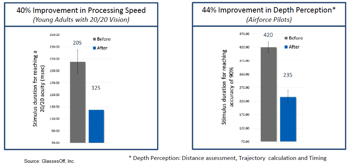
The study included results from 33 young participants, who were an average of 24 years of age, with no history of neurological conditions, and with corrected-to-normal or normal vision in both eyes. Participants' visual acuity and time required to reach a 20/20 clarity was thoroughly measured at baseline and post-two months, using a dedicated mobile app developed by GlassesOff.
In May 2015, GlassesOff announced results from a study in children and adults with attention deficit hyperactivity disorder (ADHD), demonstrating non-invasive, game-like technology that can provide an early indication of whether a child has ADHD and to what degree. The study included 45 adults, 28 of them previously diagnosed with ADHD (age average SD: 25.6±10.4 SD) and 64 children, 21 of them previously diagnosed with ADHD (age average 9.3± 2.7 SD), all of whom had no history of neurological conditions and normal or corrected-to-normal vision in both eyes. Measurements were made on smartphones, using a prototype dynamic digital assessment tool developed by GlassesOff, and results were compared between participants with and without ADHD. Findings from a new study from GlassesOff show significant differences in the visual performance of children and adults with ADHD, as compared to children and adults who do not have ADHD, with respect to specific visual tasks.
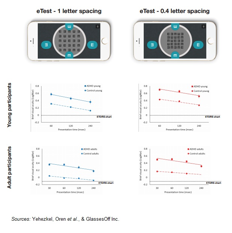
Management believes a new GlassesOff application may be able to quantitatively measure these differences as a quantitative way to screen for the disorder. We believe the new application has utility as a tool that could be used to both monitor the patient and provide insight as to whether the medication and/or its dosing are effective, or should be modified.
Conclusion
As before, we continue to take a wait and see approach with the stock, as the company has recently started to incrementally increase a marketing and advertising campaign. We hope that the campaign will pick up in the second half of the 2015, as we believe it would help to drive sales in the coming quarters. Although there is lack of significant revenues generated thus far and a lack of significant cash on the balance sheet, we still see potential for addictive gaming applications, and continue to believe that the GlassesOff app is an exciting technology. We are also intrigued by the potential for a sports-related application, or an application that can be used as a diagnostic to testing whether or not a child has ADHD, and potentially whether or not the prescribed medication is working to help treat the disease. These applications are likely to be ones that will benefit greatly from word of mouth, thus it will take a large influx of early adopters in order to drive significant sales. GlassesOff plans to launch its first sports app later this year, and we look forward to testing it out. We want to see that the initiatives the company has in store can begin to ramp up sales at a much faster clip than has occurred thus far, and we would also still like to see at least 12+ months of cash on the books.
READ THE LATEST FULL RESEARCH REPORT HERE
SUBSCRIBE TO ZACKS SMALL CAP RESEARCH to receive our articles and reports emailed directly to you each morning. Please visit our website for additional information on Zacks SCR and to view our disclaimer.