By David Bautz, PhD
OTC:GNSZ
Financial Update
On November 13, 2015, GenSpera, Inc. (OTC:GNSZ) filed form 10-Q with financial results for the third quarter of 2015. As expected, the company did not report any revenues. Net loss for the quarter was $1.4 million, or $0.04 per share, and consisted of $0.5 million in R&D and $0.9 million in G&A expenses. Cash burn for the quarter was approximately $1.1 million and the company exited the third quarter of 2015 with $1.2 million in cash. On July 6, 2015, the company announced it raised $2.5 million in gross proceeds in a private placement with institutional investors through the sale of 3,571,430 shares at $0.70 per share. In connection with the private placement, the investors got 3,571,430 series D warrants with an exercise price of $0.85 and 3,571,430 series E warrants with an exercise price of $0.70. The series D warrants expire in five years while the series E warrants expire in 18 months. We now estimate that the company should have sufficient funds through the end of 2015, but the company will need to raise cash soon or sign a partnership that could bring in capital through an upfront payment.
At the company’s annual meeting, shareholders voted to authorize the Board of Directors to effect a reverse stock split of the company’s common stock by a ratio of not less than 1-for-2 and not more than 1-for-30. The Board can perform the reverse split at its discretion anytime over the next year. We anticipate that any reverse split would occur in conjunction with an uplisting to a major exchange.
Business Update
GenSpera is focused on the targeted delivery of a novel anti-cancer agent specifically to cancerous tissue, thus mitigating systemic adverse effects that are typical with standard chemotherapeutic agents. The novel cytotoxic agent is thapsigargin, which is derived from the plant Thapsia garganica that grows wild in the Mediterranean region. Thapsigargin is a potent inhibitor of the intracellular sarcoplasmic/endoplasmic reticulum calcium adenosine triphosphastase (SERCA) pump protein, consequently causing calcium levels to rise significantly and trigger apoptosis (cell death).
The company has announced that its focus over the next 12-18 months will be on: 1) the upcoming liver cancer clinical trial, which will probably involve a development partner; 2) the ongoing Phase 2 clinical trial in glioblastoma; 3) partnering discussions with a larger pharmaceutical company; and 4) prioritization of the next thapsigargin prodrug development candidate. The company’s previously planned clinical trial in prostate cancer has been postponed until the second quarter of 2016 while the planned clinical trial in renal cell carcinoma (RCC) has been suspended indefinitely. We view the delay in both the prostate and RCC clinical trials as prudent given the company’s currently limited financial resources.
Thapsigargin as an Anti-Cancer Agent
Unlike traditional chemotherapeutic agents, which are somewhat selective based on the blockage of pathways that are required for rapid proliferation, thapsigargin inhibits the SERCA pump, which is required for both quiescent as well as proliferating cells. Thus, there is no selectivity with thapsigargin between benign and cancerous cells and systemic administration of thapsigargin is highly toxic (Denmeade et al., 1993). To overcome this limitation, a protease-activated prodrug strategy was developed whereby a chemically modified derivative of thapsigargin (12ADT) was produced and coupled to a protease-specific peptide carrier (Denmeade et al., 1998). 12ADT was shown to retain the cytotoxicity of thapsigargin while allowing the easy coupling of different peptides (Jakobsen et al., 2001).
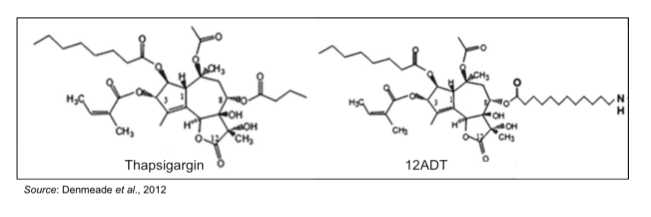
In order to target 12ADT to different types of cancers, specific enzymes that are found in high levels in tumors relative to other tissues in the body are identified and a peptide is designed that is recognized predominantly by that enzyme. The peptide is then covalently linked to 12ADT to create a prodrug, with the end result being that the prodrug can safely travel through the body without eliciting harmful side effects and 12ADT is only liberated in the presence of tumor specific enzymes. This is akin to a hand grenade, where the peptide acts as the “pin” and 12ADT is the “bomb”. When the “pin” is removed, the insoluble 12ADT immediately enters the nearby cancer cells, and after sufficient quantities of 12ADT have accumulated, the cell dies. This is depicted in the following graphic.
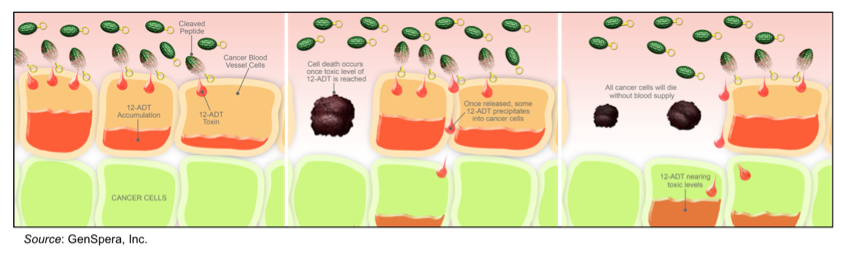
The company’s lead compound, mipsagargin, harbors a peptide that is recognized by prostate specific membrane antigen (PSMA), an enzyme that is expressed in the vasculature of almost all solid tumors.
Update on Mipsagargin in Glioblastoma Multiforme
In Febrary, 2014, GenSpera initiated a Phase 2 clinical trial of mipsagargin in patients with glioblastoma multiforme (GBM) at the University of California, San Diego Moores Cancer Center, which is funding the trial, and is being led by Dr. David Piccioni and Dr. Santosh Kesari (NCT02067156). The study is a two-stage, single-arm, open-label study designed to evaluate the activity, safety, and central nervous system (CNS) exposure of mipsagargin in up to 34 patients with recurrent or progressive GBM. After enrolling the first 12 patients, the study has now advanced to the second stage, where enrollment will continue up to 34 patients total, indicating that the first cohort of patients exhibited potential signs of efficacy and that mipsagargin was well-tolerated. As of November 6, 2015 a total of 18 patients have been treated as part of the trial.
On November 18, 2015, the company announced that mipsagargin demonstrated clinical benefit in a subset of glioblastoma patients, with the results being presented in a poster at the Society for Neuro-Oncology 20th Annual Scientific Meeting. Below is an overview of GBM as well as the data presented on the Phase 2 clinical trial.
Background on Glioblastoma Multiforme
Glioblastoma multiforme (GBM) is a grade IV brain tumor characterized by a heterogeneous cell population with a number of negative attributes. GBM cells are typically genetically unstable (thus prone to mutation), highly infiltrative, angiogenic, and resistant to chemotherapy (Wen et al., 2008). The mutations typically found in GBM allow the tumor to grow and thrive in a hypoxic environment (Furnari et al., 2007). Both activating mutations and loss of tumor suppressor genes give rise to the highly complex and difficult to treat nature of the disease.
While GBM is the most common form of primary brain tumor involving glial cells, it is still relatively rare as approximately 23,000 people in the U.S. were diagnosed with some form of malignant brain cancer in 2014. Gliomas account for approximately 80% of malignant brain cancers, with GBM accounting for approximately 45% of gliomas. The median age of GBM diagnosis is approximately 65 years, with the incidence of GBM in those over 65 increasing rapidly as shown by a doubling in incidence from 5.1 per 100,000 in the 1970’s to 10.6 per 100,000 in the 1990’s (Chakrabarti et al., 2005). Those diagnosed with the disease have a very grim prognosis, with the median survival time of untreated patients being only 4.5 months. Current standard of care treatment only provides 12-14 months of survival time after diagnosis (Johnson et al., 2012).
Standard of care for GBM tumors always begins with surgical resection of the tumor. This is performed both to alleviate the symptoms associated with the disease as well as to facilitate treatment of any residual tumor cells. Even with advances in surgical technique, complete removal of the tumor with clean margins is almost never possible, as the tumors are highly infiltrative and typically extend into the normal brain parenchyma. Due to this, almost all GBM patients have recurrence of the tumor, with 90% occurring at the primary site (Wen et al., 2008).
Due to the invasive nature of the tumors, surgical resection is followed by radiotherapy coupled with the use of chemotherapeutic agents. Radiotherapy involves the administration of irradiation to the whole brain (Grossman et al., 2004). While nitrosoureas were the most common chemotherapeutic agents used for a number of decades, in 1999 temozolomide (TMZ) became available and is now a part of the standard of care. This is due to a clinical trial that showed the addition of TMZ to surgery and radiation increased median survival in newly diagnosed GBM patients to 14.6 months compared to 12.1 months for the surgery and radiation only group (Stupp et al., 2005).
Mipsagargin for the Treatment of GBM
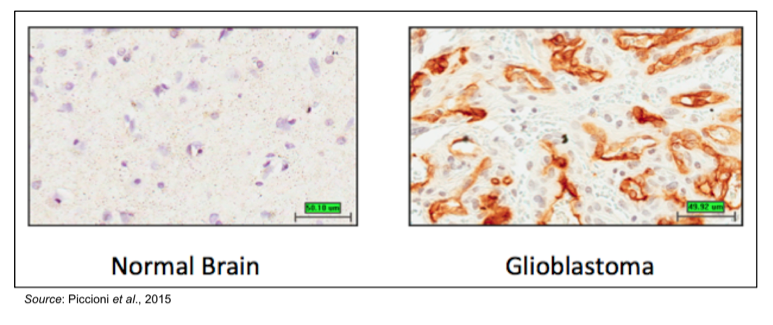
Mipsagargin is being tested as a potential therapy for GBM based on data showing PSMA expression in GBM samples but not in normal brain tissue (Nomura et al., 2014). This is depicted in the following figure, which shows how normal brain tissue shows little to no PSMA expression, but expression of PSMA is quite strong in glioblastoma (denoted by the brown staining).
The following images show brain scans from one of the patients in the ongoing Phase 2 trial that had a response to mipsagargin treatment. The image on the left was taken prior to treatment while the image on the right was taken after eight months of treatment, which shows a clear decrease in the size of the lesion. This patient remains on study.
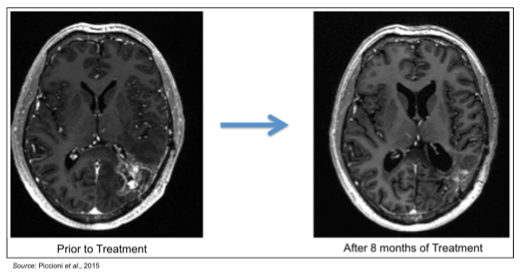
Thus far, three of 11 evaluable patients have demonstrated at least stable disease at the first disease assessment (2 stable disease and 1 partial response), one of which met the primary endpoint of six-month progression-free survival. There were no dose-limiting toxicities noted. Importantly, while PSMA staining of tumor tissue samples taken from patients has shown variability, all three responders have >2+ staining, suggesting that an enrichment strategy could be employed in future studies by only including those patients with PSMA expression in their tumors. We anticipate additional interim results in the first quarter of 2016 and then final results including an evaluation of progression-free survival in the fourth quarter of 2016.
Mipsagargin Phase 2 Clinical Results in Hepatocellular Carcinoma
GenSpera previously tested mipsagargin in a multi-site, single arm Phase 2 clinical trial in 25 hepatocellular carcinoma (HCC) patients with advanced stage liver disease who had failed first line treatment with sorafenib (NCT01777594). Eighteen of the 25 patients were Child Pugh A while seven were Child Pugh B, which is indicative of more advanced liver disease. Nineteen patients were dosed with 40 mg/m2 on days 1, 2 and 3, of a 28-day cycle while six patients were treated with 40 mg/m2 on day 1 and 66 mg/m2 on days 2 and 3 of a 28-day cycle.
The results from the study showed that mipsagargin was well tolerated, with the most frequently occurring grade ≥ 2 adverse events being increased creatinine (n=8, 32%), fatigue (n=7, 28%), and increased ALT and AST (n=6, 24%). Notably, typical side effects of standard chemotherapeutic agents such as severe nausea, vomiting, diarrhea, and hair loss were not seen in the study. In addition, there were no immunosuppressive side effects seen with treatment, which means the drug could potentially be paired with an immunotherapy. There were five serious adverse events that were determined to be mipsagargin-related: 3 patients had acute renal failure or acute renal injury, 1 patient had congestive cardiac failure, and 1 patient experience grade 3 chest pain. The company has stated that the effect on the kidney is dose dependent, non-cumulative, and 100% rapidly reversible if the patient increases their water intake. The following table gives the final results from the study.
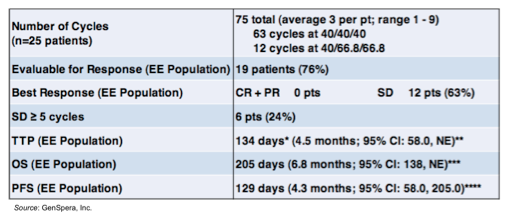
Some may look at a treatment with no complete responses (CR) or partial responses (PR) and think that it is not effective. Liver cancer is unique in that it is quite rare to see tumor regression due to the advanced nature of liver disease and cirrhosis outside of the cancer that exists in most HCC patients, particularly those patients who are Child-Pugh B or C. At the 2015 Noble Financial Conference, GenSpera CEO Dr. Craig Dionne stated that the company believes mipsagargin kills the tumor cells, which are then being replaced with scar tissue, thus on standard imaging there doesn’t appear to be a change in size where the tumor was located.
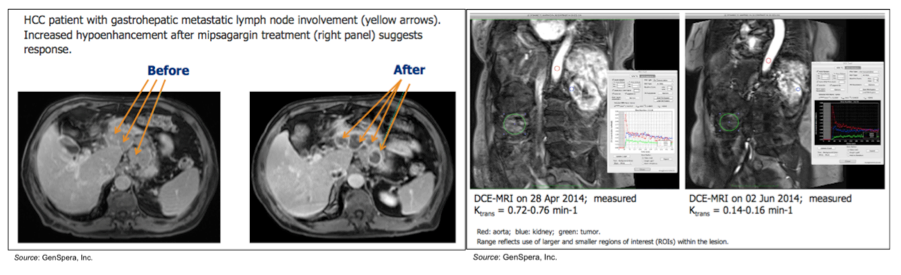
To better understand whether mipsagargin is having an anti-tumor effect, the company performed dynamic contrast enhanced magnetic resonance imaging (DCE-MRI), which allows for analysis of the vascular blood flow within the tumor. The DCE-MRI data demonstrated substantially decreased blood flow in the tumors, indicative of a pharmacodynamic proof-of-concept for the mechanism of action of mipsagargin. The following images show DCE-MRI images taken from two HCC patients before and after treatment with mipsagargin. The images on the left shows metastatic lymph nodes, which after treatment appear to show a “necrotic hole” where there does not appear to be cancer present. However, since the size of the “hole” did not change, the patient is graded as having stable disease even though all cancer cells may be gone. The images on the right are DCE-MRI scans that show decreased vascular enhancement, indicative of the cancer no longer being present.
Mipsagargin Development Plan in HCC
GenSpera now has the final report and full data set from the Clinical Research Organization that conducted the HCC Phase 2 trial. With the full data set, the company can now conduct more definitive discussions with potential corporate partners that they had previously engaged. The plan is to move into a large, international Phase 3 trial after a partnership agreement is signed, however the company is also prepared to initiate the Phase 3 trial alone.
From a strategy standpoint, the unique mechanism of action offered by mipsagargin means that the drug could be paired with another therapeutic to increase the overall efficacy. Mipsagargin is not a chemotherapeutic agent, thus the side effects typically seen with chemotherapeutic agents, particularly in regards to reduction in leukocytes, are not seen with mipsagargin treatment. This means that pairing mipsagargin with an immuno-oncology agent, which relies on a healthy immune system to drive an anti-cancer response, could be a good fit for the drug.
Mipsagargin may also be a good fit for pairing with trans-arterial chemo-embolization (TACE), which is the standard of care for intermediate stage HCC, particularly in Asia (Bruix et al., 2011). TACE has been previously combined with sorafenib in a number of trials, which showed an improvement in overall survival, albeit with increased side effects (Zhang et al., 2014). TACE leads to a hypoxic environment in the tumor, which ultimately leads to an increase in angiogenesis that can lead to tumor recurrence (Sergio et al., 2008). Since mipsagargin targets PSMA, which is overexpressed in the vasculature (blood vessels), it seems logical that an increase in blood vessel formation induced by TACE could be counteracted by mipsagargin, thereby making both treatments more effective when used together.
Whatever path the company decides to take, we believe there will be a definite focus on the Asian market, as that is where a majority of the liver cancer cases are located, and if mipsagargin is ultimately used in combination with TACE, where most of those procedures are performed. Before beginning a Phase 3 trial, the company will need to conduct a small Phase 1/2 clinical trial in East Asian patients, as we believe they will make up the majority of patients in the global Phase 3 trial. This will likely be a dosing and pharmacokinetic study that could start in early 2016 and be completed within nine months. The global Phase 3 study could then initiate after the completion of the East Asian study, which we estimate would be toward the end of 2016.
Valuation and Conclusion
With a market cap of only $11 million, we feel the market does not fully appreciate the potential for GenSpera’s core technology of the use of thapsigargin-containing prodrugs as cancer therapeutics. An investment in GenSpera has been substantially de-risked due to the proof-of-concept data generated from the Phase 2 clinical trial of mipsagargin in HCC patients and preliminary results from the GBM trial. Two important conclusions from the HCC trial are: 1) Mipsagargin is safe, as exemplified by the low occurrence of adverse events and the lack of “typical” side effects associated with traditional chemotherapy such as severe nausea, vomiting, diarrhea, and immunosuppression; and 2) Mipsagargin works as intended, which was shown by the DCE-MRI data indicating substantially decreased blood flow to the tumors, meaning that mipsagargin is being specifically targeted to the cells that express PSMA (e.g., the tumor vasculature).
At this point, the most important thing the company could do is sign a corporate partnership deal so that there is more clarity as far as the next liver cancer clinical trial is concerned. The company only has enough money to get through the end of 2015, thus getting a partnership deal signed soon that supplies the company with a fresh infusion of non-dilutive capital (from an upfront payment) would go a long way in increasing investor confidence, as the lack of a partnership is currently the greatest drag on the stock price. Given the innovative nature of mipsagargin and proven efficacy in the HCC Phase 2 clinical trial, we feel that a partnership deal is not a matter of “if” but “when”. However, we also know that the company does not want to sign a deal just to sign one, and that finding the right partner is very important, thus patience from investors may be necessary so that the right deal can come together. This may ultimately necessitate another financing round before a partnership deal comes together.
Valuation Methodology
We value GenSpera using a probability-adjusted discounted cash flow model that takes into account potential revenues from the sale of mipsagargin in HCC and GBM, as these two programs are the furthest along in development. We estimate that for HCC, a Phase 3 trial will commence in 2016, an NDA will be filed in 2018, and approval of mipsagargin will occur in 2019. For GBM, we estimate a Phase 3 trial commencing in 2017, with an NDA filing in 2019 and approval in 2020. We model for peak revenues of $600 million in GBM and $2 billion in HCC. For both indications we model for GenSpera to partner mipsagargin and receive a 15% royalty on net sales. We think the shares are worth $1.25 and we are maintaining a ‘Buy’ rating. EndFragment
READ THE LATEST FULL RESEARCH REPORT HERE
SUBSCRIBE TO ZACKS SMALL CAP RESEARCH to receive our articles and reports emailed directly to you each morning. Please visit our website for additional information on Zacks SCR and to view our disclaimer.