By Brian Marckx, CFA
NASDAQ:ICAD
Q3 2015 Results: Very Much Inline Aside From Surprise Upside in Int’l Therapy Product Sales
iCAD (NASDAQ:ICAD) announced financial results for the third quarter ending September 30. Aside from a big beat on Therapy product revenue, related to surprisingly stronger than expected (but potentially lumpy) international Xoft sales (mostly on the breast side), the numbers came in very much inline with our estimates.
Detection continues to hold up well and turned in the best revenue number since back in Q3 2011 – the recent strength coming from PowerLook upgrades and breast density software. ICAD’s proprietary breast density module, iReveal, launched in July and has apparently received a warm welcome. Unfortunately the recent solid contribution from MRI sales will likely dissipate as Invivo, ICAD’s MRI distribution partner, exercised their option to distribute the current software product. But we still look for Detection to turn in double-digit growth in 2016, fueled by breast density sales and, most significantly, from the initial tomosynthesis products’ roll out in Europe (early 2016) and the U.S. (possibly mid-2016).
Meanwhile, Therapy will almost certainly continue to struggle as a result of the recent adverse decision by Noridian Healthcare, the west coast Medicare contractor, relative to reimbursement for use of eBx in non-melanoma skin cancer. While reimbursement is not consistent, with some MACs still providing more favorable payor values, the ambiguity is likely keeping many potential customers on the sideline until there is at least more certainty to coverage levels. A dedicated non-melanoma skin cancer code (CPT III code 0394T) goes into effect Jan 1, 2016 which could improve the reimbursement picture. However, there remains significant uncertainty surrounding how many, if any, of the MACs will cover the new code, where the rate levels will be established and the relative incentive to providers to use eBx for that indication. iCAD has been in contact will all MACs and hopes to have more answers relative to the reimbursement question prior to year-end. ICAD has been very involved in lobbying the MACs for favorable reimbursement, supporting their argument with clinical data demonstrating the benefits of HDR Ebx over surgery including better cosmetic outcomes and patient satisfaction – which is in addition to lower cost of treatment. We should have a clearer idea of what the reimbursement scenario looks like by, at the latest, January 1st.
But while the reimbursement problem has significantly negatively impacted the Therapy business, ICAD still has managed to sell to the NMSC market – this includes 3 systems placed in the U.S. and one internationally related to skin cancer in Q3. And management indicated on both the Q2 and Q3 calls that despite this reimbursement issue that clinicians remain interested in the system (as do patients) but many of have postponed purchases.
But while the NMSC indication in the U.S. has largely been stymied recently, IORT breast, particularly overseas, has been gaining traction. ICAD placed 13 Xoft systems in Q3, including a record 8 in international territories. Two of the five placed in the U.S. and all but one of the international sales were for breast IORT. Two systems went to Taiwan where Xoft now has a presence in 21 cancer centers – these recent sales, along with additional international system placements expected in the near-term (including areas such as China, Russia and India where regulatory approval has just recently been attained or is expected to shortly) has the potential to further accelerate IORT breast sales overseas, including the high-margin consumables (i.e. – balloon applicators).
And in addition to the demand for breast IORT, new applicators for cervical cancer (launched in July), rectal cancer (recently received Health Canada approval) and others expected in the near-term have the potential to incrementally add to the international revenue growth.
Revenue
Q3 revenue of $9.6M was down 24% yoy and down 14% sequentially
Cancer Detection(Q3): $5.2M: +5% yoy, +5% sequentially
MRI products have been a big driver of Cancer detection over the recent past. However, with Invivo having exercised their right (in return for a $2M payment) to distribute the current version of the respective MRI product, these related revenues will dissipate. But the expected near and long-term drivers of Detection is still expected to be from breast density and 3D tomo products.
In July ICAD announced the launch of iReveal breast density software, the latest addition to the PowerLook line. The timing was good with almost one-half of all states already having enacted some form of legislation supporting breast density screening and more likely to follow. Management indicated that there has already been significant interest in iReveal. If and when mandated and widespread insurance coverage follows, breast density screening would almost certainly be fueled even further.
Breast density and tomosynthesis are the major growth areas in mammography and ICAD has been positioning their Detection product line to ride this burgeoning wave. We continue to model about mid-single digit growth for the full year 2015, although we think PowerLook AMP will continue to be significant contributor. However with the launch of the initial 3D breast tomosynthesis products, expected in Q1 2016 in Europe, we think Detection will see a significant acceleration, particularly once the products are in both the U.S. and Europe.
The 3D tomo European reader study was completed in September and management noted on the Q3 call that results were “encouraging”. ICAD expects CE Mark to come sometime this month with launch on GE's SenoClair tomosynthesis instruments following in early 2016. SenoClaire received CE Mark in July 2013 and FDA clearance in August 2014.
Relative to the U.S., the U.S. reader study commenced in October. This is expected to be a modular PMA supplement FDA filing – management laid out expected timelines on the Q3 call; first module expected in November (ie – this month) and the last in January 2016. They hope to have FDA approval and launch the 3D tomo product in the U.S. by Q2 2016. We think this is a somewhat aggressive timeline and are not modeling and U.S. 3D tomo sales until Q4 of next year. But, slipping a quarter or two from management’s timelines is relatively immaterial, particularly given the significant potential of the products. We think this could be a big winner for ICAD given the criticism and debate over the utility of stand-alone mammography and increased demand for more accurate detection of breast cancer. GE's instrument is billed as producing lower x-ray dose (i.e. - safer) than Hologic's Selenia Dimensions machine (FDA cleared in 2011), currently the only other 3D breast tomosynthesis instrument sold in the U.S., providing a real opportunity for GE's machine.
Upgrades from 2D to 3D, the new breast density software and the roll-out of tomo in Europe and the U.S. have the potential to provide inflection in the Detection segment. The company’s current installed base is about 5k today – 80% or slightly more of which is in the U.S. Per management, just considering upgrades to their current installed base represents roughly an incremental $325M direct sale opportunity plus an additional ~$45M in annual recurring service revenue. And, as the installed base grows, so should this already significant potential market opportunity.
Our modeled significant step-up in Detection revenue beginning in late 2016 represents meaningful contribution from ICAD's 3D breast tomosynthesis platform.
Cancer Therapy (Q3): $4.4M: -43% yoy, -29% sequentially
Cancer therapy revenue had been on a tear, growing 57% in 2014 and 94% in Q1 of this year - which was facilitated in part by the DermEbx acquisition (Q1 2014). The new leasing option (in lieu of outright purchase of the console) had been warmly received and also appears to have been a meaningful driver of uptake of the system. Non-melanoma skin cancer was where almost all of the growth in utilization was coming from - management noted on the Q1 2015 call that procedure volume (at locations using Radion Hub that launched prior to 2014) increased by 20% sequentially and 31% yoy.
Non-melanoma skin cancer was a tremendous opportunity for ICAD with expansion of the Therapy user base and increase in utilization coming from several fronts, including more favorable reimbursement, positive clinical outcomes data and greater awareness of the benefits the therapy. And with skin cancer treatment requiring more than one visit, this indication has been a boon to ICAD's revenue. With the DermEbx acquisition providing significant bolt-on revenue, increasing adoption for skin cancer, ramping utilization, increased awareness and a regular flow of positive outcomes data we had expected the Therapy business could ride a non-melanoma skin cancer wave of growth for some time.
But this hit, at the very least, a major speed bump with the Noridian change in policy. As indicated it's possible that the reimbursement improves - and potentially significantly so - but we expect Therapy revenue to continue to be negatively impacted through at least the remainder of 2015. Hopefully the new dedicated non-melanoma skin cancer CPT code provides, at minimum, greater clarity relative to providers' expectations on reimbursement levels. Even better would be uniform reimbursement at levels that encourage utilization. But, until there's greater clarity providers will be sitting on the sideline and we don't expect much in the way of new subscriptions or console sales related to NMSC. Existing subscriptions and consumable contracts as well as providers that continue to have success in billing at "acceptable" rates should still provide meaningful Therapy revenue, however.
Clinical data continues to show excellent outcomes including superior cosmetic results and patient satisfaction as compared to surgery, which should help support the quest for favorable insurance reimbursement. And in the meantime ICAD will pursue a CPT I code – granting of which would all but eliminate ambiguity or significant differences in reimbursement policy and values. The company is in-process of finalizing design of a clinical study to support an eventual CPT I code application – ICAD expects the trial to commence this month - which is expected to include ~500 patients. While the study will follow patients for five years, they will be able to include patients that completed treatment in 2013 and, therefore, believe that they may have sufficient supporting data to file for a CPT I code sometime in 2017.
And IORT breast may be gaining some more traction, particularly overseas. Through the first nine months of 2015 balloon applicator (ie – consumables, a gauge of utilization) sales grew 35% - the growth relates almost entirely to international markets with the U.S. just about flat ytd And, as noted earlier, international system sales are also accelerating with a record 8 Axxent consoles placed in Q3.
While we see the international business as somewhat lumpy and don’t necessarily expect this rate of system placements to be consistent, we do now model additional growth overseas and fueled from several fronts including; additional awareness of the benefits of IORT for breast cancer vs. traditional WBRT, newly-gained regulatory approvals in certain countries and applications in other cancers (in addition to skin and breast) including cervical, rectal and others.
And the U.S. remains what we think is a very viable market for breast IORT to accelerate. Clearly there has been a headwind from certain critics based on their interpretation of the TARGIT-A data and a reimbursement structure that incentivizes WBRT and the multiple procedures that that involves. But new and longer-term data is coming out on a regular basis which continues to support IORT for those patients where it’s appropriate – which includes data presented at ASTRO earlier this month as well as the interim data from the 1k-patient, 10-yr study.
Model Updates
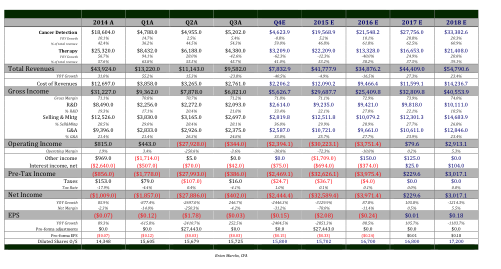
We have made some updates to our financial model following Q3 results. For Q4 2015 we have moved our OpEx up by almost $1M based on management’s comments on the call – which call for additional spend related to the U.S. reader study and certain other investments. We have also trimmed our GM in Q4 as well as for the remainder of our modeled terms as we think greater overseas contribution and a lag in service/supplies revenue may bring some margin pressure. While our full-year 2015 revenue estimate has moved up from $40.5M to $41.8M, all and more of this relates to the beat on Therapy product sales in Q3 (from the record int’l sales). We now look for Q4 revenue of $7.8M, adjusted down from $8.0M – although we note our Q4 number could prove light if Therapy products again surprise on the upside – if so, it will most likely again come from overseas.
We continue to model a very sizable contraction in Therapy sales from 2015 to 2016 which is based on our assumption that reimbursement does not play out overly favorable. But this is subject to updating based on how the reimbursement picture evolves over the next two months and, potentially, into next year. We have 2016 Therapy at $13.3M, which implies a quarterly run-rate of about $3.3M - slightly better than the ~$3.2M we are modeling in Q4 of this year - our estimated growth is coming exclusively from IORT breast as well as some contribution from cervical. So this assumes little to no improvement in skin reimbursement - we will update this if and when there is more clarity on the subject.
Relative to Detection - again, this is where we now see the most opportunity for growth going into 2016 and being driven by tomo and breast density. We have moved our numbers down some as the tomo launch in Europe has been pushed back slightly from earlier expectations (Q4 2015 to Q1 2016) and we think the U.S. launch may come closer to Q3/Q4 instead of mid-2016. But we still think Detection can turn in double-digit growth in 2016 and accelerate even more in 2017 with a full-year of U.S. tomo contribution.
ICAD was quick to cut costs following revelation of the NMSC reimbursement change. While they are guiding for OpEx to move up from about $7.2M in Q3 to about $8.0M in Q4, they also implied that going into 2016 this will be closer to a $7.0M run-rate. We have about $7.25M/qtr average allocated in our model – so the cost side also has some potential to beat our numbers. And management has in the past demonstrated willingness and great ability to slash costs in time of need, benefitting cash burn and the income statement. So, we would expect in the event the reimbursement issue lingers that the cost base will continue to be right-sized to fit revenue.
We now model 2015 EPS (excluding Q2 impairment charge) of ($0.33), adjusted down from ($0.28).
Cash
ICAD used $25k in operating activities through the first nine months of 2015 and exited Q3 with $17.5M in cash and equivalents. They guided for cash use of between $1.5M and $2.0M in Q4 and, assuming no changes in the current NMSC reimbursement picture, expect to come into the new year at about a cash-neutral burn rate.
Valuation / Recommendation
We continue to value iCAD based on competitor price/sales (P/S) and enterprise value /sales (EV/S) multiples. Using analyst's revenue estimates for the years 2015 and 2016, we calculated P/S and EV/S ratios from imaging (HOLX) as well as surgical (VAR, ARAY, ISR, EKTAF) companies. The five companies currently trade at an average P/S-2015 of 3.2x and P/S-2016 of 2.7x and average EV/S-2015 of 3.3x and EV/S-2016 of 2.8x.
Based on the average of the 2015 and 2016 EV/S multiples iCAD is valued at $8.26/share. Based on the average of the 2015 and 2016 P/S multiples iCAD is valued at $6.96/share. We use the approximate average of the two which values iCAD at about $7.50/share. We are maintaining our Buy rec based on valuation.
READ THE LATEST FULL RESEARCH REPORT HERE
SUBSCRIBE TO ZACKS SMALL CAP RESEARCH to receive our articles and reports emailed directly to you each morning. Please visit our website for additional information on Zacks SCR and to view our disclaimer.