By David Bautz, PhD
NASDAQ:IMNP
On July 29, 2015, Immune Pharmaceuticals, Inc. (NASDAQ:IMNP) announced two financing agreements that could bring in up to $21.5 million to the company. The first agreement, with Hercules Technology Growth Capital, Inc., is for a term loan of up to $9.5 million. The second agreement, with Discover Growth Fund, is for the sale to Discover of newly created Series D Preferred Stock for up to $12 million in gross proceeds.
Thus far, Immune has received $13.5 million in gross proceeds: $9 million from Discover and $4.5 million from Hercules. The company may borrow an additional $5 million from Hercules prior to June 15, 2016 and expects to receive an additional $3 million from Discover upon an effective registration statement for the securities and stockholders approval. Thus far, stockholders with close to 50% of the voting power have agreed to vote in favor of the proposal. We anticipate the registration statement to become effective by mid-September 2015.
The newly created Series D Preferred Stock have a purchase price of $10,000 and are convertible to common stock at a fixed price of $2.50 per share with a six and a half year maturity term, after which the shares will automatically convert to common stock at $2.50 per share. The shares carry an accrued annual dividend rate of 8%, which can range from 0-15% based on certain adjustments and conditions. The dividend is payable in cash or common stock according to Immune.
In connection with the financing, Immune issued to Hercules a warrant to purchase 214,853 shares of common stock at an exercise price of $1.70. TriPoint Global Equities, LLC was the sole placement agent for the deal with Hercules and received warrants to purchase an aggregate of 350,000 shares of common stock at an exercise price of $1.78 per share. Chardan Capital Markets, LLC and Roth Capital Partners, LLC acted as co-placement agents for the Preferred Shares and received warrants to purchase an aggregate of 275,000 shares of common stock at an exercise price of $2.50 per share.
With the current financing, we predict this will extend Immune’s cash runway for the next 18-24 months. Perhaps more importantly, it frees the company to maximize the value of AmiKet, as Immune is now not relying solely on upfront payments from an AmiKet partnership to provide necessary working capital. This will strengthen the company’s negotiating power and should provide the framework to deliver a deal that accurately reflects the financial potential of Amiket.
Lastly, the financing will allow Immune to both broaden the number of clinical indications for bertilimumab as well as advance additional pipeline products into clinical testing. With the newly acquired funds, the company is likely to expand testing of bertilimumab into nonalcoholic steatohepatitis, bring the newly licensed nano-formulated Cyclosporine A into the clinic, and advance the first NanoMabs candidate into clinical testing.
Quick Update on Bertilimumab
On June 25, 2015, Immune announced that the Phase 2 clinical trial for ulcerative colitis (UC) has been initiated and that the Phase 2 bullous pemphigoid (BP) clinical trial will commence on July 1, 2015. This was welcome news as much of the second half of 2014 was spent working through quality control issues on the manufacturing of bertilimumab that delayed the start of the two planned Phase 2 trials. Immune initiated the development of an enhanced manufacturing process, which has demonstrated a higher comparable performance and improved productivity than the previous process. This includes a new cell line that should lower costs and improve margins on the finish goods as well.
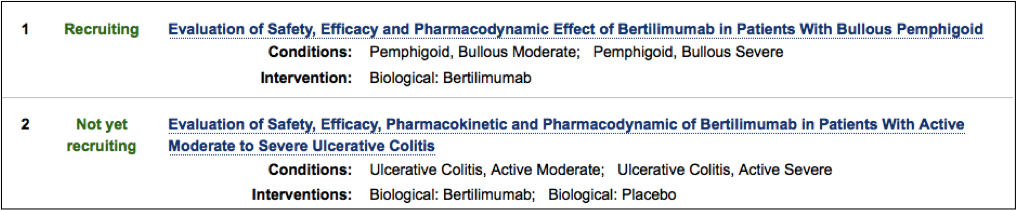
Ulcerative colitis: The Phase 2 trial of bertilimumab in UC is a randomized, double blind, placebo-controlled, parallel group, multi-center study that will evaluate the clinical efficacy and pharmacokinetic profile of bertilimumab in approximately 42 adult patients with active moderate to severe UC (NCT01671956). Eligible patients will be randomly assigned in a 2:1 ratio to one of two treatment groups, either bertilimumab at 10 mg/kg or matching placebo. Importantly, key inclusion criteria include high eosinophilia, as confirmed by eotaxin-1 levels (≥ 100 pg/mg protein) from a colon biopsy. The study will consist of three periods: a screening period of up to two weeks, a 4-week double-blind treatment period (three IV infusions at 2-week intervals), and a safety and efficacy follow-up period of approximately 9 weeks.
The primary endpoint is clinical response using the UC Mayo Clinic Index two weeks after final dosing. The study indicates that clinical response will be measured as a decrease in Mayo score from baseline of at least three points and at least 30%. Secondary endpoints include mucosal injury, eotaxin-1 and eosinophil levels in the mucosa, and clinical remission. We expect results from this trial near the end 2016.
Bullous Pemphigoid: The BP Phase 2a trial is an open-label trial expected to enroll 10 moderately to severely affected patients who have been newly diagnosed with BP, which means they have not received prior treatment for the disease (NCT02226146). All patients will be initiated on low dose oral prednisone (30 mg daily), which is approximately half of what a typical starting dose would be for a BP patient. The patients will also receive two infusions of bertilimumab, at a dose of 10 mg/kg, on days 0 and 14. The dosage of prednisone will be tapered down rapidly beginning as early as week one based on patient response.
All patients will be followed for eight weeks with primary efficacy end points focused on disease control as measured by the Bullous Pemphigoid Disease Area Index (BPDAI; Murrell et al., 2012), a quantitative measure of disease activity that takes into account the number and size of lesions as well as their location (skin vs. mucosa), as well as the percentage of patients who achieve a steroid dose of less than 10 mg per day. We anticipate initial data from the trial to be reported in late 2015 or early 2016.
Prior studies of bertilimumab have shown a 100% reduction in eotaxin-1 levels within 24 hours of administering the drug with more than 50% of the inhibition lasting for greater than 50 days. Thus, while only dosing patients two times with bertilimumab may not seem like a thorough examination of the antibody’s capabilities, theoretically there could be a rapid and sustained response to treatment if the prior pharmacokinetic (PK) data holds up in a population of BP patients. With the low dose of steroids given to each patient, there is unlikely to be more than one or two patients who respond to steroid therapy. Thus, a successful outcome for the Phase 2a trial could be if four or five patients respond to therapy with bertilimumab, as this would most likely be proof that the drug is working and can be advanced to the next clinical stage.
Development of bertilimumab for treatment of BP is somewhat complicated by the fact that BP is an orphan disease and that no drugs that have gone through the regulatory pathway for approval in this indication. We remind investors that Immune filed for Orphan Drug designation for bertilimumab in BP in October 2014. The FDA responded saying they would like to see some (we are not sure how much) patient data from the planned Phase 2 open-label study noted above before they grant the designation.
The Rest of the Pipeline Offers Additional Upside
In addition to bertilimumab, Immune’s pipeline includes Amiket™, NanomAbs, and topical nano-formulated Cyclosporine A, which we discuss briefly below.
Amiket™: AmiKet™ is a topical formulation of the FDA approved compounds amitriptyline (4%) and ketamine (2%), which the company is developing for the treatment of post-herpetic neuralgia (PHN). PHN is thought to be the result of nerve damage caused by the varicella zoster virus, which causes both chickenpox and shingles. Of the 1,000,000 individuals who develop shingles every year in the U.S., approximately 20% of them will develop PHN. There is currently no way of knowing beforehand who will develop PHN and who will not, although the condition is mostly restricted to patients who suffer from shingles after the age of 60.
In late December 2014, Immune initiated a comprehensive process targeting the 20 most likely development and commercial partners with the objective of commercializing AmiKet™. Several companies are in advanced due diligence and term sheet discussions. The company continues to anticipate an agreement to develop and commercialize AmiKet™ during 2015.
In this regard, the company provided an important update in March 2015 when Immune entered into an agreement to develop a topical nanoparticle formulation of AmiKet™, which we expect will increase the market exclusivity through novel patents, allow clinical development in additional indications, and increase the overall value of AmiKet™ to potential commercialization partners. New IP on this formulation will push patent protection to 2036, allowing expansion of the clinical program beyond the planned Phase 3 in PHN, an indication for which AmiKet™ was granted Orphan Drug designation in 2010, to other forms of neuropathy, such as diabetic peripheral neuropathy (DPN) and chemotherapy induced peripheral neuropathy (CIPN), an indication for which Immune received Fast Track designation from the FDA in 2012.
We believe that a partnership deal for Amiket™ focused on PHN could bring in between $15 to $25 million in upfront money, with an additional $200 million in backend and milestone payments along with low-teens royalties on sales.
NanomAbs: The NanomAbs platform is an antibody-drug conjugate (ADC) technology that was licensed from The Hebrew University of Jerusalem. It is a four-component technology consisting of:
1) A PEGylated PLGA nanoparticle (PPN) that transports the toxic compounds,
2) A proprietary linker that connects the monoclonal antibody to the PPN,
3) A mAb, that serves to target a cancer-specific antigen,
4) A drug loaded within the PPN.
NanomAbs are considered a second-generation ADC and hold a number of advantages over traditional ADCs including:
- High payload – traditional ADCs are only able to carry an average of 4 toxic agents per antibody compared to up to 20,000 molecules per nanoparticle.
- Increased half-life – attaching PEG molecules to the outside of the nanoparticle extends circulation time and prevents clearance by immune cells.
- Diversity of delivered compounds – traditional ADCs can only carry chemotherapeutic agents while NanomAbs could theoretically deliver antisense drugs, peptides, and multiple chemotherapeutics at once.
On May 5, 2015, Immune announced that it entered into a strategic partnership with STC Biologics to accelerate the development of NanomAbs. Development will initially focus on HER2-targeting paclitaxel nanoparticles using an anti-HER2 monoclonal antibody developed by STC, and H-Ferritin targeted paclitaxel nanoparticles using an anti-H-Ferritin monoclonal antibody developed by Immune. Licensing and joint-development agreements between STC and Immune should be finalized during the second quarter 2015.
Nano-formulated Cyclosporin A: This product is a very recent addition to Immune’s pipeline, with the company first announcing the development of nano-formulated Cyclosporin A (CyA) on June 10, 2015. CyA is an immunosuppressant that is widely used in organ transplantation, but is also used for other immune-mediated conditions including psoriasis and atopic dermatitis. It has been used extensively for over 30 years, however there are drawbacks to administering the drug systemically, including variation in bioavailability, drug-drug interactions, and the potential for adverse side effects including hypertension and nephrotoxicity. A topical formulation of CyA should result in fewer adverse events as the compound is not taken up systemically. Immune is planning to develop topical nano-formulated CyA as a treatment for both mild psoriasis and mild to moderate atopic dermatitis.
Conclusion and Recommendation
For valuation purposes, we forecast bertilimumab to have peak sales of approximately $1.5 billion, which we view as reasonable give the large patient population (approximately 750,000 individuals in the U.S. have UC) and differentiated mechanism of action compared to currently available biologic therapeutics. Bullous pemphigoid is an orphan indication and thus we forecast peak sales for bertilimumab in BP of approximately $100 million. We model for Immune to receive approximately $20 million in upfront cash for licensing Amiket™ and to receive 15% royalties on forecasted peak sales of $400 million.
All told, we believe Immune is worth $6 per share and we continue to rate the stock a ‘Buy’. With the stock currently trading below $2 per share and the removal of questions surrounding company financing, we feel this affords long-term investors in small-cap biotech the opportunity to pick up shares in Immune at a substantial discount with the potential for significant returns over the next few years.
READ THE LATEST FULL RESEARCH REPORT HERE
SUBSCRIBE TO ZACKS SMALL CAP RESEARCH to receive our articles and reports emailed directly to you each morning. Please visit our website for additional information on Zacks SCR and to view our disclaimer.